- Rating
- 8/10
- Read
- November 2012
- Why I read it
- What I took from it
- My favorite idea
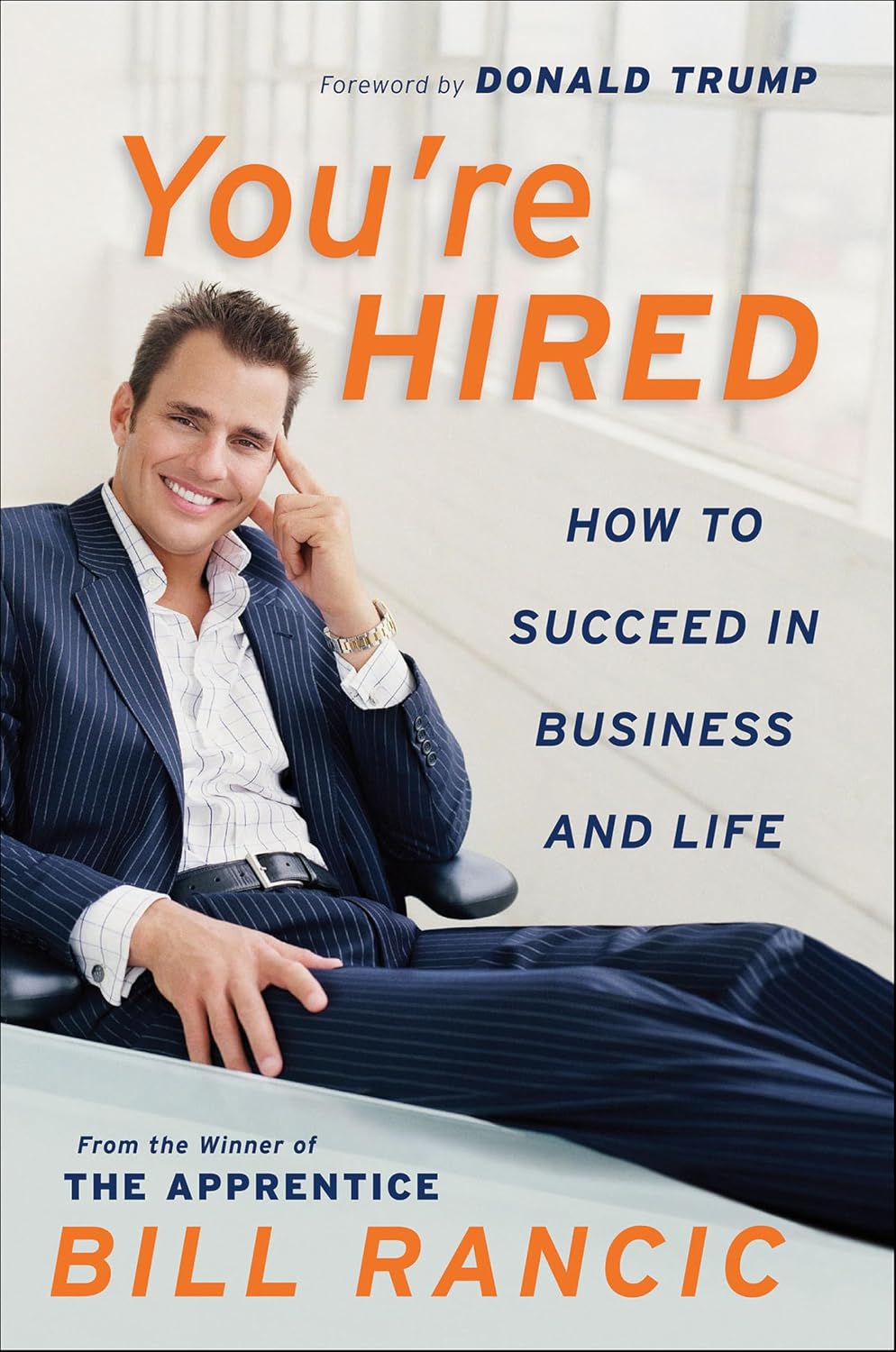
Bill Rancic won the first season of The Apprentice in 2004, beating thousands of applicants for a job running a project for Donald Trump. Before the show, he had built a business out of his apartment in Chicago selling cigars by mail, called Cigars Around the World, and grew it into a multimillion-dollar company. This book mixes both stories with practical advice on starting a business, selling, working on a team, and handling pressure. It’s a quick, easy read from someone who did it himself, with plenty of behind-the-scenes stories from the show.
Highlights
That’s what I look for when I’m building a winning team, people who bring a different set of eyes and skills to the business to keep things fresh and moving forward.
Make your vocation your vacation.
Over the years I’ve also developed my own style, my own way of dealing with other people, my own way of approaching each new situation and opportunity.
I’ve never even read a book on business or marketing or negotiating strategies, because I don’t believe good business instincts can be taught. That’s why they call them instincts. They can be rehearsed, refined, and refashioned to suit a different set of circumstances, but I’ve yet to come across a textbook situation that could be gotten through with any kind of textbook solution. That said, I’m a big believer in sharing information, learning from your mistakes, and patterning your behavior on successful individuals who have already made their marks.
No one ever got bigger, faster, stronger, or better going up against the little guy.
I’d sold myself as a salesman, but in truth I had no idea how to sell. I learned by watching, by listening to the sales pitches that worked and the ones that didn’t, by modeling my demeanor on some of the more successful salesmen we had in the field. The good ones displayed a quiet confidence. They were never desperate to make a sale, which I eventually learned was because desperation never closed any deal.
It’s a lot easier to sell when you can stand behind your product or service and know you’ve got the goods.
You are what you pretend to be.
Keep your options open. And remember, where there is no risk, there is no reward.
If there’s no clear goal in mind, how can you ever expect to reach it? Write it down. Tape it to your bathroom mirror or to the visor on your car. The constant reminder will keep you focused and on track, and will encourage you to work backwards from your target to discover the steps you’ll need to take in order to get the job done.
When you stumble across a gold mine, be sure to retrace your steps so you can stumble across it again.
I don’t mean to come off as a moneygrubbing kid, but in wanting to be fair to this man and his son I didn’t want to lose sight of the fact that I needed to be fair to myself.
In a negotiation, you must always be prepared to walk away from a deal.
Start small, think big, and aim somewhere in between. Early on, I figured out that the best move was to make a lowball offer, but to make it without insulting the owner. I’d say something like, “Look, man, I’d love to get into that car, but this is all I can swing right now.” Most times, the guy would blow me off if I came in too much below his asking price, but I learned that this was okay. This was part of the dance. I’d give him my name and number and tell him if he wasn’t able to get his price to give me a call. I’d be respectful and professional, and more times than I can count I got a call back a couple weeks later, asking if I was still interested — at my price.
We didn’t scratch our heads and think, Okay, what can we do to earn some decent money? We thought, Okay, what can we do to earn some decent money in New Buffalo? There’s a difference, and I mention it here for the way it reinforces the importance of a focused approach. It’s not enough to hope for a bright idea; you have to think with a goal in mind and work backwards. Ask yourself, “How do I get there from here?”
No one ever got rich going through the same motions as their competitors. Avis didn’t build a brand with the motto “We try pretty much just as hard as the other guys.” Beg to differ, accentuate those differences, and hope to find your niche in the space that separates you from the fold.
GO ABOVE AND BEYOND If everyone is willing and able to perform the same service, you’ll never make any money.
If no one is willing or able, there’s probably a reason — but there’s also an opportunity.
MAKE EACH DAY COUNT–TWICE Work two days every day. Seven in the morning until noon, and then again from noon to seven in the evening. Work through lunch. Get more done than anyone else. Know that when you’re sitting on your hands or twiddling your thumbs, someone else is pushing the envelope and busting his butt.
In a service business, customers buy people. Sell your enthusiasm, your dedication, and your willingness to make things right.
If you sell yourself short, you’ll never come out ahead.
No one remembers the second team of astronauts to walk on the moon. It’s the pioneers who get all the credit
Pay your key people as much as you can afford — and not as little as you can get away with.
He let me in on a family secret. He told me that one of the reasons their lumberyard had been so successful was that his family utilized every piece of wood, every scrap, every filing…in order to maximize their returns. They even sold the sawdust and shavings that wound up on their shop floor, and when he shared this with me I started to think how to apply the same principle to the mail-order cigar business.
Everything’s negotiable.
Stay on top of public events and economic developments. Read at least two daily newspapers all the way through.
Early on, I got in the good habit of reaching out to leaders in whatever industry I was pursuing, even to potential competitors, asking everything from ignorant to sophisticated questions about every aspect of their business. As long as they were willing to talk, I kept firing questions.
Most people love to talk about themselves and their experiences.
My father had always taught me that my good name (which of course was his good name too) and my reputation were my greatest assets.
BUILD A LIKE-MINDED TEAM Surround yourself with smart, hardworking, self-motivated people who share a common goal.
Our best leaders have the ability to hand off an assignment to just the right person at just the right moment. These same leaders also recognize that there are times when if they want a job done right, they have to do it themselves.
REJECT CONVENTIONAL WISDOM Or, at least, consider the source.
Most tried-and-true methods of doing business were at one time or another considered radical. In order to survive and thrive in today’s marketplace you’ll need to develop a few radical approaches of your own. It’s up to you to invent your own rules as you go along. I’m not suggesting here that you refuse to play by everyone else’s rules, but to do so at the expense of any other approach is to risk complacency. Look around: There is almost always a better way.
Remember, small minds discuss people; average minds discuss events; great minds discuss ideas.
Only you can set the agenda for the discussions of your life.
SPEAK YOUR MIND Make room in your view for second-guessing and other differences of opinion.
There’s a reason top leaders surround themselves with top people.
If you’re going to be thinking anyway, you might as well think big. — Donald Trump
Mark Burnett is an entrepreneur, same as me. He is a hustler, same as me. And he is a stickler for detail, same as me.
I cast myself as an underdog and determined to come out fighting.
In his autobiography, former Chrysler head Lee Iacocca said A good leader considers the opinions of others but is not bound by them.
Make a strong first impression and follow it up with a second and third. Make your mark.
Sometimes you simply have to reinvent the wheel if you want to push the envelope. I can’t stress this enough, yet I’m constantly meeting people who are stymied by the challenge of a new approach. That’s probably because they don’t recognize the box. Here’s one way to go about it. List ten problems in your industry that need to be addressed. Next, list ten accepted or conventional approaches that might have led to those problems. And finally, list ten concepts that are directly opposed to these conventions and craft strategies to employ them. Without even realizing it, you’ll have identified the box and lifted your thinking from within it. You can build a better mousetrap; all you have to do is think to try.
MEET YOUR DEADLINES Nothing succeeds like a schedule.
BE TRUE TO YOUR VALUES You have to stand for something or you’ll fall for anything.
HATE TO LOSE I know a ton of smart, talented, successful people who look on business as a competitive sport.