- Rating
- —/10
- Read
- September 2012
- Why I read it
- I used to watch The Donny Deutsch show on CNBC back in the day. Cameron was a guest and his story and advice as a serial entrepreneur from when he was just five years old was very inspiring.
- What I took from it
- Age doesn’t matter in business.
- My favorite idea
- He wrote about his parents buying him six stocks as their way of teaching him about the stock market and finance, I wrote about that here.
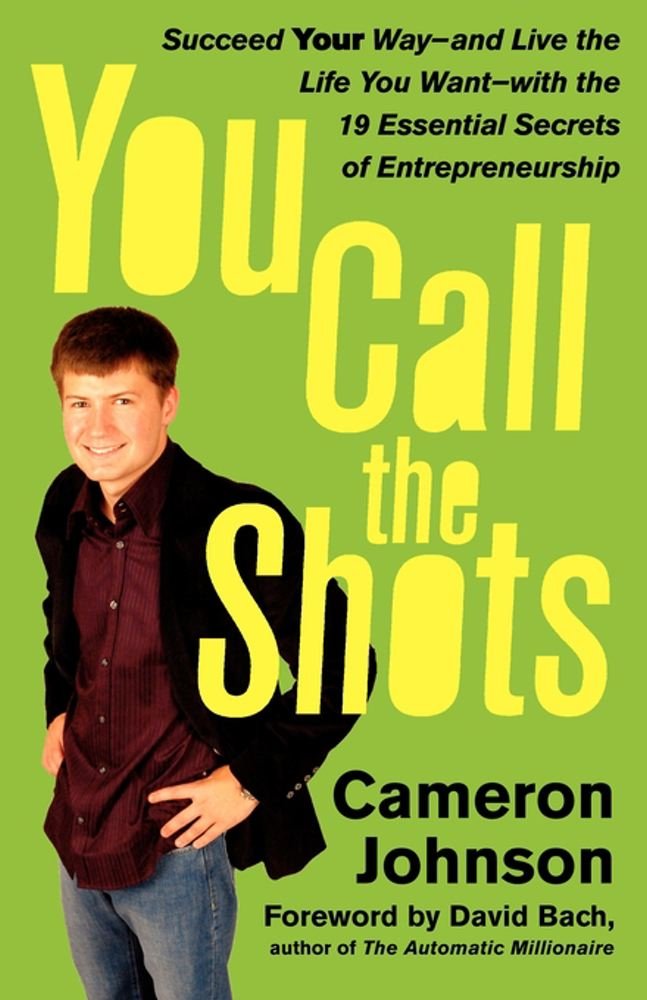
Cameron Johnson started his first business at nine, selling greeting cards he made on his computer, and by his teens had built several more, including an online reselling business and an advertising company. He wrote this with John David Mann as a set of 19 lessons from those years. The book argues that entrepreneurship is less about age, money or credentials than about habits: spotting opportunities, acting before you feel ready, learning from failures, and treating money and relationships seriously from the start.
Highlights
The truth is, building a successful business is more about common sense and the right attitude than it is about any kind of special training or inherent talents.
Becoming an entrepreneur requires learning how to take lots of noes to get to yes—learning to consider no as a challenge, not a defeat.
There’s an old expression in sales: You can give the best presentation in the world, but you still have to ask for the sale.
The best salespeople focus on asking questions and listening, not pushing.
My feeling is, I’d be doing my customers a disservice if I let them not buy my product.
They don’t give up easily because they believe in what they’re doing.
I believe in everything I’m selling, and this makes it so much easier to give customers reasons to buy. I truly feel they’re making a mistake if they don’t buy my service or product.
never underestimate the value of tapping into your personal networks and your local community, whether it’s for advice, for start-up cash, for building your customer base, or for publicity. Many people feel hesitant about that kind of networking, but this is one of the distinguishing characteristics of all good entrepreneurs: they are always growing their personal networks, always keeping in touch.
Free publicity is the best way to advertise. Why would you want to pay ten or fifteen grand to take out a full-page ad in a metro newspaper if you could have a reporter write a story about you in that same paper at zero cost? And this publicity wasn’t just free exposure, it also was exposure with credibility. People often won’t believe an ad, but they’ll trust a story. Those lessons have been key to my promotional philosophy ever since. I always use free publicity to promote my businesses.
When you don’t have a lot of capital, you’re forced to scrutinize everything you do, and there’s nothing better for a business than ruthless self-examination. Starting small forces you to learn from early mistakes. You have to watch every single expense and justify it.
Demand was constantly running way ahead of supply,
Find a business that will be low-cost to run and will
generate strong word of mouth, and you’ll be way ahead of the game.
One of the most important qualities of the most successful entrepreneurs is that they appreciate the true value of money and pay close attention to how they manage it.
New entrepreneurs often make the mistake of thinking that the purpose of building a business is to make money. But money isn’t an end in itself; it’s only a tool. At first it’s a tool to help you build and grow your business further.
If you want to successfully start and grow your own business, you need to have a firm grasp on basic money management skills.
by not being in control of their money, they’re letting their money control them—and
You don’t need a business course to learn this. You just need to be determined to stay on top of your finances and make your money work for you.
My mom is someone who does not take no for an answer. (In fact, this may be the most important thing I’ve learned from her.)
At the end of 1995, when my first business was not quite two years old and I was still months away from selling Claire’s Beanie Baby collection, my parents gave me two shares each of stock in three companies: Disney, Marriott, and CSX Railroad. (Years later, one writer joked, “Instead of getting a toy train set for Christmas like most kids, Cameron got railroad stock.”) I learned how to follow the stocks’ progress on AOL and in the newspapers, and started watching them every day.
I especially liked reading biographies of successful entrepreneurs, people I looked up to, such as Donald Trump, Bill Gates, and Michael Dell. I also regularly read BusinessWeek, Forbes, and other business magazines.
Nobody believed that would work—but it did,
I’ve come to realize that gaining a basic understanding of the stock market is as much a part of money management as balancing your checkbook. To me, knowing how to make your own trades and knowing how to intelligently pick those companies you’re willing to invest in are essential skills for any entrepreneur.
The most important thing I’ve learned about money is not to chase it. If you chase money, it will ruin your life. If instead you
put your energies into pursuing skills, knowledge, and understanding, the money will follow you.
In other words, don’t put money first. Keep your focus on building your business and delivering value to your customers. When you do, you will be successful—and the financial rewards will come.
I wish I could say I’d had an amazing “Eureka!” moment like that. But the truth is, great ideas for successful new businesses don’t need a miraculous moment of inspiration. Good business ideas are all around us—and they start coming to you a whole lot more naturally if you just keep your brain working on them and your mind open to them.
It helps to apply Warren Buffett’s investment advice here: start with what you know. You don’t need to stray far from your own home to find great ideas. If your passion is antique cars, video games, or first-edition mystery books, any of those could be a good place to start hunting for business ideas. Maybe you have a skill you love, like carpentry or knitting. For me as a kid, Beanie Babies was home turf.
You can figure that a company will typically sell for about five times its annual earnings, plus the market value of whatever assets it has (which might include such things as inventory, buildings, real estate, or even a recognizable brand).
If I were thinking about starting a business today in a brand-new niche, a market I’d never thought about before, I would start by asking myself, “What do people in this industry need? What’s bothering them, hassling them, costing them money, keeping them from getting what they want?”
Think about small businesses in your area: What do they need? Maybe your local dry cleaner or clothing boutique needs a delivery service, or your coffee shop or ice cream shop needs local promotion.
Choose a niche, find a need, and then see what could help those people do their job better.
To go into business for yourself, you don’t necessarily have to come up with a brand-new idea. Another great strategy is to spot a trend that’s just starting to pick up steam and ride that wave.
How do you find the right trend? You don’t have to be a genius: you just need to stay on top of current events and keep percolating those ideas.
Some ideas come from stumbling on a great product (Beanie Babies); others come from identifying a clear need in the marketplace (MyEZMail). Here was yet a third way to find a great idea: notice someone else doing a poor job.
When you create a business, you are the idea person and the bottom line: not only does the initial concept come from you, but also all decisions ultimately come down to you.
Part of building a business is knowing how to find and work with people who have more expertise than you do.
we split the stock up roughly 40/30/30, so that I had the largest share but nobody had a clear majority—in other words, it would take at least two of us to make any major decision.
As I’d learned back in the days of my very first business, there’s no more powerful channel of promotion than word of mouth.
Never underestimate the potential of a good idea. And never underestimate the better execution of a good idea that someone else is executing poorly.
If you know how to generate solid, inventive, well-researched ideas, how to calculate risks and take measured steps, and how to find the best people to work with, you can leap over virtually any barriers and obstacles. You can even beat the competition—even if they are a thousand times larger and more heavily capitalized than you are.
It wasn’t just Taka’s clever promotional skills; this was genuinely newsworthy to them.
Nothing gives you credibility like the press—and
But even if only on a smaller scale at the local level,
if you want to build a successful business, it’s going to be important to embrace the notion of being a public figure in your community.
I love selling.
It’s just like effective selling: you need to know, with rock-solid conviction, the value of what you’re offering, and have a clear sense of what you want from the other party. To know where you are willing to give, and where you are not.
Years ago, I learned from my dad that your goal in sales is not to convince anyone that they want what you’re selling; it’s to help remove any obstacles to their getting what they already know they want. When a customer on the showroom floor is hesitating about the car he wants to buy, the solution is not to harangue him or tell him all the reasons he ought to buy. The solution is to ask him, “What would have to happen for you to sign the papers and drive this car off the lot today? What would it take?”
What will truly make you happy? It’s not always easy to know the answer, but nobody else can find it for you.
Listen carefully to your inner sense, and don’t be afraid to act on it. You’ll come out way ahead—in your work, and in your life, too.
In fact, maybe this change could even offer new opportunities, for
entrepreneurs observant enough to see them.
My friend Joe Sugarman, a master marketer and founder of BluBlocker Sunglasses, says, “The greatest success stories are created by people who recognize problems and turn them into opportunities.”
But fundamentals are fundamentals. That is the art of good business: keeping one eye firmly on the core principles, which never change (know your customers, don’t let your expenses outrun your income, carefully calculate all risks, etc.), and the other eye on the shifting business climate, which is always changing.
listen to your customers and give them what they want.
his grandmother Rose inspired him to make his first stock market purchase at age seven.
Whatever these people put their minds to, it doesn’t matter how many noes they get, they will persist until they get a yes. They have very clear objectives and never take no for an answer.
I’m always on the lookout for people who know more than I do, people who have something they can teach me.
Number three of Bill’s Rules is, “Everyone wants to buy
from a person they like and trust. Listen; become their friend.”
She loved to play thinking games with me, anything that involved creativity—she was passionate about that.
I’ve always been a big believer in education. By “education” I mean being on the constant lookout for any opportunity to learn.
you can’t have continuous improvement without continuous learning.
I think the willingness to learn something new every day is one of the most important attributes of a successful person—not
how well you perform in school or “know” something on an academic level has little to do with how well you will actually perform the task on your own later in life.
It’s quite possible to ace a test and still not grasp its concepts. This is one of the fallacies of formal education.
Parents, teach your kids about money—because chances are, nobody else will.
Entrepreneurs are successful at what they do because: They know people and treat them well; They know basic business concepts;
They are willing to take risks and learn from their mistakes; They share a common goal with their employees; They know their industry.
I attribute my success to the education that came about from these three factors: I am willing to work hard; I follow through on my ideas; I’m willing to fail.
I believe you can learn more from failure than you can from success. Failing allows you to critique your
mistakes, learn from them, and correct them in the future.
Having the greatest product on the planet doesn’t mean a thing unless you have a way for enough customers to find out about it.
We couldn’t have Customer One on Day One looking at an empty
storefront. If our potential customers came to an empty site, who would list there? Nobody.
line—a good example of a calculated risk. We also leveraged our own cash investment by persuading as many retailers as we could to give us gift cards on consignment (i.e., we would pay for them only after we’d sold them).
I’d always known that the media and its form of word of mouth is the most powerful form of advertising there
is.
People trust mass-media advertising less and less, but the news is still the news. Publicity is just another way of using word of mouth.
The story was no longer, “Young Whiz Kid Starts Successful Business.” Now it was, “Teenager with More than a Dozen Successful Businesses behind Him Launches His Latest and Biggest.”
One of the reasons why CertificateSwap.com was such hot press was that people were hungry for good news about the future of business on the Internet. The truth was, people were hungry for good news about the future of business, period.
For me, CertificateSwap.com was a confirmation of everything I’d learned to that point. Pulling it off took all the lessons I’d gleaned from all my prior
experiences in business, and that, more than anything else, was why I found its success so satisfying.
I had already considered and brainstormed all the potential problems they might bring up and long since solved them to my satisfaction.
The truth is, no matter what type of business you’re
in, all businesses come down to understanding people.
you can’t inherit respect, and you can’t demand it; you have to earn it.
what you’re really doing is helping people remove all their obstacles.
As a salesman, your job is to find out from the customer what it will take to earn his business today.
It’s all about looking for your customers’ needs and addressing them.
The purpose here is not to put pressure on the customer, but simply to find out what we’re doing wrong—and even more important, what else we can do right.
One of the most powerful lessons I’ve ever learned about managing people is that nothing improves
performance like great incentives.
Offer people an appreciable reward for extra effort, and you’ll see effort that will amaze you.
In many ways, managing is about making sure your team has the same goal and vision as you do.
One of the best situations I can think of for the education of an entrepreneur is holding down a regular job while at the same time working on your own start-up.
Or to understand that to stay in business, you can’t just keep going after new customers; you also have to take care of the customers you already have.
Never Rely on Advertising
The most powerful form of advertising, and the one form that will never lose its effectiveness or become obsolete, is word of mouth: people who buy your products tell their friends about it. If you can get your customers to have such a great experience with you that they just have to tell others, then they’ll tell everyone. Investing in your customers is worth more than any investment in advertising, because if you treat them well, your customers will do your advertising for you.
under-promise and overdeliver.
take care of the customer and the customer will take care of you.
Treat your customers better than the competition does, give them your respect, and you’ll earn their respect—and their business.
Ever since I started working at Magic City Ford I’ve been fascinated with what distinguishes the top salespeople. In our business, the top one or two salespeople take the time to send Christmas cards or birthday cards to their customers, or even just get in touch at random to check in and say, “How are you doing?”
Ask any individual salesperson about follow-up, and he or she will tell you it’s the single most important aspect of selling.
“Everyone wants to buy from a person they like and trust.”
When customers feel that their interest is your interest, that your priority is taking care of them, they’re more likely to do business with you.
It’s a solid, tried-and-true recipe for business success: figure out what your customer needs and wants, and then provide that in the form of a great product, at a great price, with great customer service.
No mistake about it: being an entrepreneur is hard work.
One of the biggest rewards of going into business for yourself is that it allows you—in fact, it requires you—to exercise your creativity.
Carnegie Mellon University professor Richard Florida,
“to use your innate creativity and think outside the box!”