- Rating
- —/10
- Read
- May 2021
- Why I read it
- What I took from it
- My favorite idea
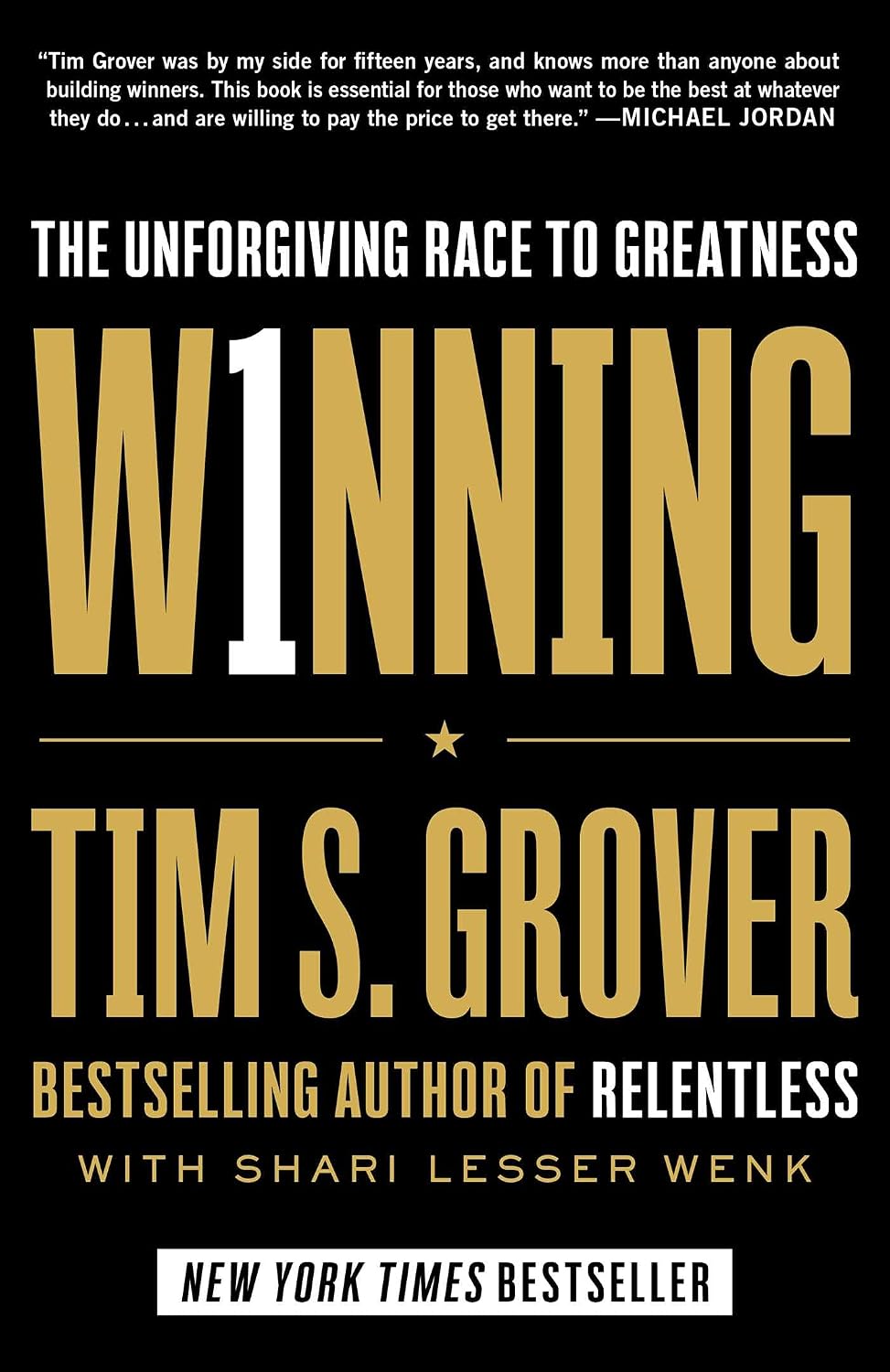
Tim Grover spent decades as the personal trainer to Michael Jordan, Kobe Bryant, Dwyane Wade and other elite athletes, and wrote this with Shari Wenk as a follow-up to his earlier book, Relentless. It’s not a feel-good book. Grover’s argument is that winning is a personal, unforgiving pursuit: it demands obsession, sacrifice and a willingness to be uncomfortable for a long time, and it doesn’t care about your excuses. He walks through the mindset he saw in the greatest competitors, including how they handled pressure, fear, failure and the people around them, and is blunt that most people don’t want to pay the price.
Highlights
I hear those words over and over. Always chasing that win. Never done.
He had to know why, when, how much, how long… every detail mattered to him.
Thinking back over the years, all my clients chased something. A record. A paycheck. A legacy. A ghost.
What are you chasing? What’s chasing you?
Because if you’re comfortable with sacrifice and pressure and criticism and pain, if you can learn to focus on the result instead of always focusing on the difficulty… you can chase Winning, fight for it, and defend your right to catch it.
Winning has its own language, and it doesn’t speak bullshit.
Winning requires real talk. Or, even better, no talk at all.
In the language of Winning, there is no talk about motivation. Motivation is entry level, the temporary rush you get from eating too much frosting. It’s that incredible riptide of artificial power and passion and ravenous energy… right before it wears off and you’re suddenly face-planted on the hard cold floor wondering what the hell happened.
Motivation is for those who haven’t decided whether to commit to their goals, or how much time, effort, and life they’re willing to invest to achieve them.
I’m talking about their need to have others push them into action with a swift kick in the ass.
I don’t work with clients who need that kick in the ass. If you come to me, I need to know you’re already kicking your own ass, and you’re ready for more.
I don’t want to “fire you up”—that’s your job.
There are no rewards for “showing up.”
There’s nothing normal about Winning. If you need normal, if you need to fit in, be prepared for a long stay in the middle of the pack. Winning requires you to be different, and different scares people. So if you’re worried about what others will say, the long-term effects, the sacrifices you’ll make, the sleep you’ll lose, your family being angry… I can’t help you with that. There’s nothing “typical” about the lifestyle and choices you’ll have to make. Winning is inside all of us, but for most, that’s where it will stay, trapped under a lifetime of fear and worry and doubt.
That’s it. What does Winning feel like to you? What does it represent?
Glorious. Euphoric. Success. Domination. Achievement. Power. Satisfaction. Triumph. Awesome. Amazing. Not bad answers. If your answer was on that list, you fit right in with the majority. If that’s where you want to be.
Let me share with you some of the answers I’ve heard from the greats. Not just in sports but from the business world as well: Uncivilized. Hard. Nasty. Unpolished. Dirty. Rough. Unforgiving. Unapologetic. Uninhibited. Kobe: “Everything.”
I pulled people along when they didn’t want to be pulled. I challenged people when they didn’t want to be challenged, and I earned that right because my teammates who came after me didn’t endure all the things that I endured. Once you joined the team, you lived at a certain standard that I played the game, and I wasn’t gonna take anything less. Now if that meant I had to go in there and get in your ass a little bit, then I did that. You ask all my teammates, “The one thing about Michael Jordan was he never asked me to do something that he didn’t fucking do.” When people see this, they’re gonna say, “Well, he wasn’t really a nice guy, he may have been a tyrant.” Well, that’s you. Because you never won anything. I wanted to win, but I wanted them to win and be a part of that as well. Look, I don’t have to do this. I’m only doing it because it is who I am. That’s how I played the game. That was my mentality. If you don’t wanna play that way, don’t play that way.
It’s Kobe tearing his Achilles but refusing to go to the locker room until he shot—and made—two free throws. The infamous 4:00 a.m. trips to the gym to put up shots, until he could master the shot he missed the night before. The countless hours alone in the dark replaying every game and practice in his mind.
Look at these definitions of Winning again: Uncivilized. Hard. Nasty. Unpolished. Dirty. Rough. Unforgiving. Unapologetic. Uninhibited. Everything.
When you start apologizing for who you are, you stop growing and you stop winning. Permanently.
#1. WINNING belongs to them, and it’s your job to take it.
#1. WINNING wants all of you; there is no balance.
#1. WINNING is selfish.
Winning will cost you everything, and reward you with more, if you’re willing to do the work.
Stop being afraid of what you’ll become. You should be more afraid of not becoming that.
winners all understand one thing: There’s a price to pay, and you must pay it.
none brought in someone from outside the organization to train them. MJ was the first, when he hired me.
If you think like everyone else, if you act like everyone else, if you follow the same protocols and traditions and habits like everyone else, guess what: You’ll be like everyone else.
Everyone wanted to be like Mike. Mike did not want to be like anyone else.
That whole BS about thinking outside the box is just that: BS. Winners don’t see the box. They see possibilities. They use their own decisions, successes, and failures as a springboard to elevate their thinking and results.
Every great creation and invention started with people who knew how to think and didn’t allow themselves to be told what to think.
And unless you know how to think for yourself, you’re just going to keep pivoting back and forth, this way and that way, waiting for someone to save you. Waiting to be told what to think.
Kobe did the same thing with him; he’d call or text Michael in the middle of the night asking how he played against a certain guy, how he handled a situation, what he thought about this or that. And Michael would always answer his questions, and help him learn. That’s a major trait of the greats, by the way: They want to pass along their knowledge, so the next generation can keep learning.
When you know what to think, you’re ready to compete. When you know how to think, you’re ready to win. Your education teaches you what to think. Life experience teaches you how to think.
Coaches and bosses tell you what to think. Doing the work tells you how to think.
If you follow a recipe for the perfect chocolate cake, you’ll get that exact cake because you were told what to do. But after you’ve made it a few times, maybe you start thinking of a way to make it even more perfect, so you change something in the recipe. And you were right; it turned out even better. That’s about how to think, not what to think.
Thinking for yourself creates independence, which many of the self-help “experts” out there dread, despite their promises to the contrary. Why? The more you think for yourself, the less you’ll need the “experts.”
If you’re always reading self-help books and listening to motivational talkers and following inspirational geniuses on social media and podcasts, if you can’t make a decision without consulting mentors and masterminds… you’re being told what to think. You’re being told, I’m successful, this is how I did it, this is what I believe, so you should believe it too.
Everyone looks for the “key” to Winning, like you can carry it in your pocket and pop it into a lock. There is no key; it’s a combination vault of infinite numbers and infinite outcomes, with rusted, decayed dials that barely move, and digits that have been rubbed bare by countless desperate fingers trying to turn them in their favor.
Believe me, I’ve tried a lot of ideas that didn’t work at all. I’ve spent hours putting together the perfect program, only to take my client through the workout and realize within five minutes that I have to throw out the whole thing.
Winning demands that you look past “the right way” and create your own way.
Your nonnegotiables have to be things you—and only you—can control. The food you eat. The effort you commit. The words you speak. The results you deliver.
I’ve seen great competitors get to the top by refusing to negotiate their ambition to win. They made every right choice, committed the time and effort, and did the work better than anyone. But as soon as they won, they renegotiated everything. The celebration began, the pressure was off, the priorities changed, and the focus on Winning was suddenly blurred by the pursuit of countless other things.
One of my nonnegotiable core values is trusting my instincts, and believing what I know. I might be wrong, but I want the chance to be right. And I’d rather decide for myself than allow others to decide for me.
What are the thoughts that dance into your head in the middle of the night when it’s finally quiet enough for you to hear yourself think? Did I get enough done? Could I have worked harder? Can I do this? Am I kidding myself? Am I ever going to make it? Those thoughts can trigger disaster for many who fear they’re failing; they wake up every day in a panic, facing another day of anxiety and dread. I have no idea what I’m doing. I’m a fraud and everyone is going to see it. I’m never going to make it. I’m a mess. I can’t do this. But for others, those thoughts are a blueprint for improvement. Did I get this right? Can I do better? I know what to do, I need to make that happen.
That was Kobe. I can’t rest until I make this shot I should have made today. He’d be playing that moment over and over in his head, trying to figure out what happened so it didn’t happen again. He’d relive the game in his mind, watching film at 4:00 a.m., until he could understand why he missed that shot. What was going on with the defense? Where was the ball? Did it rotate correctly? Was it wet? Was it heavy? Was my head too far back? Did I catch it right? Was my elbow correct? He’d go through every possible variable until he could answer his own questions, and know with some certainty that the answer in his mind would resolve the issue on the court.
I’ve dealt with so many athletes with brilliant talent, whose careers were completely destroyed inside their mental bomb shelters. They believed every gratuitous compliment about their greatness, every grandiose tribute to their excellence. From the time they were kids, they were told how special they were, which may have been true enough at the high school or collegiate level. Unfortunately, they hadn’t actually accomplished anything at the pro level, and instead of working harder to match their alleged potential, they bought into the hype and focused on “building their brand” instead of their results.
Note: Get the results, and the brand will build itself. Play it the other way around, and your career will be dead long before your shoe deal expires.
How well do you deal with distractions? I’m sure you know people—including yourself—who have no ability to filter and manage issues with family and friends, addictions, financial problems, relationships, health, legal trouble… everything that happens to them is their new reason for not getting to the finish line. They give their time and energy to everything and everyone, and then blame all those things that “got in the way,” without ever once recognizing that the biggest obstacle in the way was themselves. And at the end of the day, their focus is on everything except the one thing that could have made it all work—Winning.
I’m not talking about distractions like watching videos on your phone or texting your friends or wandering into the kitchen for your fifteenth snack of the evening, although those are definitely distractions. I’m talking about the internal distractions caused by your own mental combat with yourself.
If you’re procrastinating, if you’re constantly apologizing for things you did and didn’t do, if you get to the end of the day and realize you didn’t accomplish a single thing you wanted—or needed—to do, you’re distracted by your own thoughts.
We all have some kind of “To Do” list, but for most, it’s a “Things to Do That Will Never Get Done” list. Winners have a “Done” list.
Distractions can be fatal to your goals, if you don’t manage them. Notice I said “manage,” not “eliminate.” I know, you’ve been told a thousand times to “eliminate distractions.” Not possible. You might be able to erase some, but people are still going to need you, there will still be tasks and chores to do, the phone and the TV and the refrigerator are still going to be there, taunting you. And if those things are so distracting, enough that they’ve created an issue, they’ll be even more distracting when you try to eliminate them. If you want to manage distractions and get control of that battle, you need to put some routines in place.
To me, routines are freedom, if you use them correctly. They allow you to take action with certainty and purpose; they remove the variables and speed bumps that slow you down. And most important, they bypass the battlefield decisions: Should I? Should I not? This way? That way? Today? Tomorrow? How long? Who should I ask? When you have a well-planned routine, those questions have already been answered.
MJ had the most disciplined game-day routine I’ve ever seen, from the way he selected his timepiece to the way he laced his shoes. He planned and organized every detail of his day, from the time of his workout to the car he drove to the arena. He put his clothes on in a specific order, organized the game tickets for his family and friends, ate at the same time every day… everything had purpose and discipline.
If you can’t master the fundamentals, you can’t master anything else.
His fundamentals were so well rehearsed, he never had to think about those basics during a game. He knew if he could get to a certain spot on the court, nothing could stop him. Most players have a spot like that. MJ had them all over the floor; that was his minefield. He knew exactly where to position himself, and where his doomed opponents would be blown up.
No different from elite military executing a complex operation. Routine isn’t an option, it’s imperative. Every detail is planned, mapped, and required; the team has to work in complete synchronization, or everyone is at risk. From the way you’re taught to make your bed, to the precision and accuracy of jumping out of a plane, there is no room for creative options; the decisions have been made for you. Don’t think. Execute.
Why was routine so important to him? Because the games themselves were so unpredictable. Not uncontrollable, but unpredictable. And controlling the unpredictable was his specialty. He never panicked, never flinched at unforeseen obstacles. Rodman thrown out of a game? No problem, we’ll pick up his rebounds. Scottie injured? No problem, we’ll handle his points. Team being dismantled at the end of the season? I got this. Give me the ball and get out of the way.
You can’t manage any of that if your mind is battling everything else in your life.
His routine allowed him the mental freedom and clarity to focus on one thing:
Confidence is the ultimate drug, and Winning is the dealer. It’s the cure for doubt and insecurity and panic and low self-esteem, the antidote to the free fall you experience when you’re losing control, the vaccine for fear and weakness.
Winning requires you to set unrealistic goals, and expect to achieve them. That doesn’t mean chasing unattainable dreams; it means making smart, educated, and confident decisions about what you’re capable of achieving.
here’s a slightly different take from Kobe, in an interview about being a teammate: “If you’re going to lollygag through this scrimmage, through this drill, I’m going to beat you, I’m going to let you know I beat you, and I’m going to want you to reconsider your professional life choice. And for the most part, people will say that doesn’t make a great teammate. Well, I’m not here to be a great teammate. I’m here to help you win championships.”
“My mentality was to go out and win at any cost,” he said. “If you don’t want to live that regimented mentality, then you don’t need to be alongside of me because I’m going to ridicule you until you get on the same level with me. And if you don’t get on the same level, then it’s going to be hell for you.”
I was doing some consulting for a tech company that decided to let go of its top performer because she had a reputation for being “difficult.” She didn’t get along with everyone, they said; she pushed others too hard and often made people uncomfortable by insisting that everyone needed to do better. Someday maybe I’ll understand why that’s a bad thing; I’ll take difficult and effective over easy and incompetent any day. But there were ego and personality issues, probably because the pressure and tension were too high, and management decided it would be better for “morale” to let her go, along with her huge book of business and years of experience. And within a month of her departure, morale and productivity actually got worse, because those who had the issues with her suddenly had no one to blame for their poor performances, and no one to hold them accountable. And eventually, her former bosses realized that the person who was the “problem” was actually the one holding it all together. The “thorn” in everyone’s side was the most important part of the rose.
Your greatest winners are the least sensitive. And the more they win, the less sensitive they become.
As Michael said in The Last Dance: Winning has a price. Leadership has a price.
Staying in control of yourself is a choice. Losing control is a choice. But to develop that level of control you have to understand what’s dictating your actions, and your thoughts. Is it you? Is it something external? Are you so busy fighting with everyone else that you don’t even realize your biggest battle is with yourself?
Self-control means facing the things you don’t want to face, looking for answers in yourself and not others, knowing you’re not always going to be happy or secure. It means resisting the celebration every time something good happens, and not falling apart every time things don’t go your way. It’s about managing the low moments, the setbacks, and not getting caught up in things you shouldn’t—the things that test you.
Control your thoughts, and you control your emotions. Control your emotions, and you control your actions. Control your actions, and you control the outcome.