- Rating
- —/10
- Read
- November 2014
- Why I read it
- What I took from it
- My favorite idea
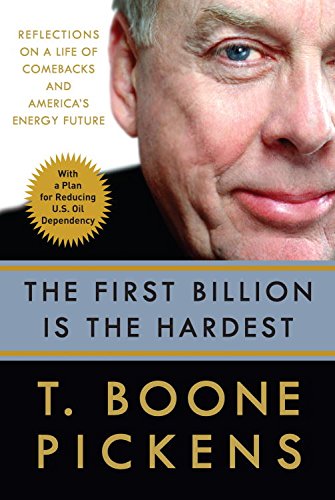
T. Boone Pickens grew up in Oklahoma during the Depression, started his own oil company, Mesa Petroleum, in the 1950s with a few thousand dollars, and became famous in the 1980s for his takeover bids on far bigger oil companies. In the 1990s he lost control of Mesa, went through a divorce and had health problems. Then, in his late sixties, he started over with BP Capital, an energy investment fund, and made more money than ever, most of it after turning 70. The book mixes that comeback story with lessons on risk, deals and persistence, and ends with his case for American energy independence.
Highlights
RISK HAS ALWAYS BEEN a part of my life. I’m not sure whether I’m drawn to it or it’s drawn to me, but at every point in my eighty years, I’ve been faced with a challenge, and in just about every instance I’ve taken it.
“Remember, a fool and his money are soon parted,” she said when I told her I was going to spend 50 cents on a haircut, a movie, and a bag of popcorn.
He told us to play all out but not to dwell on either successes or losses. He taught me that when the game is over, it’s over.
My single-minded focus gave me an edge: I was now going to succeed or fall on my ass. In fact I always think I have an edge, but I love to be the underdog.
Stay away from the temptation. Temptation scares me to death. Just don’t go where you are going to get exposed. I’d break down just as quick as another guy, but I just didn’t—and still don’t—give myself the opportunity. Again, it’s simple. There is work, and there is home, and there aren’t any stops in between.
Only I decided early on to
concentrate on business and home and to omit the distractions and temptations that mess up so many lives.
We made a $435,310 profit on revenue of $1.5 million our first year. I thought it was a very good start. By 1968, revenue had grown to $6.2 million, with profits of $1.4 million.
Taking no for an answer would not be an option.
“Boone, you will spend just as much time on a big deal as on a little deal. In big deals, there’s always serendipity. You’ll find a lot of lagniappe.” That’s a term folks in my part of the country use for a bonus or fringe benefit. “There’s so much in a big deal that nobody can evaluate,” Dow told me. “Once you get in there you’ll find out what I’m talking about. The bigger, the better.”
Booneism #2: Chief executives who themselves own few shares of their companies have no more feeling for the stockholders than they do for baboons in Africa.
I have been frugal in my businesses, always keeping in mind that shareholders are the owners of a company, while members of management are employees.
Booneism #3: Far too many executives are more concerned with the four Ps—pay, perks, power, and prestige—than with making profits for shareholders.
Booneism #4: As my father used to say, “There are three reasons we can’t do it. First, we don’t have the money, and it doesn’t make a damn about the other two.”
One of our first stops for potential takeover partners was Gulf Oil. I knew their CEO, Jimmy Lee, from the Yellowstone fishing trip and thought
he would be easy to talk to. “We would like to look at anything you think would make sense and make us money,” Lee said when I called to see if he would join me in a bid for Cities. He added that his board might even live with a hostile takeover attempt, but he wanted me to bring our plan to him and show him what I was talking about. So we went to Pittsburgh to meet him in February 1981. I gave Lee and his CFO, Harold Hammer, a two-hour presentation. Lee took notes; Hammer didn’t. He just sat there looking as if he would rather have been undergoing a root canal. I went through my pitch, showing them our takeover strategy. Then Lee dropped a bombshell: “Boone, I’m sorry, but we can’t be in a hostile deal.” It was just the opposite of what he’d told me on the phone the day before. On the way out the door, Mesa’s CFO, Gaines Godfrey, said just what I was thinking: “Do you realize what those bastards did? They know exactly what we’re going to do.”
Booneism #5: The higher a monkey climbs a tree, the more people can see his ass.
They said I’d be a small fish in a big pond instead of a big fish in a small one. How wrong they were. I love Dallas. Not only has the city accepted me with open arms but I also soon realized the business significance of being headquartered in one of the country’s major metropolitan areas. The deal flow, the contacts, the travel—everything is so much easier in a big city.
Booneism #7: You are pissing in my ear and telling me it’s raining outside.
So leaving Mesa wasn’t an end but the opportunity for a new beginning. When one door closes, another opens.
Before turning off the lights for the last time and heading to my temporary home in the Four Seasons Hotel, I stood in an emptying office flooded with memories. I kept thinking how far we had come—and how far we had fallen. I contemplated what had happened, what hadn’t happened, and what should have happened. It was all just a warm-up for what was yet to come.
Booneism #8: I have always believed that it’s important to show a new look periodically. Predictability can lead to failure.
I was going to build a new life and a new business with the greatest capital anyone can have: experience.
I also learned that the direction of success is never straight up.
Most people, both in business and in life, surrender. As a result, they fall short of their dreams, opportunities, and potential. I learned that if you never give up, if you push through the resistance and keep driving for what you want, you will ultimately achieve rewards beyond any you had hoped for. Because down deep, just beyond the hard, tough spot we all have found ourselves in, there awaits the opportunity to become stronger, more successful, and more fulfilled than you have ever imagined. Never, never, never give up.
“The Old Man Makes a Comeback.” It’s an imaginary headline that has captivated me for years.
You can stay around as long as you stay active—and, of course, have a plan. A fool with a plan can outsmart a genius with no plan any day.
I remember thinking, If we could make a couple million dollars a year, I’d be satisfied. It would be comeback enough.
There’s nothing like a commodities play for consistent action. Doing it successfully calls for accurate analysis, the nerve to take risks, and the ability to act.
My strategy was the same as today: staying current on every possible source of information, investing on the fundamentals of supply and demand, and sticking with my conviction over the long haul. I also
reinvested all of my profits, thereby greatly increasing the number of contracts I held.
Booneism #9: My mother once told me, “Son, you talk too much. You should listen more. You don’t even know who the enemy is.”
Don’t forget, information is everything. You can never have enough, and as you get older you find that keeping current keeps you in the game. And then there’s risk. If you are going to make a lot of money, you have to take risk. Entrepreneurs put the chips on the table if they believe in their analysis. If you have 4:1 odds in your favor, and if you have the money to stay in the game long enough, you are going to win.
Putting your money in a savings account is fine, but entrepreneurs, I told him, put their money at risk. Because only with risk come the greatest rewards.
THE PEOPLE WHO followed me from Mesa believed in me. They knew me as a leader who milked every minute out of every day, a businessman of high intensity, always on full burn.
Booneism #10: Show me a good loser, and I’ll show you a loser.
Throughout my career, I’ve been known for my optimism and belief that any obstacles or failures could be overcome.
AS MY MIND cleared and my focus returned, I stepped up my commitment to physical fitness. No amount of money, success, or fame can raise a body from a bed or turn fat into muscle. My friend Arnold Schwarzenegger has said that weights in a gym never care about how rich or famous you are. Only constant and aggressive exercise can keep a human being young and fit.
After I took up racquetball and then jogging, I noticed a big difference in how I felt. My stamina improved. So did my powers of concentration. I got a lot more done and had energy to spare. Exercise did so much for me that I was sure it would have the same effect for our company. We bought everyone at Mesa memberships at the YMCA, but there was a catch. They had to use it, or I’d take it back. In 1979, we built a $2.5 million fitness center on the third floor of our parking garage. It had four racquetball courts, a full basketball court, an indoor running track, and state-of-the-art exercise equipment. I’m convinced it was the most complete corporate fitness center anywhere.
Mesa became among the first companies in America to institute a corporate wellness program, and within three years our wellness center paid for itself in health-care savings. Our company’s per-employee health-care cost dropped almost 60 percent below the national average. The average number of sick days for those enrolled in the program also dropped dramatically. Mesa gave cash incentives to employees if their families participated in the fitness program.
• Some days we work the chest: four sets of eight to twelve repetitions, with the understanding that each set is always done until failure—meaning I lift until I can’t do another rep. At that point Eric typically asks me to do one more, and I
push past that tough spot toward greater success.
I never forget the words of Arnold Schwarzenegger: “The last three or four reps of each set are what make the muscle grow. This area of pain divides the champion from someone else who is not a champion. That’s what most people lack, having the guts to go on and just say they’ll go through the pain no matter what happens.”