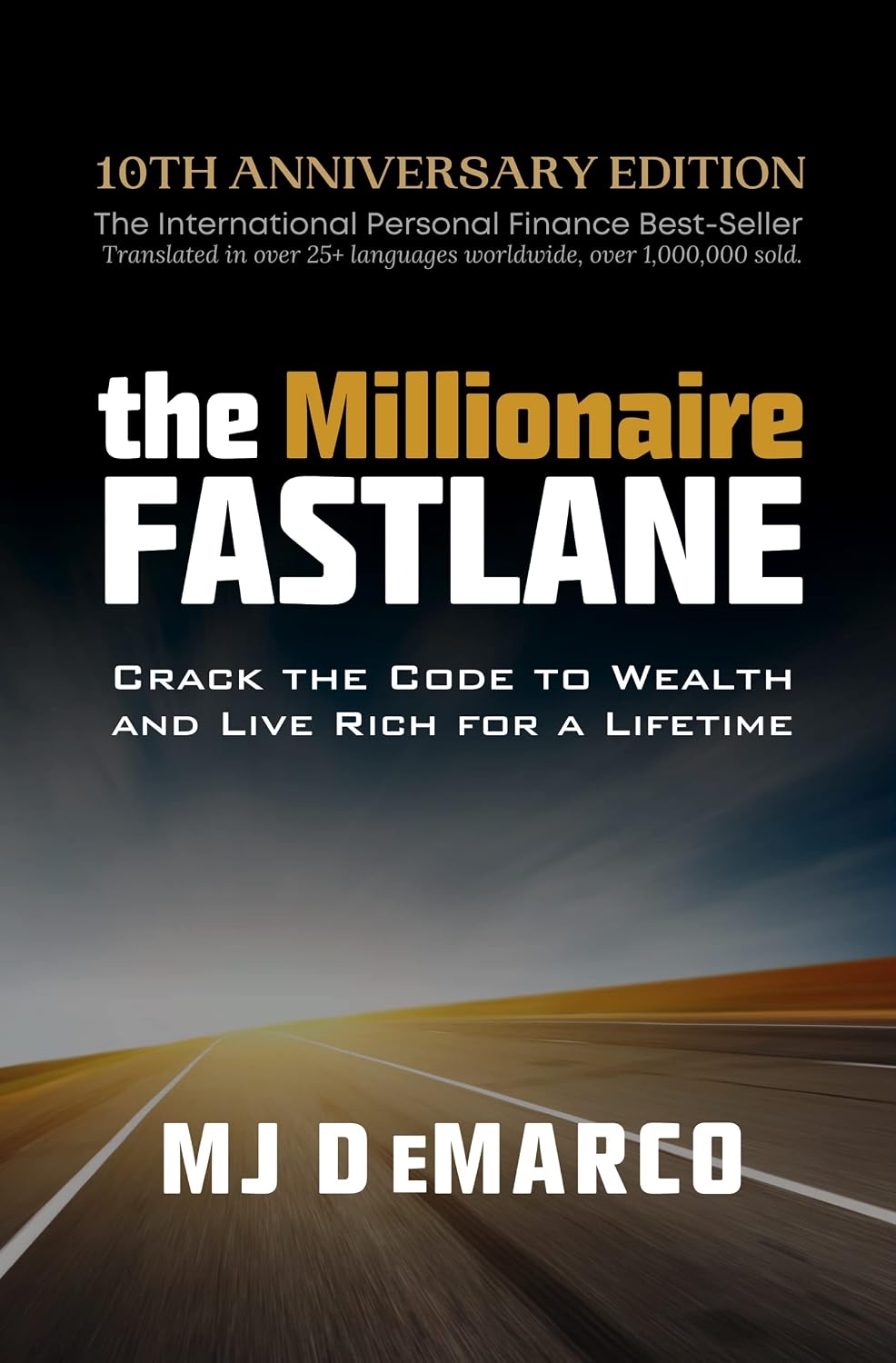
- Rating
- 10/10
- Read
- February 2024
- Why I read it
- What I took from it
- My favorite idea
An incredible book. The title makes it sound like another get-rich-quick book built on theory. It isn’t. It’s built around the true story of how MJ DeMarco started Limos.com and sold it, not once, but twice.
Highlights
The answer is more about what you’ve been doing than what you haven’t. There’s an old proverb that has mutated a few times but the gist is this: If you want to keep getting what you’re getting, keep doing what you’re doing.
If you aren’t wealthy, STOP doing what you’re doing. STOP following the conventional wisdom. STOP following the crowd and using the wrong formula. STOP following the roadmap that forsakes dreams and leads to mediocrity. STOP traveling roads with punitive speed limits and endless detours.
In essence, you have to unlearn what you have learned.
I’m a normal guy living an abnormal life. It’s a fantasyland but my reality, my normal,
Alternatively, if you travel the right roads and leverage the right roadmap, you can resurrect your dreams to possibility.
Normal is not something to aspire to, it’s something to get away from. ~ Jodie Foster
Yet, we continue to trust the same old tired gang of financial media darlings who espouse these doctrines of wealth. Yes sir, get a job, work 50 years, save, live mindlessly frugal, invest in the stock market, and soon, your day of freedom will arrive at age 70 . . . and if the stock market is kind and you’re lucky, 60! Gee, doesn’t this “wealth in a wheelchair” financial plan sound exciting?
The object of life is not to be on the side of the masses, but to escape finding oneself in the ranks of the insane. ~ Marcus Aurelius
The Search for the Millionaire Fastlane After the Lamborghini encounter, I made a conscious effort to study young millionaires who weren’t famous or physically talented. But I wasn’t interested in all millionaires, just those who lived a rich, extravagant lifestyle. This examination led me to study a limited, obscure group of people: a small subset of fameless millionaires who met these criteria: They were living a rich
After the Lamborghini encounter, I made a conscious effort to study young millionaires who weren’t famous or physically talented. But I wasn’t interested in all millionaires, just those who lived a rich, extravagant lifestyle. This examination led me to study a limited, obscure group of people: a small subset of fameless millionaires who met these criteria:
lifestyle or were capable of such. I wasn’t interested in hearing from frugal millionaires who lived “next door” in the middle class. They had to be relatively young (under 35) or they had to have acquired wealth fast. I wasn’t interested in people who spent 40 years of their life jobbing and penny-pinching their way to millions. I wanted to be rich young, not old. They had to be self-made. I was broke. Silver-spoon winners of the lucky sperm lottery weren’t invited to my lab. Their riches couldn’t be from fame, physical talent, playing pro ball, acting, singing, or
entertaining.
If I was going to survive, I needed to change.
My time was being sold off for money.
“Dude! Turn those emails into money somehow.” He was right, but how? And how can it solve a legitimate need? He left me with this challenge and I was intent to solve it.
Do we really need custom-branded water bottles? And logo T-shirts? Are these revenue generating actions?
Since reclaiming my business, it grew meteorically. Some months I’d PROFIT more than $200,000. Yes, profit! A bad month was $100,000. I earned in two weeks what most people earned in an entire year. Wealth poured in and I was flying low on the radar . . . no fame. If you earned $200,000 every month, how would your life change?
Change can happen in an instant.
If wealth has escaped you, it’s probably because you are “road-focused” and not using the whole formula.
You can’t crack wealth’s code with one variable in a multi-variable equation.
Imagine if I threw you into the kitchen with sugar and flour and ordered you to bake cookies. The feat is impossible because two ingredients alone don’t make the entire formula. Forget the baking soda and the cookies won’t rise. Remove the butter and the cookies taste awful. One forgotten or flawed ingredient and the process fails. Therein lies the fault with most wealth books: They are “road focused.” They specialize on the most titillating part of the formula—the sugar!
Millionaires Are Forged by Process, Not by Events
All self-made multimillionaires create their wealth by a carefully orchestrated process.
Wealth is a process, not an event. Ask
Wealth eludes most people because they are preoccupied with events while disregarding process. Without process, there is no event.
Process makes millionaires, and the events you see and hear are the results of that process. For our chef, the cooking is the process, while the meal is the event.
When a 20-year-old sells his Internet company for $30 million dollars, you read about it on a tech blog. The event is lauded and showcased for all to admire. Sidelined is the process—you didn’t hear about the long hours of coding the founder had to endure. You don’t hear about the cold dark days working in the garage. You don’t hear about how the company was founded on credit cards at 21.99% interest. You don’t hear about the founder and his rusty P.O.S. Toyota with 174,000 miles. When J. Darius Bikoff founded Glaceau Vitamin Water in 1996 and 11 years later Coca-Cola offers him $4.1 billion for the company, the offer makes headline news around the world. What doesn’t? The 11 years of struggle forged by a sharpened process. The billion-dollar offer is the event—the process is the struggle and the backstory.
Outsiders see the nice house and the expensive cars and might think, “Wow, if I only could be so lucky.” Such a belief is a mirage of event over process.
All events of wealth are preceded by process, a backstory of trial, risk, hard work, and sacrifice.
Wealth is a formula, not an ingredient.
Process makes millionaires. Events are by-products of process.
If you don’t know where you are going, any road will get you there. ~ Lewis Carroll
Self-made millionaires don’t become millionaires by stumbling into money, just as financial failures don’t become failures by stumbling into poorness. Both are the direct result of the financial roadmap chosen and the actions and beliefs that evolve from that roadmap.
Your current financial situation is a product of your existing roadmap, whether chosen or not.
Your roadmap guides your actions, and the consequences of those actions have created your financial life. How your life unfolds is determined by your choices, and these choices originate from your belief systems, and those belief systems evolve from your predisposed roadmap. If you want to change your life, change your choices. To change your choices you must change your belief system. Your belief system is defined by your roadmap.
Beliefs are powerful mechanisms that drive action, whether true or not. Our parents said Santa Claus was real and we believed it. We left cookies, we looked out the window for the flying reindeer, and we wondered how he got his big butt down the chimney. We believe what we’re taught until we gather evidence to the contrary.
Primary Wealth Accelerator: How are you accelerating your net worth and creating wealth? Or are you?
Wealth Equation: What is your mathematical plan for accumulating wealth? What wealth equation defines the physics of your wealth universe?
Destination: Is there a destination? If so, what does it look like?
Responsibility & Control: Are you in control of your life and your financial plan?
To force change, change must come from your beliefs, and your roadmap outlines those beliefs.
When you’re the first person whose beliefs are different from what everyone else believes, you’re basically saying, “I’m right, and everyone else is wrong.” That’s a very unpleasant position to be in. It’s at once exhilarating and at the same time, an invitation to be attacked. ~ Larry Ellison
A Sidewalker’s financial destination doesn’t exist. The plan is to have no plan. Surplus money is immediately spent on the next great gadget, the next trip, the next newer car, the next fashionable styles, or the next hot fad. Sidewalkers are carelessly trapped in a “Lifestyle Servitude” fed by an urgent, insatiable need for pleasure, image, and instant gratification.
reports. According to a US Census Bureau study conducted in 2000 (before the technology implosion of 2001 and the financial crisis in 2008), here are the disturbing facts: A person under the age of 55 is 57% likely to have zero net worth, or negative net worth. An estimated 62% of all households in the United States have less than $100,000 in net worth.
89% of all “under 35” households had a net worth less than $100,000. A person in the 35–44 age range has a median net worth of $13,000 excluding home equity. A person in the age 45–54 group has a median net worth of $23,000, excluding home equity. In a 2007 Census Bureau survey, 61% of all people who earned income earned less than $35,000/year.
Sidewalkers are the majority.
If you’re older than 35 and you have less than $13,000 in net worth let me be blunt: What you are doing isn’t working. You need a new roadmap.
Why would something that you’ve been doing for 5, 10, 20 years suddenly start working? Yes, insanity is doing the same things repeatedly and expecting different results.
The first step to escape the Sidewalk is recognizing that you might be on it . . . then replace it with something that works!
Newsflash: The Sidewalk is money blind. It doesn’t care about how much money you make. You can’t medicate poor money management with more money.
Sidewalkers come from all walks of life, even those with the visual embodiments
of wealth. They own businesses, they work high-paying careers like medicine or law, or they live as successful actors or musicians and earn big incomes. The common denominator remains consistent: There is no plan, no savings—spend more than you earn and trade a secure tomorrow for a “living large” lifestyle of today. A Sidewalker’s wealth equation is determined by income plus debt, determined by available credit.
more money is not a solution to poor financial management
Tossing more money at the deficiency is like trying to plug a hole in a dam with more water. More money doesn’t buy financial discipline.
A first-class ticket to the Sidewalk is to have no financial plan.
You cannot solve poor financial management with more money.
Family (relationships) Fitness (health) Freedom (choice)
Wealth is strong-spirited familial relationships with people. Not just your family, but with people, your community, your God, and your friends.
Second, wealth is fitness: health, vibrancy, passion, and boundless energy. If you don’t have health, you lack wealth. Ask any terminally ill person what they value. Ask any cancer survivor how they suddenly feel reborn and happiness is displaced from “stuff” to people and experiences. There is no price on health and vibrancy.
And finally, wealth is freedom and choice: freedom to live how you want to live,
what, when, and where. Freedom from bosses, alarm clocks, and the pressures of money. Freedom to passionately pursue dreams. Freedom to raise your children as you see fit. And freedom from the drudgery of doing things you hate. Freedom is the liberty to live your life as you please.
I researched the car and determined the price I wanted to pay. I walked into the dealership with a cashier’s check and told the salesman, “I have a cashier’s check for $44,000 and I want to buy that car. I need a YES or a NO.” Twenty minutes later, I owned a Lexus. This is wealth, not an impersonation of wealth.
Wealth is authored by strong familial relationships, fitness and health, and freedom—not by material possessions. Unaffordable material possessions are destructive to the wealth trinity.
People who declare, “Money doesn’t buy happiness” have already concluded they will never have money. This old equivocation becomes the torchbearer to
their poorness. And since money doesn’t buy happiness, why save it? And then logic begs, if money doesn’t buy happiness, does poverty?
Normalcy Is the Rat Race, a Modern-Day Slavery
Why am I wealthy, versus the guy stuck in morning traffic driving to work? I have freedom. I wake up and do what I want. I pursue dreams. I write this book without worrying about how many will sell. I hop a plane to Las Vegas for two weeks without worrying about jobs, bosses, or unpaid electric bills. Freedom is fantastic.
Normal is waking at 6 a.m., fighting traffic, and working eight hours. Normal is to slave at a job Monday through Friday, save 10%, and repeat for 50 years. Normal is to buy everything on credit. Normal is to believe the illusion that the stock market will make you rich. Normal is to believe that a faster car and a bigger house will make you happy. You’re conditioned to accept normal based on society’s already corrupted definition of wealth, and because of it, normal itself is corrupted. Normal is modern-day slavery.
“affordability,” you can’t afford it because affordability carries conditions and consequences. If you buy a boat and resort to mental gymnastics over affordability, YOU CAN’T AFFORD IT. Sure you can assuage affordability and make outlandish arguments, often starting with... “I can afford this as long as . . . . . . I get that promotion.” . . . my mortgage doesn’t adjust.”
. . . my stock portfolio makes another 10% this month!” . . . my sales forecasts are double.” . . . my wife finds a job.” . . . I cancel my health insurance.”
This self-talk is a warning that you can’t afford it. Affordability doesn’t come with strings attached. You can bluff yourself but you can’t bluff the consequences.
Many Americans are fat because the easiest (and cheapest) instant gratification comes from food. When you plop your butt on the recliner and maul through a can of Pringles, you choose pleasure now in lieu of pain later.
Wealth, like health, isn’t easy and is cut from the same fabric. Their processes are
identical. They require discipline, sacrifice, persistence, commitment, and yes, delayed gratification. If you can’t immunize yourself from the temptations of instant gratification, you’ll be hard pressed to find success in either health or wealth. Both demand a lifestyle shift from short-term thinking (instant gratification) to long-term thinking (delayed gratification). This is the only defense to Lifestyle Servitude.
Instant gratification is the bait and Lifestyle Servitude is the hook.
Know wealth’s enemies and what actions invite those enemies into your life. Wait until you can truly afford your lifestyle luxuries … and in the Fastlane, that day can come sooner rather than later.
Money, properly used, can buy freedom, which can lead to happiness.
Happiness stems from good health, freedom, and strong interpersonal relationships, not necessarily money.
The consequence of instant gratification is the destruction of freedom, health, and choice.
I’m a great believer in luck, and I find the harder I work, the more I have of it. ~ Thomas Jefferson
I once overheard someone call me a “lucky bastard.” What a sad, delusional Sidewalking belief. I’m not lucky; I’m a player of the game.
Cuban understands the dichotomy that most don’t: Process creates events that others see as luck. He goes on to comment how nobody mentioned luck when it came time to reading complicated software texts or Cisco router manuals or sitting in his house testing and experimenting with new technologies. Where was luck then?
understand that luck is a product of process, action, work, and being “out there.” And when you are “out there” you stand a chance at being in the right place at the right time.
There are right places and wrong places. The right place isn’t on your sofa watching American Idol or slapping greenbacks into thongs at Betty’s Booty Cabaret, or down at the neighborhood bar getting jacked-up on Bud Light while watching the Cubs lose another game. If you want to be at the right place at the right time you indeed have to be at the right place—and the right place knows which places are the wrong places.
Sidewalkers love events but hate process.
It’s only natural for Sidewalkers to assume wealth is luck, because they believe wealth is an event.
To realize luck, engage in processes where better probabilities exist.
Believe me, Fastlane drivers aren’t up at 2 a.m. because of some boob tube rerun; they’re forging process and muscling toward their destination.
First, wealth is not about luck but about process improving probabilities.
Like wealth, luck is created by process, not by event.
Luck is created by increased probabilities that are improved with the process of action.
Responsibility is the price of greatness. ~ Winston Churchill
John F. Kennedy’s “Ask not what your country can do for you, but what you can do for your country” has maligned into “What can my country do for me?”
A friend of mine recently had her identity stolen. As we dined at a restaurant she bellyached about the nightmarish ordeal. Determined to find the cause of her problem, I stopped her contempt midstream and asked a few questions. I wondered, was she a victim, or not being accountable? I asked, “How did your identity get stolen?” “My purse was stolen in Mexico.” “How did that happen?” I probed.
“I was at a restaurant and someone swiped it” “Oh? Was your purse laid out, wide-open on the table, like it is now?” She glanced at her purse and got my point. As we dined, her purse sat on the tabletop in open view of everyone. Any thief could easily snatch her purse and run. She looked at me, scoffed, and then grabbed her purse and secured it to her lap. A victim? Or not holding herself accountable? Her problem was caused by a bad choice—the choice to not safeguard her purse.
Responsibility: It was my fault that my purse was stolen. Accountability: In the future, I will take precautions to ensure it doesn’t happen again.
You deserve what your actions earned, or haven’t earned.
Taking responsibility is the first step to taking the driver’s seat of your life. Accountability is the final.
What if I told you ‘insane’ was working fifty hours a week in some office for fifty years at the end of which they tell you to piss off; ending up in some retirement village hoping to die before suffering the indignity of trying to make it to the toilet on time? Wouldn’t you consider that to be insane?
For me, every day is a Saturday because I haven’t sold off Monday through Friday.
By working faithfully 8 hours a day, you may eventually get to be the boss and work 12 hours a day. ~ Robert Frost
If you want to escape the Slowlane, find wealth and freedom fast, you’ve got to dump the job. Let me repeat. Dump the damn job!
To Trade Time Is to Trade Life
Somebody should tell us, right at the start of our lives, that we are dying. Then we might live life to the limit, every minute of every day. Do it! I say. Whatever you want to do, do it now. There are only so many tomorrows. ~ Michael Landon
Why is ULL so important? To accumulate financial wealth, you need to attract large sums of money. To attract large sums of money, you need two things: 1) Control and 2) Leverage.
The only thing that interferes with my learning is my education. ~ Albert Einstein
Take advice from people with a proven, successful track record of their espoused discipline.
Many money gurus often suffer from a Paradox of Practice; they teach one
wealth equation while getting rich in another. They’re not rich from their own teachings.
Sadly, in today’s terms, a “millionaire” (net worth of $1,000,000) is simply upper middle class. A millionaire is not rich. Five million is the old one million. Depressing, I know.
Slowlane millionaires have MBAs. Fastlane millionaires hire people with MBAs.
Slowlane millionaires work for their time. Fastlane millionaires have time working for them.
Slowlane millionaires are employees. Fastlane millionaires hire employees.
Slowlane millionaires use their house for net worth. Fastlane millionaires use their house for residency.
middle class. $5 million is the new $1 million.
People would do better, if they knew better. ~ Jim Rohn
Controllable Unlimited Leverage (CUL),
1) Controllable Unlimited Leverage (CUL) Whereas the Slowlane is defined by uncontrollable variables with no leverage, the Fastlane exploits the opposite conditions: maximum control and leverage.
2) Business Your own business, self-employment, and entrepreneurship are centrist to the Fastlane, much…
The Fastlane is a lifestyle choice: a commitment of blended beliefs,…
4) Rapid Wealth Creation The Fastlane is about creating large sums of wealth rapidly and beyond the…
Here is a story that best describes the Fastlane, and yes, this story is inspired from a real story posted on the Internet. After four long years, I sold my company [THE BUSINESS] for $32 million [RAPID WEALTH CREATION] and I wouldn’t change a thing. I’m happy I sold because I wanted to make money fast and transform paper money into real money. This decision changed my life permanently. Now, I do whatever I want and I’m not the least bit bored. The world is my playground; I travel, I learned two new languages and how to play piano. I play water sports, hike, and snowboard at least a month a year. I own three homes, I watch pro sports and my favorite teams whenever I choose, watch 3–4 movies a week, and read 1–2 books a week. Most of my time is spent with my family, and I literally watch my two daughters grow before my eyes. My family has lived on all four corners of the planet, including Australia and the Caribbean. Looking back, it wasn’t easy. I worked 12–16 hour days for four years, almost always six days a week, and always a few hours on Sunday. We created an awesome service and sold the crap out of it. [THE BUSINESS WITH CUL] I remember tough times, and I had to put every dime of my money into the company . . . we had less than 50 bucks in our account at least five times. Except for my family during those startup years, I sacrificed plenty; I canceled cable TV and I temporarily stopped doing a lot of things I enjoyed because I was…
The Fastlane Mindposts Like the other roadmaps, the Fastlane Roadmap contains the same mindposts or behavioral characteristics that drive the Fastlaner…
Debt Perception: Debt is useful if it allows me to build and…
Time Perception: Time is the most important asset I have, far…
Education Perception: The moment you stop learning is the moment you stop growing. Constant expansion of my knowledge and…
Money Perception: Money is everywhere, and it’s extremely abundant. Money is a reflection of how many lives I’ve touched. Money…
Primary Income Source: I earn income via my business systems and investments. Primary Wealth Accelerator: I make something from nothing. I give birth to assets and make them valuable to the marketplace. Other times, I take existing assets and add value to them. Wealth…
Wealth Equation: Wealth = Net Profit +…
Strategy: The more I help, the richer I become in time, money, and…
Destination: Lifetime passive income, either through business…
Responsibility & Control: Life is what I make it. My financial plan is entirely my responsibility and I choose…
Life Perception: My dreams are worth pursuing no matter how outlandish, and I understand that it will take money to make some of those dreams real. These mindposts are what…
The Parable of Fastlane Wealth A great Egyptian pharaoh summons his two young nephews, Chuma and Azur, and he commissions them to a majestic task: Build two monumental pyramids as a tribute to Egypt. Upon completion of each nephew’s pyramid, Pharaoh promises each an immediate reward of kingship, retirement amidst riches, and
lavish luxury for the rest of their natural lives. Additionally, each nephew must construct his pyramid alone. Chuma and Azur, both 18, know their daunting task will take years to complete. Nonetheless, each is primed for the challenge and honored by the Pharaoh’s directive. They exit Pharaoh’s chambers ready to begin the long pyramid-building process. Azur begins work immediately. He slowly drags large heavy stones into a square formation. After a few months, the base of Azur’s pyramid takes shape. Townsfolk gather around Azur’s constructive efforts and praise his handiwork. The stones are heavy and difficult to move, and after one year of heavy labor, Azur’s perfect square foundation to the pyramid is nearly finished. But Azur is perplexed. The plot of land that should bear Chuma’s pyramid is empty. Not one stone has been laid. No foundation. No dirt engravings. Nothing. It’s as barren as it was a year ago when Pharaoh commissioned the job. Confused, Azur visits Chuma’s home and finds him in his barn diligently working on a twisted apparatus that resembles some kind of human torture device. Azur interrupts, “Chuma! What the hell are you doing!? You’re supposed to be building Pharaoh a pyramid and you spend your days locked in this barn fiddling with that crazy machine?”
Chuma cracks a smile and says, “I am building a pyramid, leave me alone.” Azur scoffs, “Yeah, sure you are. You haven’t laid one stone in over a year!” Chuma, engrossed and unfazed by his brother’s accusation retorts, “Azur, you’re short-sightedness and thirst for wealth have clouded your vision. You build your pyramid and I will build mine.” As Azur walks away, he chides, “You fool! Pharaoh will hang you in the gallows when he discovers your treason.” Another year passes and Azur solidifies the base of his pyramid and begins the second level. Except a problem arises. Azur struggles in his progress. The stones are heavy and he cannot raise them to the pyramid’s second level. Challenged by his physical limitations, Azur recognizes his weakness: he needs more strength to move heavier stones, and to do so, seeks the counsel of Bennu, Egypt’s strongest man. For a fee, Bennu trains Azur to build bigger and stronger muscles. With great strength, Azur anticipates the heavier stones will be easier to lift onto the higher levels.…
construction slows to a disheartening crawl. It often takes one month just to place one stone. Moving stones to the upper levels require great strength and Azur spends much of his time working with Bennu to build greater strength. Additionally, Azur is spending most of his money on counseling fees and the exotic diet required for the training. Azur estimates at his current construction pace, his pyramid will be completed in another 30 years. Unfazed, Azur lauds, “After three years, I’ve far surpassed my brother. He hasn’t placed one stone yet! That fool!” Then, suddenly, one day while hauling a heavy stone up his pyramid, Azur hears a loud commotion erupting from the town square. The townsfolk, regular observers to his work, abruptly abandon his plot to examine the celebratory fuss. Curious himself, Azur takes a break and leaves to investigate. Surrounded by a cheering crowd, Chuma trolls up the town square commandeering a 25-foot contraption, a towering machine built from a twisted maze of gantries, wheels, levers, and ropes. As Chuma slowly moves…
pyramid. One after another, the machine effortlessly lifts the stones and softly places them side-by-side into place. Miraculously, the machine requires little effort for Chuma’s operation. Crank a wheel attached to a rope and cantilever entwined by a gear system, and bingo! Heavy stones are moved quickly and magically. While Azur’s pyramid foundation took over a year to build, Chuma lines up the foundation to his pyramid within one week. The second level that Azur so arduously struggled with is even more shocking: Chuma’s machine does the work 30 times quicker. What took Azur two months takes Chuma’s machine two days. After 40 days, Chuma and his…
Instead of honoring the machine, Azur vows, “I must get stronger! I must lift heavier stones!” Azur continues the hard labor of pyramid building while Chuma continues to work the crank of his machine. After eight years, Chuma finishes his pyramid at age 26: three years to build the system and five years to reap the benefits of the system. The great pharaoh is pleased…
never has to work another day in…
Meanwhile, Azur continues to dredge away at the same old routine. Lift rocks, waste time and money to get stronger, lift rocks, and get stronger. Sadly, Azur refuses to acknowledge his flawed strategy and endures the same old process: Carry heavy stones until you can lift no more . . . then get stronger so you can lift heavier stones. This mindless prescription leads Azur to a lifetime of toil. He never finishes his pyramid promised to Pharaoh simply because he decides to do the heavy lifting himself when he should have focused on a system to do it for him. Azur has a heart attack and dies while on the 12th level of his pyramid, just two levels from finishing. He never experiences the great riches promised by Pharaoh. Meanwhile, Chuma retires 40 years…
The Slowlane is a job: your hard work traded for your employer’s cash. Azur’s struggles resemble that of a Slowlaner; to get rich, you’re told to get stronger (spend money, return to school, and earn more in the job market) so you can lift heavier stones. The Fastlane is about building a better system, a better contraption, a better product, or a better “something” that will leverage your work. In the Slowlane,…
The Fastlane Roadmap: The Playbook for Wealth Losing teams use losing playbooks. Play for a losing team and you’re stuck using their losing playbook. To win, switch teams and use the winner’s playbook.
Where is this playbook and how do you get it? You have to forsake the ideology of the majority and become a Slowlane traitor.
Reshape life’s focus on producing, not consuming.
Applied, this means instead of buying products on TV, sell products. Instead of digging for gold, sell shovels. Instead of taking a class, offer a class. Instead of borrowing money, lend it. Instead of taking a job, hire for jobs. Instead of taking a mortgage, hold a mortgage. Break free from consumption, switch sides, and reorient to the world as producer.
I know; it’s not easy. However, once you see the world from a producer perspective, your perception sharpens like a fine-tuned
radio frequency, from static to clear stereo sound. Suddenly, opportunities have clarity, ideas surface, and scams are exposed.
Remember, the rich are a minority, and you want to be in that minority. It starts with a producer mindset.
When you encounter an advertising message that coaxes you to buy something, examine it from the producer perspective. How does this company make money? What is the aim of its message? What kind of business processes are involved in offering this product or service? Is this company making a profit? What is the revenue model? Is this product manufactured overseas or locally?
As producers, our job is to entice consumers to buy. As a producer
locked into a producer mindset, I attract wealth because consumers seek producers. Consumers are the majority who demand their fill!
Producers get rich. Consumers get poor. Switch teams and reorient as a producer first, a consumer second. Make wealth attracted to you!
To switch teams and become a producer, you need to be an entrepreneur and an innovator. You need to be a visionary and a creator. You need to give birth to a business and offer the world
value.
You see, when you unlock yourself from the handcuffs of time imposed by the Slowlane roadmap, you assign income to a system that leverages unlimited mathematics, and fast wealth becomes possible
Chapter Summary: Fastlane Distinctions Producers are indigenous to the Fastlane roadmap. Producers are the minority as are the rich, while consumers are the majority as are the poor.
Fastlaners are producers, entrepreneurs, innovators, visionaries, and creators.
Only those who will risk going too far can possibly find out how far one can go. ~ TS Eliot
The secret is to divorce yourself from the ugly and obese Slowlane equation (ULL) and trade up to the smoking hot blonde—the Fastlane equation (CUL).
Controllable unlimited variables will make you rich. So how did I control this variable? How is it unlimited? Simple. My average conversion ratio was 12%. If I want to make more profit, I don’t walk into the boss’s office and ask for a raise. No, I have several
weapons available for deployment. 1) Raise Units Sold by Increasing Conversion Ratio A 1% increase from 12% to 13% would give me an instant raise of about $480 per day. That’s $14,400 per month. If I redesign the Web site, hit a home run and get conversion to 15%, now I’ve expanded my income to over $43,000 PER MONTH.
2) Raise Units Sold by Increasing Web Traffic To raise profit, I can increase traffic. If I increase Web users to my Web site from 12,000 to 15,000 and conversion stays at 12%, my daily income rises by $1,440 per day, or $43,200 per month! Not likely? It happened! On some days I would have traffic spikes where over 20,000 users would visit.
3) Raise Unit Profit If I detect a weakness in supply for my service or improve value, I can raise prices and increase my unit profit. If my unit profit moves from $4 to $4.50,I raise my income to $10,800 per day from $8,000. That translates to an additional $84,000 per month! Is your mouth on the floor yet?
Isn’t it wonderful to have control?
Millionaires Create and Manipulate Assets (Asset Value)
In a survey of 3,000 pentamillionaires ($5 million net worth) the Harrison Group (HarrisonGroupInc.com) reported that almost all pentamillionaires made their fortunes in a big lump sum after a period of years. Worth repeating: a big lump sum, not “by saving 10% of his paycheck for 40 years.” “A big lump sum” is just another phrase for “asset value.” Furthermore, 80% either started their own business or worked for a small company that saw explosive growth. Explosive growth is another phrase representing asset value. And yet, none of these multimillionaires had a cushy union job down at the DMV.
The primary wealth accelerant of the rich boils down to one concept: Appreciable and controllable assets
Slowlaners and Fastlaners have two antagonistic views of “assets.” Slowlaners and Sidewalkers buy and sell depreciating assets that decline in value over time. Cars, boats, electronics, designer
clothes, gizmodos, and sparkly bling to impress that newly divorced woman in the adjacent cubicle—these are all assets that lose value the moment your credit card is charged. Contrary to this, Fastlaners buy and sell appreciating assets: businesses, brands, cash flows, notes, intellectual property, licenses, inventions, patents, and real estate. As it relates to the Fastlane wealth equation, the power of “Asset Value” lies in your ability to control the variable in a virtually limitless fashion.
Twenty-four-year-old Sheila Hinton quits her job to become a roving computer technician, eradicating viruses and cleaning computers. At first, her business operates in the local metropolitan area, but growth forces her to hire additional technicians. Her growth to additional cities is explosive and driven by demand.
In a few years, Sheila owns a company that operates in 27 states. She moves from a technician to a facilitator of the system, and her company enjoys an impressive $2.9 million profit. After enjoying the profits (and saving most of it), she sells her company for $24 million to a large computer manufacturer. She built an asset from nothing to something. The asset was her system, and now with a $30 million nest egg, she never has to work again.
Time is the coin of your life. It is the only coin you have, and only you can determine how it will be spent. Be careful, lest you let other people spend it for you. ~ Carl Sandburg
the system was built to be its own machine—a living, breathing entity that did the dirty work for me. My system was a surrogate and traded its time. I owned my time instead of time owning me.
Money grows on trees if you own a money tree. And, you can own
one if you know how and where to get the seeds.
Money trees are business systems that survive on their own. They require periodic support and nurturing but survive on their own, creating a surrogate for your time-for-money trade.
The Five Fastlane Business Seedlings There are five business seedlings to money trees. Mind you, these aren’t absolute and they interbreed with each other. Each system inherently has a grade that rates its level of passivity. A higher grade means a greater potential for passivity, but not necessarily a greater income. Rental Systems Computer/Software Systems Content Systems
Distribution Systems Human Resource Systems
Real estate is one “rental system.” I consider real estate money trees as Fastlane 1.0 or Wealth 1.0. It is the old way and still very much a road to wealth.
Leases, royalty payments, and licensing are other forms of “rental systems” that can produce reoccurring monthly income.
Likewise, if you invent and patent a product process and license it to other companies, you again earn income from the licensing fee.
My preferred system is computer and software systems, including the Internet.
Of course, the road to the Fastlane wasn’t easy for Nicholas. An engineer at Sun Micro Systems, he worked on his application after working eight-hour days, cradling his one-year-old son in one hand and coding with the other. How did he learn how to code an iPhone app? Nicholas couldn’t afford books so he taught himself by scouring websites. Hmmm . . . do you smell process behind the event?
surrogate
The rich rule over the poor, and the borrower is slave to the lender. ~ Proverbs 22:7 (NIV)
To his club wingman, I heard Gary drunkenly declare: “Thanks to municipals and treasuries, I never have to work another day of my life.” Another piece of the wealth puzzle solved.
The best money tree inexistence sits right in your pocketbook: The good old-fashioned buck. Yes, money. Money is the king of money trees. How is money passive? If you have a lot of money, you’re given the gate key to switch teams from consumer to producer. Specifically, you move from borrower to lender. You move from employee to employer. You move from customer to owner. In other words, people pay you to use YOUR MONEY in the form of interest or ownership.
For example, let’s examine interest, which is a fee earned to lend money. Right now you’re probably someone who doesn’t earn interest, but pays it. Someone lent you money for the mortgage on your home, and in return you pay the note-holder interest. That interest is profit or income to someone else.
I retired in my thirties because of this simple reality. I’m a lender, and when you have a lot of money to lend, you live free because passive income arrives every month. If you had $10 million and lent it at a mere 5% interest, you’d enjoy a passive income of $41,666 every single month. At 8% your monthly income would be $66,666 per month—fully passive. Over $60,000 every month! This is WITHOUT touching the principal. You can do this for years and still have 10 million dollars left over!
Imagine opening your mailbox every month to a $40,000 check—and you didn’t have to do anything for it. What kind of trouble can you get into earning $40,000 per month? I bet a lot.
Unrealistic? It isn’t. This is how I live.
Amass Your Army of Freedom Fighters Every dollar saved is another freedom fighter in your army. If your money is fighting for you, your time is freed and you break the equation of “time for money.” Money is your army. The more you have, the more they will fight
for freedom.
And I’m not referring to just the U.S. dollar, but all international dollar-denominated assets. As I write this, much of my income is derived from non-U.S.-dollar assets in other countries with stronger currencies and better yields. Fastlaners think globally, not locally.
The point of this illustration is to show that the rich aren’t using compound interest to get wealthy; they’re using it for income and liquidity.
As for earning your $10 million, that solution lies in exponential leveraged growth stemming from a Fastlane business—net income plus asset value—NOT in expenses, NOT in the stock market, and NOT in a job.
One saved dollar is the seed to a money tree. A mere 5% interest on $10 million dollars is $40,000 a month in passive income. A saved dollar is the best passive income instrument.
Try not to become a man of success, but a man of value. ~ Albert Einstein
If you want to get rich, start observing the true law of the universe—MATH—and not some hocus-pocus law that can neither be proved nor documented. Singing positive platitudes around the campfire isn’t going to make you rich. Oh, don’t get your panties in a wad; I know the Law of Attraction sounds great and has practical applications. For those not familiar with The Law of Attraction (“LOA”), it’s a mystical philosophy that states you become what you think and that your conscious and unconscious thoughts make your reality. The LOA contends that if you know exactly what you want, ask the universe for it, see it coming, then you will eventually receive it. Think riches and you will have riches! Sounds easy, huh?
I won’t hide my candid sacrilege to the LOA crowd; I think it’s a bunch of baloney orchestrated to sell books to those who think “thinking” will make you rich. In fact, the LOA is nothing but old principles of belief and visualization repackaged and remarketed for mass consumption. Who are the true Fastlaners? The LOA marketers!
Thinking never made anyone rich, unless that thinking manifests itself into consistent action toward application of laws that work.
Yes, positivity is favored over cynicism. Belief is the starting point to change. Visualization is crucial. Yes, if you don’t believe you can do it, I’ve got news for you—you can’t. This stuff isn’t new, it’s OLD.
The Law of Effection: The Fastlane Primer The Law of Effection states that the more lives you affect in an entity you control, in scale and/or magnitude, the richer you will become. The shortened, sanitized version is simply: Affect millions and make millions.
A while ago, I wrote an article titled The Shortest “Make Millions” Article Ever Written. Guess how long the article was? A paragraph? Maybe a sentence or two? Nope. Just two words. And those words?
Impact millions.
Impact millions and make millions. It doesn’t get any simpler than that!
Show me any self-made billionaire and I will show you a person
who has touched the lives of many in scale or magnitude, directly or indirectly. To Woodward and Bernstein, Deep Throat said, “Follow the money,” and when you do, you find the only one true law of wealth, and that is Effection. Why? Because Effection is rooted in mathematics, and because of this it operates exclusive of any roadmap.
Retrace the source of millionaire money and you will find millions of something.
Chapter Summary: Fastlane Distinctions The Law of Effection states that the more lives you affect or breach, both in scale or magnitude, the richer you will be.
The Law of Attraction is not a law, but a theory. The Law of Effection is absolute and operates exclusive of a roadmap.
To make millions you must serve millions in scale or a few in magnitude.
Your life is the sum result of all the choices you make, both consciously and unconsciously. If you can control the process of choosing, you can take control of all aspects of your life. You can find the freedom that
comes from being in charge of yourself. ~ Robert F. Bennett
The Leading Cause of Poorness If poorness were an illness, take a guess as to its cause. Of course, lack of money. But is that a cause or a symptom of the underlying problem? Lack of education? Lack of opportunity, positive role models, or determination? Nope. Those are all symptoms. If you retrace poverty’s footprints you will find that poorness starts at the exact same place: choice.
Poor choices are the leading cause of poorness.
The Heart of the Problem As my income elevated, so did my
cholesterol. The road of good living runs parallel to a cliff of gluttony. My doctor’s preferred method of attack was prescription drugs. I refused because I wanted to fix problems, not mask symptoms. If you approach wealth like a big pharmaceutical company and attack symptoms while neglecting problems, you will not succeed. Feeling tired? Take this pill. Want to lose weight? Another pill. The problems are ignored while the symptoms are addressed in catatonic cycles. I refused cholesterol medication because it addressed the symptom, not the problem. The problem is poor diet; cholesterol is the symptom.
If you aren’t where you want to be, the problem is your choices. Your circumstances are the symptoms of those choices. For example, everyone loves success quotes.
Perseverance is architected by many choices that fabricate lifestyle.
The point of this dissertation is that Fastlane success isn’t one choice. It’s hundreds. And when you line a string of choices together, they create your process, and your process will create your lifestyle. Lifestyle choices will make you a millionaire
Your Life’s Steering Wheel Your choices spark the fires of future circumstances. The fabric of your life is sewn by
the cumulative consequences of your choices—millions of them—that you set into motion. You act, react, believe, disbelieve, perceive, misperceive, and all of it engineers your existence. If you’re dissatisfied with life, your choices take full responsibility. Blame yourself and the choices you’ve made. Yes, you are as you have chosen
It took me 26 years of life and a blizzard to grasp the horsepower of my choices. The blizzard impeded my limousine, but I was there because I chose it. I chose to get the job. I chose to pursue low-rent businesses. I chose to continue life in Chicago. I chose to avoid corporate after college. I chose my friends. I chose my business pursuits. I chose all of it, and it engineered my life to that exact moment. I awoke to the epiphany that I was the driver of my life and my problems were the consequences of my choices. I steered myself there!
You chose to. Yes, you are exactly where you decide to be. And if that’s unhappiness, you need to start making better choices.
Choose to Be Wealthy or Choose to Be Poor
There’s a big chasm between thinking wealth and choosing wealth.
The leading cause of poorness is poor choices. The steering wheel of your life is your
choices. You are exactly where you chose to be.
Success is hundreds of choices that form process. Process forms lifestyle. Choice is the most powerful control you have in your life.
hard
We have two types of choices: Choices of perception (thought
patterns) Choices of action (choosing to read)
Choices of perception serve as the impetus to choices of action. If you believe and perceive a certain idea, you are likely to act in accordance with that belief.
Your internal language carries weight. If a brain surgeon told you before surgery, “I think I can operate on you and I will try to succeed,” you should freak out and trade in your hospital gown for some eternal nighties. Altering your words and thought perceptions are akin to wiping your windshield clean and seeing beyond your own sphere of sight. How do you manage your choice of perception? What language do you use in your mind? “I never …I can’t . . . If only . . .” Or do you choose better words?
“It’s possible . . . I’ll overcome. . . I will . . . I can.”
If your world is canvassed with words like “never” and “can’t,” guess what? It’s true—you can’t and you never will!
So how do you upload new beliefs and overwrite the old ones? Find the information, resources, and the people that align with the new beliefs. For myself, I pursued the stories of those who acquired wealth fast and soon learned that “Get Rich Quick” wasn’t a myth.
The universe doesn’t care about your past. It is blind to it.
If the universe doesn’t remember, why should you? Being
Your choices of action manifest from your choices of perception.
What you choose to perceive, or not perceive, will manifest itself to a choice of action, or inaction. You can change your choice of perception by aligning yourself with those who experience the perception as reality.
The universe has no memory, only you do.
We must not hear the naysayers, because they have been conditioned by society.
You can’t worry about deviating from social norms, because the norm is to be two paychecks from broke. If you want to push beyond average results produced by average people, you’ll need to adopt an uncommon approach that doesn’t fall in the favor of “everyone.”
society’s prescription for normal: Get up, go to work, come home, eat, watch a few episodes of Law and Order, go to bed . . . then repeat, day after day after day. Before you know it, 45 years have passed and you need another 25 just to make your financial plan work. Time passes, dreams die, and what remains?
Take control and make choices that can alter the trajectory of your life.
People are like roads—they can either bring opportunity or distress into your life. The quality of these roads solely depends on the quality of the person.
How? Join entrepreneur clubs, attend networking events, ally yourself with like-minders, get yourself around people who subscribe to a Fastlane, anything is-possible mindset, and decide who you want on your team of warriors. Read books and autobiographies of those who have the kind of success you want. Find a mentor. Join entrepreneur forums with a Fastlane mindset, like the Fastlane Forum! Not
One of my first girlfriends was A+ marriage material. But she fully subscribed to the Slowlane philosophy. She couldn’t understand why I was so fervent to be an entrepreneur. Our relationship stagnated as my failures grew, and the relationship eventually ended. This occurrence wasn’t either one of our faults; we just were two different people on two different paths.
Fastlaners understand that time is the gas tank of life. When the gas tank runs dry, life ends.
Time is the greatest asset you own, not money,
The reality is that time is deathly scarce, while money is richly abundant
paycheck? The distinction lies in the valuation of free time, the chosen roadmap, and the acquisition of parasitic debt. Guess the behaviors—rich or poor? This person sleeps until noon. This person watches hours of reality TV. This person drives two hours to save $20. This person buys airline tickets with multiple layovers to save $100. This person spends hours surfing social networks and gossip blogs. This person is a Level 10 Druid in World of Warcraft. This person watches every Chicago Cubs game (just kidding, all you loyal Cubs fans). Behind the tangled roots of poorness, you will find a poor valuation of free time, which breeds from bad choices. “Time losers” are poor evaluators of time. These are the people camped out at Wal-Mart at 4 a.m. waiting to grab the early bird sales.
Fastlaners regard time as the king of all assets. Time is deathly scarce, while money is richly abundant.
Make the real world your university. Yes, you are your own university.
Ask any successful entrepreneur and they will validate this truth: You learn from engagement, from doing, and from getting out and taking repeated action, more so than from any book or professor.
Bookstores: Books possess the greatest return for your educational dollar. Buy them, borrow them, or steal them. Just read them.
Infinite knowledge is everywhere and it’s free. What’s missing is discipline to assimilate it.
Mark Zuckerberg, founder of Facebook, didn’t build the most-used social networking site by being interested. He was committed. Thomas Edison didn’t invent the light bulb by interest; he was committed. Interest is quitting after the third failure; commitment is continuing after the hundredth.
While I was building my company, my system, my surrogate, I was committed. I’d spend 12 hours a day for weeks perfecting and building my system. I’d forgo nights drinking with friends. I lived in a cramped studio apartment. I’d eat cheap pasta for lunch and dinner. I was ready to wash dishes to work my plan. While my friends were more concerned with bragging rights for having the fastest car on a racing videogame, I wanted financial freedom. I wanted a fast car in reality, not on a videogame. My friends were committed to being winners in a fantasy world, while I was committed to being a winner in the real world. Fastlane winners are forged at the Redline.
How bad do you want it? How willing are you? Are you willing to sleep in your car for it? Are you willing to live in a tiny apartment while your friends own
houses? Are you willing to forgo the new BMW in favor of a rust bucket with 150,000 miles? Are you willing to wait tables at Maloney’s Bar and Grill when your friends have cushy $50K/year jobs? How willing are you? Most people aren’t willing, and it separates the winners from the losers.
it. You can have mediocre comfort now or meteoric comfort later. The Fastlaner trades short-term comforts with the foreknowledge that long-term extraordinary comfort is to be gained.
You can’t drive the road to wealth with the brakes engaged. You have to take risks. You have to get uncomfortable. You have to get out there and fail.
“A smart man learns from his mistakes. A wise man learns from the mistakes of others.”
Ninety percent of all new businesses fail within five years, and I know why they fail. They fail because they fail the Commandment of Need.
When you build a business on a flawed foundation, it will fail.
Businesses that solve needs win
Businesses that provide value win.
Businesses that solve problems win profits.
People care about what your business can do for them. How will it help them?
What’s in it for them? Will it solve their problem? Make their life easier? Provide them with shelter? Save them money? Educate them? Make them feel something? Tell me, why on God’s green Earth should I give your business money? What value are you adding to my life?
Reflect back to our producer/consumer dichotomy. Consumers are selfish. They demand to know is “what’s in it for me!” To succeed as a producer, surrender your own selfishness and address the selfishness of others.
Stop Chasing Money—Chase Needs
Stop thinking about business in terms of your selfish desires, whether it’s money, dreams or “do what you love.” Instead, chase needs, problems, pain points, service deficiencies, and emotions.
Entrepreneurs fail because they create businesses based on selfish premises, and selfish premises don’t yield profitable businesses; they lead directly into the 90% failure wastebasket.
You and your business attract money when you stop being selfish and turn your business’s focus from the needs of yourself to the needs of other people. Give first, take second. Needs come first, not money!
To Attract Money Is to Forget About Money Want to make big bucks? Then start attracting money instead of chasing it. Money is like a mischievous cat; if you chase it around the neighborhood, it eludes you. It hides up a tree, behind the rose bush, or in the garden. However, if you ignore it and focus on what attracts the cat, it comes to you and sits in your lap. Money isn’t attracted to selfish people. It is attracted to businesses that solve problems. It’s attracted to people who fill needs and add value. Solve needs massively and money massively attracts.
Money isn’t attracted to selfish people. It is attracted to businesses that solve problems. It’s
The amount of money in your life is merely a reflection to the amount of value you have given to others.
Successful businesses share one common trait: The satisfaction of consumer needs as reflected by sales in the marketplace.
The marketplaces and consumers, not you, determine if your business is viable.
Need something more concrete? No problem. Make 1 million people achieve any of the following: Make them feel better. Help them solve a problem.
Educate them. Make them look better (health, nutrition, clothing, makeup). Give them security (housing, safety, health). Raise a positive emotion (love, happiness, laughter, self-confidence). Satisfy appetites, from basic (food) to the risqué (sexual). Make things easier. Enhance their dreams and give hope.
The Commandment of Need states that businesses that solve needs win. Needs can be pain points, service
gaps, unsolved problems, or emotional disconnects. Ninety percent of all new businesses fail because they are based on selfish internal needs, not external market needs. No one cares about your selfish desires for dreams or money; people only want to know what your business can do for them. Money chasers haven’t broken free from selfishness, and their businesses often follow their own selfish needs. People vote for your business with their money. Chase money and it will elude you. However, if you ignore it and focus on what attracts money, you will draw it to yourself.
Passion for an end goal, a why, drives Fastlane success. Having a passionate “why” can transform work into joy.
Our plans miscarry because they have no aim. When a man does not know what harbor he is making for, no wind is the right wind. ~ Seneca
Saturation causes noise. Noise causes declining sales volumes.
There is no dependence that can be sure but a dependence on one’s self. ~ John Gay
In business, to be a success you only have to be right once. ~ Mark Cuban
Having the world’s best idea will do you no good unless you act on it. People who want milk shouldn’t sit on a stool in the middle of the field in hopes that a cow will back up to them. ~ Curtis Grant
The Tribe Has Spoken My Web site needed a redesign, and I spent six weeks creating a new look. I was excited, and the world was going to love this design—it was clean, user friendly, and showcased my design prowess. And then I launched it. And the world hated it. Complaints poured in. My site’s bounce rate (people who visit one page and immediately leave) skyrocketed. My conversion rate plummeted to virtually nothing. I went from 1,200 leads per day to barely 500. The tribe had spoken. Despite my investment in that redesign, I immediately reverted back to the old version and trashed six weeks of work.
If you do build a great experience, customers tell each other about that. Word of mouth is very powerful. ~ Jeff Bezos
Look Big, Act Small During Mr. Miller’s gym class in my sophomore year of high school, I became aware of Mark Cegraves—except there was no such student. Mr. Miller had a knack for butchering the simplest of names: Henderson became Hankerson, Seagroves became Cegraves, and Rickson became Rakesh. No matter what your name was, Mr. Miller would shred it. I don’t know if he was illiterate or just old. So fast-forward more than a decade, and who is listed on my Web site as my chief technology officer? Mark Cegraves. Oh, and look who’s my web developer—Gretchen Hankerson! Wow, so did I hire my friends from high school? No, I didn’t, especially since their names were just mere illusions of the real people. None of
these people worked for me. Yet if you visited my Web site’s “Contact” or “About Us” page, they were listed as employees in high profile positions: CTO, business development, or Web producer. These people weren’t employees, but it looked like my staff was big, and growing.
Complaints are valuable insights into your customers’ minds.
Looking big but acting small sets up customer service expectation violations in the positive. Looking big can scare away potential competitors.
People are definitely a company’s greatest asset. It doesn’t make any difference whether the product is cars or cosmetics. A company is only as good as the people it keeps. ~ Mary Kay Ash
A good accountant and attorney will save you thousands, perhaps millions.
Customer service philosophy is delivered from human interactions—not ambitious mission statements on a wall plaque in the CEO’s office.
A market is never saturated with a good product ,but it is very quickly saturated with a bad one. ~ Henry Ford
“Me-too” businesses make “me-too” incomes. It isn’t hard to find businesses founded on something other than a need. They have no differentiation or
uniqueness, and they sink into a crowded abyss of me-too and make their owners crazy once the illusion of “be your own boss” fades. Businesses founded on false premises will rocket to the bin of commoditization and force you to do the inevitable: To play checkers.
I mistakenly assumed that all business owners thought like I did, when their predisposition often was the opposite. I learned fast that most business owners paid more attention to their competition than to their own business. Instead of minding their own business, they had their noses into everything that everyone else was doing. When this happens, you neglect your own product and become reactive instead of proactive.
If your eyes are glued to the competition’s butt, guess what? Your eyes aren’t on the road ahead. If you’re following, you aren’t leading, and if you aren’t leading, you’re not innovating.
Another “dead professor” moment: Forget about your competition 95% of the time. The other 5% should be used to exploit their weaknesses and differentiate your business.
In my industry, I lead the pack. I innovated and everyone followed me. If I instituted a new feature, my competition would add the same thing months later. I introduced the lead generation revenue model, and it was copied dozens of times. My eyes weren’t affixed to everyone else because I was preoccupied with my own success and the satisfaction of my customers.
On the rare occasions you peek in at your competition, do so for exploitation. Mine
their weaknesses and differentiate your product.
If you are too busy copying or watching your competition, you’re not innovating. Use your competition to exploit their weaknesses.
Everyone has an invisible sign hanging from their neck saying, ‘Make me feel important. ’Never forget that message when working with people. ~ Mary Kay Ash
Marketing is a game of perceptions, and whatever the perception is, that’s the reality.
People are loyal to brands and relationships, not corporations or
businesses.
When you think about the automobile Volvo, what do you think of? I think safety. How about Porsche? I think speed. How about Ferrari? I think rich. Volkswagen? Practical. Toyota? Reliability. Yet, when someone mentions Chevrolet, nothing clear comes to mind other than looming bankruptcy, union squabbles, and unpredictable reliability. Some auto manufacturers have carved out strong brands, while the others fortify a business.
The first step at building a brand is to have a Unique Selling Proposition or a USP.
My USP was powerful: No-risk advertising. If we send you nothing, you pay nothing.
USPs are the building blocks to brands and can compensate for higher prices or even an inferior product! FedEx was introduced to the world when it said, “When your package absolutely positively has to be there overnight.” M&M’s said, “The milk chocolate melts in your mouth, not in your hand.” Notice how these USPs target benefits. I don’t like Domino’s Pizza (despite once being employed by them),and yet that didn’t stop them from building a pizza empire based on the USP of “delivered to your door in 30 minutes or less—or it’s free.” Domino’s identified the need: Pizza delivery was a long ordeal. They solved it, branded it, and the rest is history. How did Domino’s infiltrate such a crowded marketspace and succeed?
Step 4: Keep it Short, Clear, and Concise The best USPs are short, clear, and powerful. Long phrases get skipped over.
Step 5: Integrate Your USP into ALL Marketing Materials A USP is worthless if it isn’t conveyed throughout every aspect of your business.
Step 6: Make It Real A USP has to be strong enough to convince people to buy or, even better, switch brands.
emotions. You and I buy stuff because we want to feel something. I don’t buy a Lamborghini to go from point A to point B; that’s practicality. I buy to feel something—pride, achievement, uniqueness, adrenaline, and fame.
What’s in It for Me?
The first human behavior you can count on is selfishness. People want what they want. People don’t care about you, your
business, your product or your dreams; they want to help themselves and their family. It’s human nature. Therefore, our marketing messages must focus on benefits, not features. People need to be told exactly what’s in it for them. How will your product or service help them? What’s the benefit? In marketing speak, it’s called the “What’s In It For Me?” (WIIFM) principle.
consumers, we buy things to solve needs. We engage in transactions to fill voids. You don’t buy a drill; you buy a hole. You don’t buy a dress; you buy an image. You don’t buy a Toyota; you buy reliability. You don’t buy a vacation; you buy an experience.
We must become problem solvers, and to identify our business as a savior to someone, we must translate features into benefits.
Translating Features into Benefits If you want to sell anything, translate features to benefits. A four-step process accomplishes this. Switch places. Identify features. Identify advantages. Translate advantages into benefits.
First, trade places with your typical buyer. Be them. Who are they? What is their modus operandi? Are they affluent CEO types? Or price-sensitive Wal-Mart shoppers? Cash-strapped students? Or single moms? If you can’t identify your typical buyer, your results will be flawed and your benefit will be no benefit. Once you identify your buyer, ask: What do they want? What do they fear? What problem do they need solved? Or do they just want to “feel” something?
Price is like a paint job for your product or service.
Price Conveys More than Just Cost Price is a brand-builder because price implies value. The more expensive your price, the higher its perceived value. The cheaper your price, the cheaper its perceived value. Price isn’t simply a number that tells someone what something costs. It conveys value and worth.
There’s an old story I heard about how price equates to value. Cleaning his basement, a man found an old dresser and decided to give it away. He moved the dresser to the street corner and placed a sign atop it: FREE. Shockingly, the dresser stood there all day, and for several days thereafter. This confused the man because the dresser, albeit old, was in decent shape and just needed a quick wood stain for perfection. The man decided a new strategy was warranted. He went to the street corner and replaced the “FREE” sign with “$50.” Not an hour later, the dresser was stolen.
A company placed two ads for only one Web programmer position in the paper. One listed the salary as $120K a year. The other ad listed it for $32K a year. The first, higher paying ad received only about four responses. The second ad for MUCH less pay got over 100 responses. Most people have a lack of confidence in themselves and their ability and are willing to settle for so much less.
Businesses have identity crises,
brands don’t. Identity crises force business owners into price commoditization. Unique Selling Propositions (USPs) are the keys to your brand and differentiate your company from the rest. People have a natural disposition to be unique and unlike everyone else. To succeed in marketing, your messages have to break above the advertising clutter, or noise.
Consumers make buying decisions based on emotions before practicality. If you can arouse emotions in your audience, you will be more likely to convince them to buy.
To be unconventional means to first isolate and identify what is conventional, then doing the opposite, or interrupting that convention.
Consumers are selfishly motivated. Always target your messages toward the predisposition of “What’s in it for me?”
Features are translated to benefits when you switch positions from
producer to consumer, identify the feature’s advantages, and extrapolate those advantages into a specific result. Price implicitly conveys value and worth. Don’t allow your own perception of price direct your brand to mediocrity.
Your choices are made in a moment, but their consequences will transcend a lifetime. ~ MJ DeMarco
1. Formula (Fastlane supercharger) Wealth is a Formula and a systematic process of beliefs, choices, actions, and habits that form a lifestyle. Wealth is a process, not an event.
3. Stop and Swap (faStlane supercharger) Stop following the wrong roadmaps. Stop doing what you’ve been doing. Stop selling your soul for a weekend. Stop thinking that 401(k)s and mutual funds will make you rich. Swap ineffective roadmaps for the Fastlane roadmap. Swap your allegiances from consumer to producer.
6. Assets and Income (fastlAne supercharger) Wealth is accelerated by exploding income and Asset value via a business that can be systemized and eventually sold in a liquidation event. Live below your means but seek to expand your means by focusing on income while simultaneously controlling expenses. Exponential growth of income and asset value, not slashing expenses, creates millionaires.
7. Number (fastlaNe supercharger) What’s your Number? How much money will you need to live a lifestyle of your choosing? Determine your number, break it down by the penny, and make it real today. Start saving your loose change, open a brokerage account, and put a chart
on your office wall that continually monitors your number’s progress. Make your dream lifestyle real by posting photos of that lifestyle at your workspace. For example, if you want a cabin on a mountain creek, find a picture of that vision and put it on computer so you have to see it every day. Make your visions of the future real and force them into your psyche so you’re constantly reminded. If your dream is a Ferrari, buy a die-cast Ferrari model and put it in your car or on your desk. Make those dreams real and inescapable!
Impact millions and you will make millions. When you solve needs on a massive scale, money flows into your life. Money reflects value.
Pledge to never stop learning. What you know now is not enough to become the person you need to be tomorrow.
Train your mind to see needs and problems.
You don’t have to find the next breakthrough; just find a problem, a pain-point, or a service gap, and solve it.
HAVE what others NEED and money will flow into your life. This reflects the Commandment of Need. You can’t explode your income by chasing money. Stop chasing money, because it eludes those who try. Instead, focus on what attracts money, and that is a business that solves needs. Money comes from providing value. Cast aside selfishness and seek to HAVE what your fellow man WANTS. When you do, money flows into your life because money is attracted to those who have what others want, desire, crave, or need.
18. Grow (fastlane supercharGer) Grow your business by treating it multi-dimensionally, like a game of chess. Build a brand, not a business. Treat customers like your boss and reposition complaints to opportunities. Listen to the world as they offer the best directional clues. Resist commoditization. Differentiate yourself from the competition. Get above the noise. Focus on one business and one business only.
The Fastlane road trip isn’t a destination but a personal journey, and that journey becomes your life and your process. You will discover that that journey is worth living as long as your dreams are alive and have probability. It doesn’t matter where you start, but how you proceed. The garage door to an exceptional life is open—leave behind the past that keeps you grounded and take to the road. All Fastlaners start in similar straits of life turbulence.
Beware of the “buts,” because they do just that: They grind your butt into the couch, doing nothing. Excuses never made anyone rich, and we all have them. Stop being like everyone and start taking action. Make a choice today that can change the course of your life forever.
11. Not assign faith to events, but to process.
19. Not chase a path of money, but a path of need.
23. Not do what everyone does.
29. Not swim as a guppy in a pool, but as a shark in the oceans.
30. Not consume first, but produce first, and consume later.
33. Not give credence to ideas, but to execution.
36. Not focus my marketing messages on features, but benefits.
39. Not live above my means, but seek to expand my means.