- Rating
- 9/10
- Read
- October 2026
- Why I read it
- What I took from it
- My favorite idea
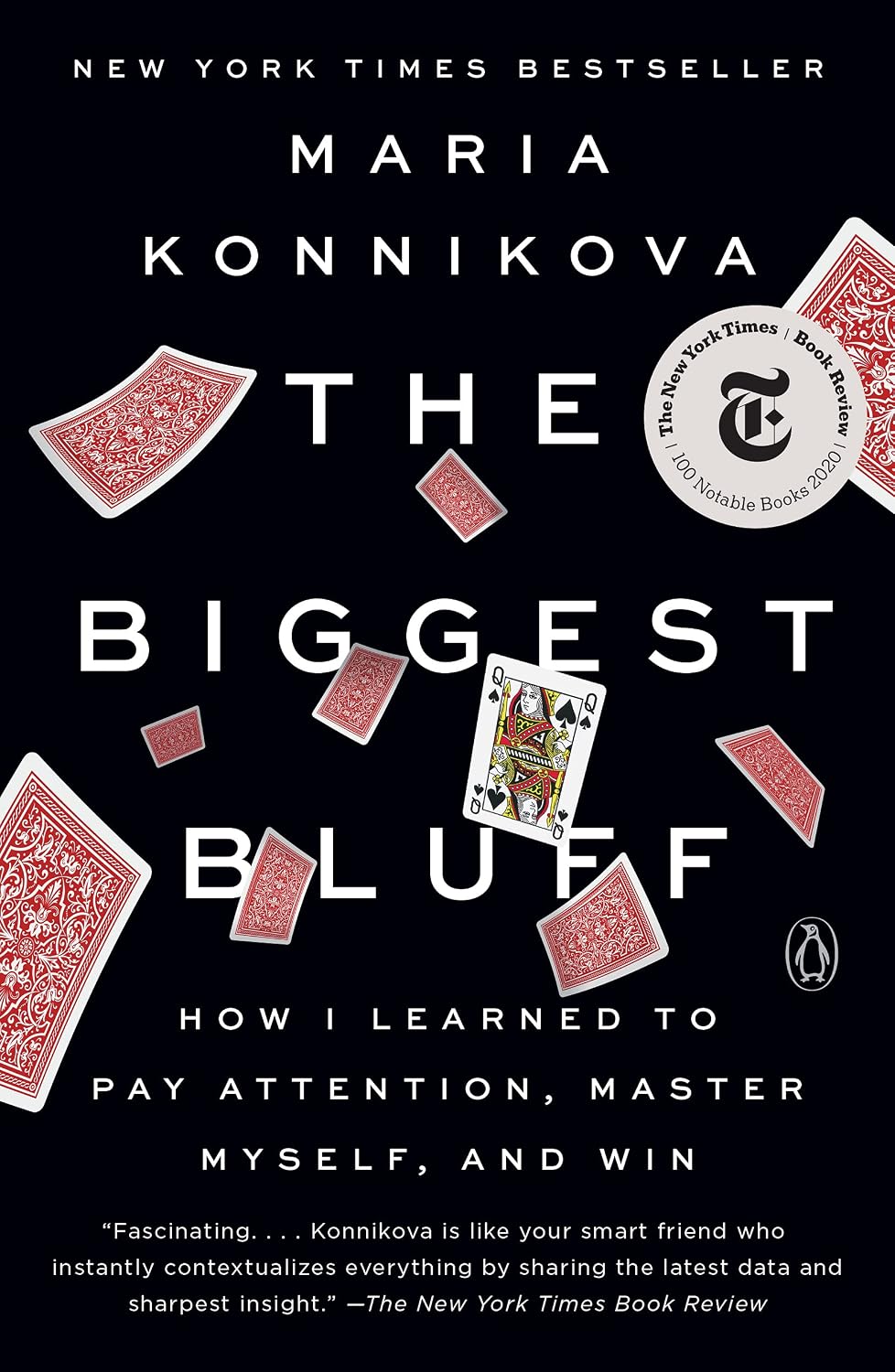
This is a great story about Maria Konnikova, a journalist with a Ph.D. in psychology, who set out to learn poker to better understand luck, skill, and human behavior. She’d never played a hand. Her goal was to work her way up to the World Series of Poker Main Event, with poker legend Erik Seidel as her mentor. What started as research for a book turned into much more. She became a successful professional poker player, learning lessons about herself and life along the way.
As a poker player myself, I found it fascinating. But you don’t need to play poker to get something out of it. It’s about self-mastery, psychology, luck, skill, paying attention, managing your emotions, making decisions with incomplete information, and recognizing what you can and can’t control. Poker is the setting. The lessons reach well beyond the felt.
Highlights
Erik's single piece of advice to aspiring poker players: pay attention.
Presence is far more difficult than the path of least resistance.
In study after study, people fail to internalize numeric rules, making decisions based on things like “gut feeling” and “intuition” and “what feels right” rather than based on the data they are shown.
“If we consider games of chance immoral, then every pursuit of human industry is immoral; for there is not a single one that is not subject to chance, not one wherein you do not risk a loss for the chance of some gain.” THOMAS JEFFERSON, “THOUGHTS ON LOTTERIES,” 1826
Poker isn’t just about calibrating the strength of your beliefs. It’s also about becoming comfortable with the fact that there’s no such thing as a sure thing—ever. You will never have all the information you want, and you will have to act all the same. Leave your certainty at the door.
Finding a good mentor is crucial to learning any new skill—and one of the things the best mentors do well is know when to delegate.
Erik has been clear from the beginning: certain markers have to be met before I can move forward in my poker journey. If I’m to work with him, I can’t skip steps. First I read and watch—read Harrington, watch streams with real hands being played by the best players. (“Sign up for Run It Once,”)
Erik has explained that the earlier you open, the stronger your hand needs to be, because more players are still to act. That makes sense. In any decision, information is power. The earlier you act, the less information you have.
Action Dan and Erik himself actually offer a pretty compelling case study by their success: Be solid, fundamentally. Cultivate the solid image. And then add the hyper-aggression, but at the right place and the right time. Not always, not continuously, but thinkingly. There’s never a default with anything. It’s always a matter of deliberation.
“If you want to be good in big tournaments,” Erik tells me, “like, let’s say you’re playing a field of four hundred people. You have to be involved in many more hands, because just good cards aren’t going to get you there. They’re not going to get you there a high enough percentage of the time.” And so despite knowing fundamentally sound strategy, you have to be willing to part with it. “It turns out that people who are sort of involved and reckless are more likely to go deep.” To go deep means to make it through a large portion of the field. “You just have to be smart about it.”
M, Erik explains, is a way of thinking about your position in a tournament. “You have to be aware of everyone’s stack size,” he tells me. Normally, people think of stack sizes in terms of big blinds. M takes it one step further, by quantifying your risk of going broke. How many orbits around the table can I sit and not play a hand? Your M is, basically, your cushion for putting in the minimum each orbit. The lower your M, the more in danger you are of busting the tournament sooner.
“You become a big winner when you lose,” Dan says. “Everyone plays well when they’re winning. But can you control yourself and play well when you’re losing? And not by being too conservative, but trying to still be objective as to what your chances are in the hand. If you can do that, then you’ve conquered the game.”
One of the keys to success, Erik says, if not the key, is objectivity. And objectivity is a hard thing to come by.
“You know that these swings happen, that there’s a randomness to the way these swings happen.”
“When things go wrong, other people see it as unfairness that’s always surrounding them,” he tells me. They take it personally. They don’t know how to lose, how to learn from losing. They look for something or someone to blame. They don’t step back to analyze their own decisions, their own play, where they may have gone wrong themselves. “It’s a really big handicap in life to think that way.
It’s like that great Kipling quote: ‘If you can meet with Triumph and Disaster, and treat those two impostors just the same . . . ’”
This is such a fundamental part of poker. The wins really go to people’s heads. And the losses—they can’t deal. It’s so easy to be delusional in this game,” he tells me.
When it comes to learning, Triumph is the real foe; it’s Disaster that’s your teacher. It’s Disaster that brings objectivity. It’s Disaster that’s the antidote to that greatest of delusions, overconfidence. And ultimately, both Triumph and Disaster are impostors. They are results that are subject to chance. One of them just happens to be a better teaching tool than the other.
Erik listened quietly and then told him one phrase: “Less certainty. More inquiry.” There is no certainty. There is only thought.
Poker is all about comfort with uncertainty, after all. Only I didn’t quite realize it wasn’t just uncertainty about the outcome of the cards. It’s uncertainty about the “right” thing to do. The only certain thing is your thinking.
‘The object of poker is not to make money, it's making good decisions.’ I think that’s a really good way to look at poker.”
“He will win who knows when to fight and when not to fight. He will win who knows how to handle both superior and inferior forces. He will win whose army is animated by the same spirit throughout all its ranks. He will win who, prepared himself, waits to take the enemy unprepared.” SUN TZU, THE ART OF WAR, 5TH CENTURY BC
In one of the first hands of the game, I raise an off-suit jack-ten from early position and receive multiple callers—that. “OK, we have a lot to talk about,” Erik says as the hand plays out without me “First, why did you raise there?”. “You can’t open that hand until much later,” Erik says. “There are just too many people behind you who can raise—and then you’ll be in a really bad spot for the rest of the hand.” Jack-ten: it’s a weapon whose value changes depending on when and how it’s deployed.
When you’re the person acting last, you have the best of it. You already know your opponents’ decisions, their plays, their opening bids. In a negotiation, you have the power. In an argument or debate, you have the power. You know more than they do. They have to initiate. You have the benefit of responding. Position is king.
But the most crucial mistake I made wasn’t necessarily the poor strategy—“You’ll get there, that’s the easier part,” Erik says—but the fact that I don’t have good reasons for most of my decisions.
“We’ve talked about this,” Erik says. “You have to have a clear thought process for every single hand.
“When you’re multiway,” Erik tells me, “you tend to have to be more straightforward.” There are simply too many variables to juggle.
My enemy. What are the weak points? The strong points? When do I defend? When do I attack? How do they behave when they’re strong? When they’re weak? Do they bluff too often? Not enough? Just right?
“You have to learn to pay attention to board texture,” Erik tells me. Is it a dry board, one where the cards don’t have much relation to one another—different suits, values spread far apart, making it unlikely that someone has a strong draw? Is it a wet board, one where the cards are closely connected—two or three of a suit, cards that could form a part of a straight, a landscape that means players who don’t yet have a strong hand can suddenly find themselves with a monster if a draw completes? Is it a static board—no new cards are likely to change the situation that much? Is it a dynamic board—many draws, like straights and flushes, are available, and any new addition is likely to change the advantage and can significantly change the value of your hand? The texture is the changing battleground. Different textures require different strategies.
Bet sizing and what it accomplishes is an incredibly useful analogue for most any decision. Do you need to send in the whole battalion where a handful of soldiers would do?
Not playing scared is not the same thing as being aggressive. You can be way too aggro and still scared. And being passive can be strong.”
Almost every time I play, I hear Erik telling me: “Pick your spots.” Any idiot can win any given hand with the best cards. That’s not the point of poker. You get dealt the best cards only every so often, and if you wait for them every time, your chips will run out. And in order to do that, you need to learn to pick your spots: know when to be aggressive, and how to be aggressive.
There’s a false sense of security in passivity. You think that you can’t get into too much trouble—but really, every passive decision leads to a slow but steady loss of chips.
“What was the hand?” He leans back in his chair, shoving his cards lightly into the middle of the table—he’s folding this one. I tell him about the ill-fated king-jack, omitting all the details that I’m still too angry about to share. “Yeah. You shouldn’t have played that,” he says matter-of-factly, never shy in pointing out mistakes. “I probably play king-jack less than most players. It’s just not a good hand.”
Once you gain proficiency, you also lose perspective. You go on autopilot—I’ve got this covered; I can even check my phone while behind the wheel, I’m that good. That, of course, is when you’re most susceptible to bad luck.
No skill: chance looms high. Relatively high skill: chance recedes. Expert level: you once again see your shortcomings and realize that no matter your skill level, chance has a strong role to play. In poker and in life, the learning pattern is identical.
“You never can tell whether bad luck may not after all turn out to be good luck. . . . One must never forget when misfortunes come that it is quite possible they are saving one from something much worse; or that when you make some great mistake, it may very easily serve you better than the best-advised decision.” WINSTON CHURCHILL, “MY EARLY LIFE,” 1930
You’ll never get good unless you put in the hours,” Erik says. “And you learn best when you’re playing every day.”
Until I start winning the $40 tournaments, I can’t play in the $140 ones.
Indeed, one of the secrets to Erik’s success is his ability to stay calm even in the downturns. “One area where I seem to be good,” he tells me in an uncharacteristic moment of saying something positive about himself, “is that the financial swings have always been manageable for me. I get through them.
True skill is knowing your own limits—and the power of variance in the immediate future. Because who knows how long “immediate future” might last? After all, probability distributions don’t care about the past.
“Look, every player is going to want to tell you about the time their aces got cracked. Don’t be that player,” he continues. “Bad beats are a really bad mental habit. You don’t want to ever dwell on them. It doesn’t help you become a better player. It’s like dumping your garbage on someone else’s lawn. It just stinks.”
“Focus on the process, not the luck. Did I play correctly? Everything else is just BS in our heads,” Erik tells me. “Thinking that way won’t get you anywhere.
How we frame something affects not just our thinking but our emotional state. It may seem a small deal, but the words we select—the ones we filter out and the ones we eventually choose to put forward—are a mirror to our thinking. Clarity of language is clarity of thought—and the expression of a certain sentiment, no matter how innocuous it seems, can change your learning, your thinking, your mindset, your mood, your whole outlook. As W. H. Auden told an interviewer, Webster Schott, in a 1970 conversation, “Language is the mother, not the handmaiden of thought; words will tell you things you never thought or felt before.” The language we use becomes our mental habits—and our mental habits determine how we learn, how we grow, what we become. It’s not just a question of semantics: telling bad beat stories matters. Our thinking about luck has real consequences in terms of our emotional well-being, our decisions, and the way we implicitly view the world and our role in it. There is no such thing as objective reality. Every time we experience something, we interpret it for ourselves. How we phrase sentences—are we the one doing the acting or being acted upon?—can determine whether we have an internal or external locus of control, whether we’re masters of our fates or peons of forces beyond us. Do we see ourselves as victims or victors? A victim: The cards went against me. Things are being done to me, things are happening around me, and I am neither to blame nor in control. A victor: I made the correct decision. Sure, the outcome didn’t go my way, but I thought correctly under pressure. And that’s the skill I can control.
If you suffer a bad beat in life, it may set you back considerably more—and last a lot longer. All of a sudden, your framing matters significantly more. A victim of the cruel cards? This may serve as something I think of as a luck dampener effect: because you’re wallowing in your misfortune, you fail to see the things you could be doing to overcome it. Potential opportunities pass you by; people get tired of hearing you complain, so your social network of support and opportunities also dwindles; you don’t even attempt certain activities because you think, I’ll lose anyway, why try?; your mental health suffers; and the spiral continues.
Erik will pull me aside in a big tournament and tell me he’s worried about my thinking. I’m describing things as happening to me rather than taking responsibility for my actions. The great players don’t play that way. It’s too draining, and it makes you too much the victim. And the victim doesn’t win. Bad table draw? It’s a challenging table that will force you to play well. You can’t change tables, so you may as well call on all your inner powers to play the best version of your game. See it as an opportunity to learn. Card dead? No one knows that. If your face reads card dead, everyone will walk all over you as you meekly fold. If you decide to take the opportunity to cultivate a conservative image and then make a well-timed move, suddenly you have the upper hand. The best players don’t need pocket aces to win. Everything is in how you perceive it.
It’s the old glass half-full versus half-empty, except we live it all the time without realizing it. Bad beats drag you down. They focus your mind on something you can’t control—the cards—rather than something you can, the decision. They ignore the fact that the most we can do is make the best decision possible with the information we have; the outcome doesn’t matter. If you choose wisely, you should make that same choice over and over. Focusing on the unlucky runout is just toxic—and even if you’re not putting the garbage in someone’s yard, it’s already poisoning your mind and making you less able to execute clearheaded decisions in the future.
“Let’s make a deal,” Erik says. “I don’t care about the result of the hand. I don’t care if you won or lost. When you’re telling me hands, don’t even say how it ended. I want you to do your best to forget how it ended yourself. That won’t help you.”
Erik nods. “When you’re at the table, the amount of focus that you can generate is really rewarded,”
“Choice of attention—to pay attention to this and ignore that—is to the inner life what choice of action is to the outer. In both cases man is responsible for his choice and must accept the consequences.”
Attention is a powerful mitigator to overconfidence: it forces you to constantly reevaluate your knowledge and your game plan, lest you become too tied to a certain course of action. And if you lose? Well, it allows you to admit when it’s actually your fault and not a bad beat. But paying attention is one of the best ways I can see of minimizing the window for negative variance to peek through.
“Where observation is concerned, chance favors only the prepared mind.” We tend to focus on that last part, the prepared mind. Work hard, prepare yourself, so that when chance appears, you will notice it. But that first part is equally crucial: if you’re not observing well, observing closely to begin with, no amount of preparation is enough. The one is largely useless without the other.
You’re not lucky because more good things are actually happening; you’re lucky because you’re alert to them when they do.
William Beveridge writes in The Art of Scientific Investigation. If we want to be successful, “we need to train our powers of observation, to cultivate that attitude of mind of being constantly on the look-out for the unexpected and make a habit of examining every clue that chance presents.” We can’t control the variance. We can’t control what happens. But we can control our attention and how we choose to deploy it.
Chewy, it turns out, also has an incredibly Zen attitude toward losing. Like Dan Harrington, he firmly believes that losing is essential to learning how to win—but the attitude toward loss is a very different one. Where Dan views it as a way of teaching yourself strategic lessons and analyzing your game, finding your mistakes and plugging your leaks, Chewy sees it in more cosmic terms. When he loses, he sees the loss as part of a larger pattern.
Philosophically, it’s a powerful way of viewing life. (“Poker is exactly like life, but with instant karma,” Chewy remarks.)
“Some people just become overly emotionally invested in their sadness and their misfortune,” he says. “They forget to be grateful to be in the tournament, and then they lose their remaining chips.” That’s a bad attitude. Not only do you feel bad, but your decision making suffers. “Everybody has a great opportunity to succeed and prosper at whatever they do, and everyone has some kind of unique gift. And I see that oftentimes, the most difficulty we cause ourselves is kind of fighting against the grain of what is healthy for us.”
“What you need to know first and most important of all is that poker is storytelling,” he says. It’s a narrative puzzle. Your job is to put together the pieces. “In the game of poker, you’re a detective and a storyteller,” he tells me. “You must figure out what your opponent’s actions mean, and sometimes more importantly, what they don’t mean.” “You have to poke holes in the story he’s trying to tell, and from that, deduce what he’s trying to hide.”
“You’re constructing your own story at the same time, doing everything you can to make sure it will add up.” In other words, before you do anything, think ahead to how that action fits into your narrative arc. If it doesn’t, well, perhaps it won’t work out the way you’d like it to. You need to be aware enough of your own narrative that it coheres, comes together, makes sense. “The times I have my largest advantages over an opponent are when they think the story they’re telling makes sense—and I know that it doesn’t,” he tells me. “I know how they’d play certain hands better than they do.”
In poker, it’s much the same thing. You need to find the motivation to find the narrative cohesiveness. What is this person’s story—and does what they are doing make sense given what you know? Identifying motivation is key if I’m ever to become anything other than a merely competent player. Always ask why: Why is someone acting this way? Why am I acting this way? Find the why and you find the key to winning. “That’s my challenge to you,” Phil says. Never do anything, no matter how small it may seem, without asking why, precisely, you’re doing it. And never judge anything others do without asking the same question. “Every action your opponent takes has a reason behind it, whether conscious or unconscious,” he says.
“Even terrible players make the plays they make for a reason, and it’s your job to figure it out,” he tells me. “When a hand is shown down, try to walk back through your opponent’s decision and come up with reasons they might have had for taking the actions they did.” Don’t judge them.
“Generally speaking,” Erik begins, “your tournament cash rate should be around twenty, twenty-five percent. Not fifty percent.” What? I’m cashing too much? How is that a bad thing? “You need to be playing for the win, not for the min cash. Be willing to bust more often, take the higher variance lines that might mean I lose all my chips—but if I win, will propel me into a far more commanding position to go deeper, last longer, get closer to that final table. Be willing to be more aggressive even if that means losing more. There’s a saying in poker that if you’re never caught in a bluff, you’re not bluffing enough. “Good players are going to realize if the min cash is important to you,” Erik says. “And they’re going to take advantage of that. They’ll really abuse you.”
Do I do that often? I find myself asking. Do I go for the min cash in my life decisions, holding on for the safer sure thing rather than taking more risk for the more uncertain but ultimately more attractive option? Do I lack gamble in my life? Do I let myself be taken advantage of by people who recognize the fright behind my eyes? I’m not sure I’m prepared to know the answer.
Our brains, it turns out, are veritable prediction machines. We are constantly making sense of the environment—and making guesses about what will happen. It’s called predictive processing: we actively think one step ahead and look at the environment accordingly. Our brains are more proactive than reactive. Whether our predictions are accurate or not, of course, depends on the inputs and the prediction-making process. Whether they improve in accuracy or not over time depends on our capacity and willingness to learn.
I recheck my cards several times. “The moment you recheck your cards, you risk falling into a pattern,” he warns. Some players recheck only their marginal hands—it’s easy to remember when you have pocket kings, but you may need to double-check if you have five-six suited or six-seven.
Suspect action number two: the way I put my hands on my cards. “Just don’t do it. No hands on cards, ever,” Blake warns. People tend to place their hands on their cards in different ways with different parts of their range—one style of motion when strong, another when marginal. In fact, he says, don’t put anything on your cards. “Almost every time a player puts a chip on a card, it’s a tell,” Blake says. It’s not the placement of the chip as such. It’s the style with which you do it.
“Before each action, stop, think about what you want to do, and execute,” Blake suggests.
Because I’ve thought before I acted, I act with confidence every time—and I act with a delay every time.
People aren’t a combination of traits. They are a mosaic of reactions to and interactions with situations.
They can’t be separated. And as I’m learning, the craft of poker certainly cannot be mastered without self-knowledge, self-care, and self-reflection.
Erik beforehand; there’s a difference between knowing what you’re supposed to do and actually having the nerve to do it in the moment.
No matter how good your starting hand, you have to be willing to read the signs to let it go.
“Ignore the average,” Erik implores. “Just focus on how many blinds you have.
Jared stops me. “That word you just used.” What word? “Hope. Hope has its place in the world, but when it comes to poker, it really doesn’t belong,” he says. “As far as hope in poker, fuck it.” Interesting. I’d thought hope was a tenet of mental health. In some sense, yes. But not in the sense of making me a mentally strong player. “You need to think in terms of preparation. Don’t worry about hoping. Just do.”
Norbert Schwarz and Gerald Clore, social psychologists who spent multiple decades studying the varying effects of mood on our thoughts and outcomes, have argued that in the right context, emotions can be powerful drivers of correct choice: the emotion just needs to be integral to the decision, rather than incidental to it. Touching a hot stove makes you feel pain and anger—and you avoid touching the stove in the future. By anticipating the negative emotion caused by pain, you make a more prudent choice the next time around. We experience emotions for a reason, and the goal is not to stop experiencing them. Instead, the goal is to learn to identify our emotions, analyze their cause, and if they’re not actually part of our rational decision process—and more often than not, they aren’t—dismiss them as sources of information.
We take a twenty-minute break. Jared has created a routine for me, and I now follow it by the minute. First five minutes of break: off-load and brain dump. I write down some of the key hands so that they don’t occupy any of my headspace going forward. I’ll analyze them later with Erik. For now, the important thing is to get them out of my system so that my mind is ready for new information. Then a few minutes of contemplating my decision making. Asking myself: How was my thinking? Were there any emotionally compromised decisions? Again, I’m not analyzing now, just noting for the future. Next ten minutes: nothing. No poker talk. No thinking. Just walking and relaxing. And then, right before the end of break, a few minutes of warm-up for the next level.
I remember what Phil Galfond told me all those months ago over dinner in Vegas. Retell the story from the beginning. Does the narrative flow—or are there logical gaps?
“Luck is not something you can mention in the presence of self-made men,” E. B. White wrote during World War II. “The Society of Movers and Doers is a very pompous society, indeed, whose members solemnly accept all responsibility for their own eminence and success.”
“Denying luck individually is to suggest that we have much greater agency than we really have over outcomes in our lives.”
Belief is a powerful thing. Our mental state is crucial to our performance. And ultimately, while some superstitions may give you a veneer of false confidence, they also have the power to destroy your mental equilibrium.
But one thing that poker has given me are the very skills necessary to deal with the chaos that can be thrown at you from outside the poker table. Experiencing smaller one-off events over and over during play has taught me both the mathematical and the emotional forbearance to accept them for what they are—and to emerge on the other side.
“Those afraid of the universe as it really is, those who wish to pretend to non-existent knowledge and control and a Cosmos centered on human beings, will prefer superstition,” Sagan concludes. “But those with the courage to explore the weave and structure of the Cosmos, even where it differs profoundly from our wishes and prejudices, to those people belongs the future. Superstitions may be comforting for a while. But, because they avoid rather than confront the world, they are doomed. The future belongs to those able to learn, to change, to accommodate to this exquisite Cosmos that we have been privileged to inhabit for a brief moment.”
Nothing is all skill. Ever. I shy away from absolutes, but this one calls out for my embrace. Because life is life, luck will always be a factor in anything we might do or undertake. Skill can open up new vistas, new choices, allow us to see the chance that others less skilled than us, less observant or less keen, may miss—but should chance go against us, all our skill can do is mitigate the damage.