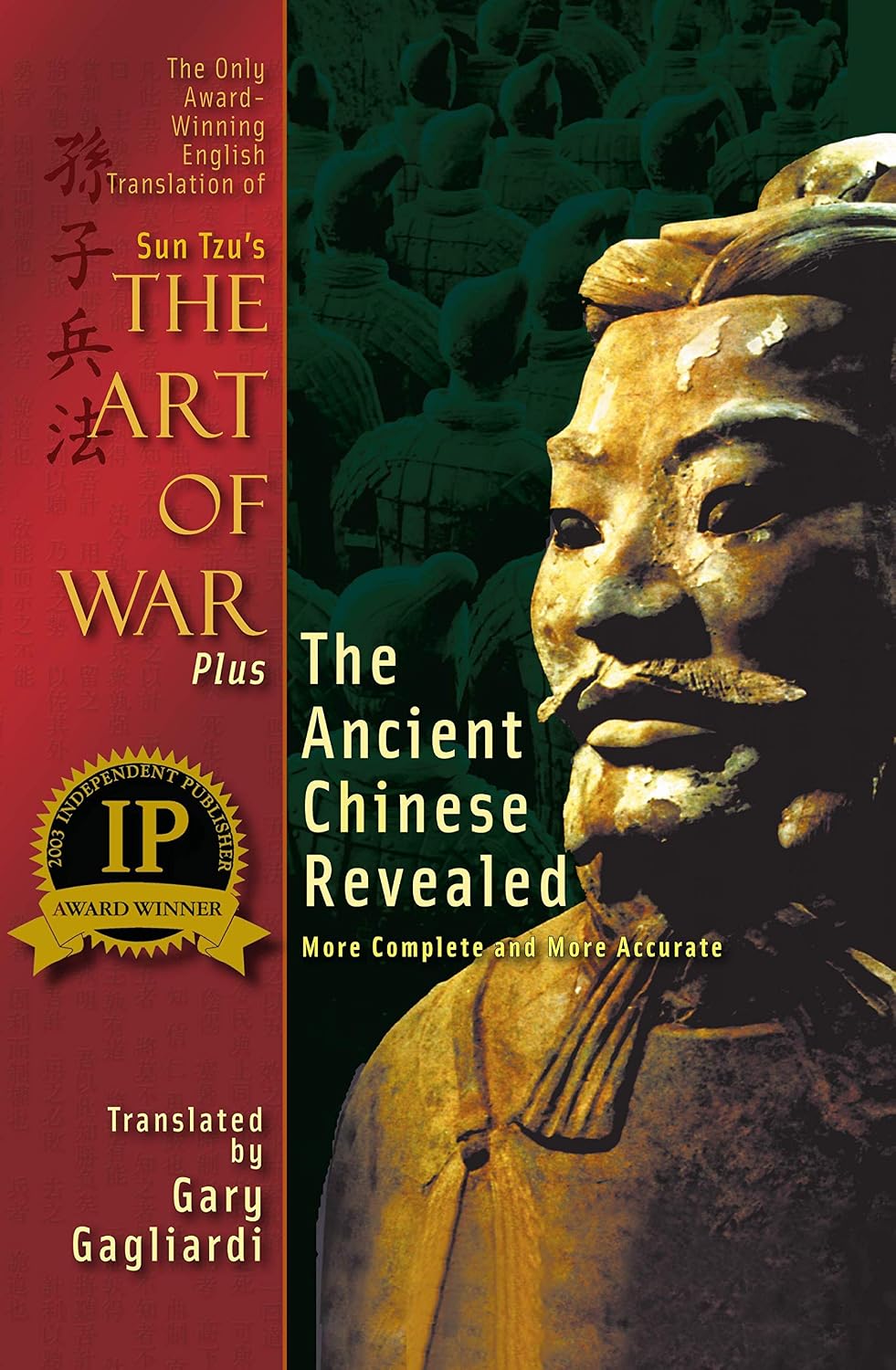
- Rating
- 10/10
- Read
- September 2014
- Why I read it
- Initially, I read it to improve my poker game. While reading, I realized the philosophies and strategies can and should be applied to business and life as well.
- What I took from it
- Strategy
- My favorite idea
- Only your enemy can allow you to win.
I first read The Art of War around 2005, when I was about 22 and had just started playing poker seriously. I’ve read a few translations since, and this one is the easiest to read. Written roughly 2,400 years ago, Sun Tzu’s The Art of War is a Chinese philosophical manual on strategy that applies just as well to poker, business and life.
Highlights
Warfare is one thing. It is a philosophy of deception. 3When you are ready, you try to appear incapacitated. When active, you pretend inactivity. When you are close to the enemy, you appear distant. When far away, you pretend you are near.
Manage to avoid
battle until your organization can count on certain victory.
The best policy is to attack while the enemy is still planning.
Victory comes from knowing when to attack and when to avoid battle.
Victory comes from finding opportunities in problems.
We say: “Know yourself and know your enemy. You will be safe in every battle. You may know yourself but not know your enemy. You will then lose a battle for every one you win. You may know neither yourself nor your enemy. You will then lose every battle.”
You pay attention to your enemy to find the way to win.
You alone can deny victory to the enemy.
Only your enemy can allow you to win.
We say: You can recognize the opportunity for victory; you don’t create it. Position:
You are sometimes unable to win. You must then defend. You will eventually be able to win. You must then attack. Defend when you have insufficient strength. Attack when you have a surplus of strength.
ou must engage only in winning battles. Position yourself where you cannot lose. Never waste an opportunity to defeat your enemy.
You win a war by first assuring yourself of victory. Only afterward do you look for a fight.
This is the art of war: “1. Discuss the distances. 2. Discuss your numbers. 3. Discuss your calculations. 4. Discuss your decisions. 5. Discuss victory.
You control a large group the same as you control a few. You just divide their ranks correctly. You fight a large army the same as you fight a small one. You only need the right position and communication.
A hawk suddenly strikes a bird. Its contact alone kills the prey. This is timing.
You must create only winning battles. Your momentum must be overwhelming. Your timing must be exact.
Chaos gives birth to control. Fear gives birth to courage. Weakness gives birth to strength.
You have strengths and weaknesses. These come from your position.
You must force the enemy to move to your advantage.
Be skilled in attacking. Give the enemy no idea where to defend.
11Be skillful in your defense. Give the enemy no idea where to attack.
Always pick your own battles.
Avoid the battles that you don’t want.
8Manage your military position like water. Water takes every shape. It avoids the high and moves to the low. Your war can take any shape.
Make war without a standard approach. Water has no consistent shape. If you follow the enemy’s shifts and changes, you can always find a way to win. We call this shadowing.
Don’t entice the enemy when his ranks are orderly. You must not attack when his formations are solid. This is how you master adaptation.
Do not follow those who pretend to flee.
Do not attack the enemy’s strongest men.
Do not swallow the enemy’s bait.
Do not press a desperate foe.
You must be creative in your planning. You must adapt to your opportunities and weaknesses.
Your enemy speaks humbly while building up forces. He is planning to advance. The enemy talks aggressively and pushes as if to advance. He is planning to retreat. Small vehicles exit his camp first. They move the army’s flanks. They are forming a battle line. Your enemy tries to sue for peace but without offering a treaty. He is plotting. Your enemy’s men run to leave and yet form ranks. You should expect action. Half his army advances and the other half retreats. He is luring you. Your enemy plans to fight but his men just stand there. They are starving. Those who draw water drink it first. They are thirsty. Your enemy sees an advantage but does not advance. His men are tired.
If you are too weak to fight, you must find more men. In this situation, you must not act aggressively.
We say: Know the enemy and know yourself. Your victory will be painless. Know the weather and the field. Your victory will be complete.