- Rating
- —/10
- Read
- October 2012
- Why I read it
- What I took from it
- My favorite idea
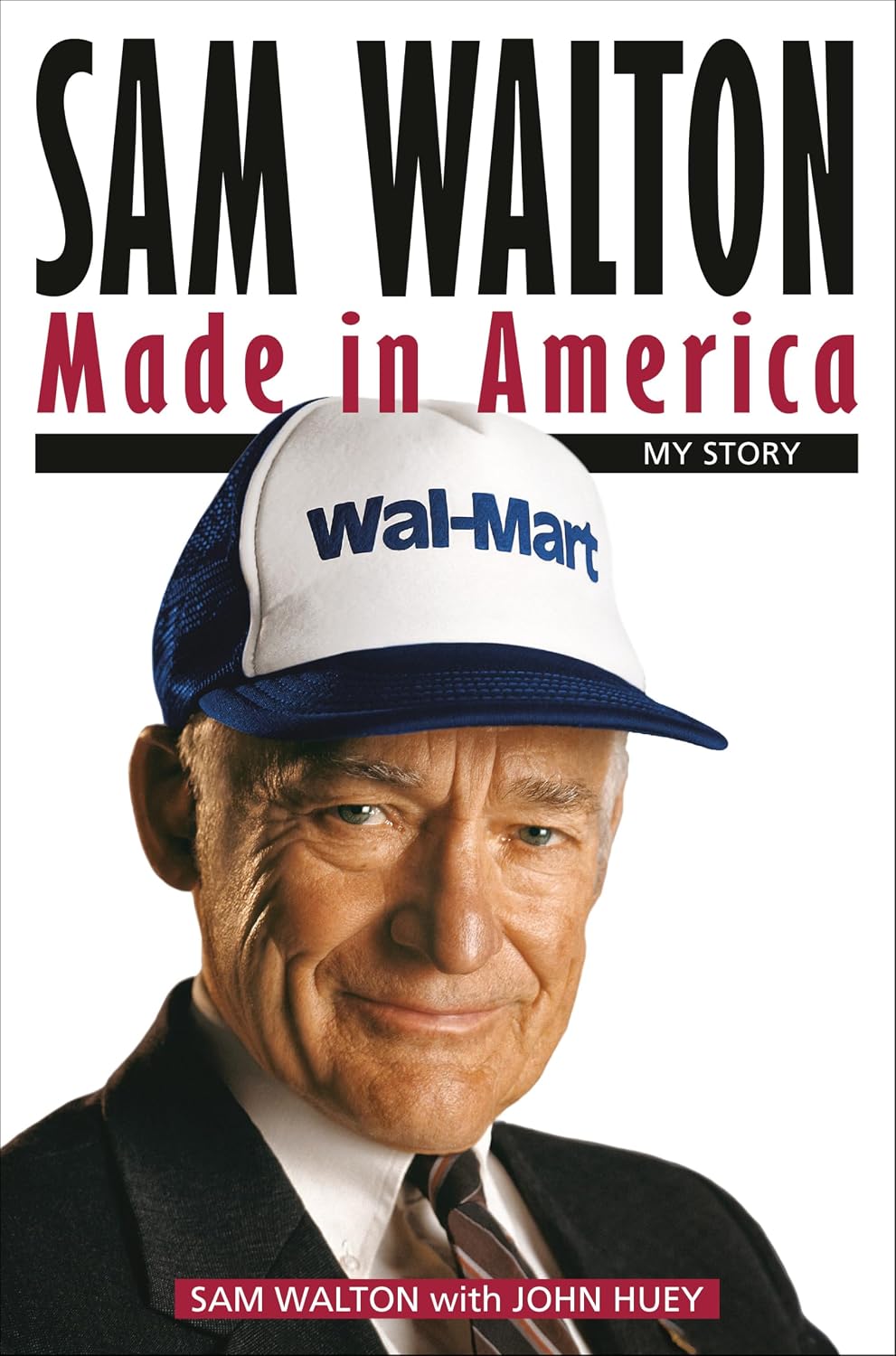
This may have been the first autobiography I read, and if I hadn’t read it, I’m not sure I would’ve picked up another. There’s so much to learn from Walton’s story. He was 44 when he opened the first Walmart, obsessed over price and expenses, borrowed good ideas wherever he found them (mostly from competitors), and constantly figured out creative ways around problems. More than anything, I love how candid the book is about how he thought, competed, made decisions, and built Walmart into the largest retailer in America.
Highlights
It never occurred to me that I might lose; to me, it was almost as if I had a right to win. Thinking like that often seems to turn into sort of a self-fulfilling prophecy.
Ever since high school, I had made all my own money and paid for all my own clothes.
he could sell more than anybody else.
I learned a lesson which has stuck with me all through the years: you can learn from everybody. I didn’t just learn from reading every retail publication I could get my hands on, I probably learned the most from studying what John Dunham was doing across the street.
But it didn’t take me long to start experimenting—that’s just the way I am and always have been.
I had lots of arguments with manufacturers. I would say, “I want to buy these ribbons and bows direct. I don’t want you to sell them to Butler Brothers and then I have to pay Butler Brothers 25 percent more for them. I want it direct.”
I was always looking for offbeat suppliers or sources.
If you’re interested in “how Wal-Mart did it,” this is one story you’ve got to sit up and pay close attention to.
selling them at three pair for $1.00.
Here’s the simple lesson we learned—which others were learning at the same time and which eventually changed the way retailers sell and customers buy all across America: say I bought an item for 80 cents. I found that by pricing it at $1.00 I could sell three times more of it than by pricing it at $1.20. I might make only half the profit per item, but because I was selling three times as many, the overall profit was much greater.
In retailer language, you can lower your markup but earn more because of the increased volume.
now. We tried a lot of promotional things that worked really well. First, we put a popcorn machine out on the sidewalk, and we sold that stuff like crazy. So I thought and thought about it and finally decided what we needed was a soft ice cream machine out there too.
It was new and
different—
I think my constant fiddling and meddling with the status quo may have been one of my biggest contributions to the later success of Wal-Mart.
By now, I was real involved in the community and kept my ear to the ground pretty good,
I hustled down to Hot Springs, to find the landlady of that Kroger building. Somehow, I convinced her to give me the lease, instead of giving it to Sterling.
Our money was made by controlling expenses. That, and Sam always being ingenious. He never stopped trying to do something different.
I was a member of the church’s board of deacons, was active in the Rotary Club, and had become president of the Chamber of Commerce as well as head of its industrial committee. I was pretty much involved in everything around town.
crazy thing we tried
I’ve never been one to dwell on reverses, and I didn’t do so then. It’s not just a corny saying that you can make a positive out of most any negative if you work at it hard enough. I’ve always thought of problems as challenges, and
only even better this time.
Still, I love competition,
THREET, CLERK, WALTON’S FIVE AND DIME, BENTONVILLE: “I guess Mr. Walton just had a personality that drew people in. He would yell at you from a block away, you know. He would just yell at everybody he saw, and that’s the reason so many liked him and did business in the store.
brought in business by his being so friendly. “He was always thinking up new things to try in the store.
unlike the competition.
We were innovating, experimenting, and expanding.
so I did something I would do for the rest of my run in the retail business without any shame or embarrassment whatsoever: nose around other people’s stores searching for good talent. That’s when I made my first real hire, the first manager, Willard Walker.
doing—most everything I’ve done I’ve copied from somebody else—
“Two things about Sam Walton distinguish him from almost everyone else I know. First, he gets up every day bound and determined to improve something. Second, he is less afraid of being wrong than anyone I’ve ever known. And once he sees he’s wrong, he just shakes it off and heads in another direction.”
I began looking around hard for whatever new idea would break us over into something with a little better payoff
Of course I wasn’t about to sit there and become a target.
Sam Walton wasn’t the kind of guy you issued ultimatums to.”
experimenting, trying to do something different, educating ourselves as to what was going on in the retail industry and trying to stay ahead of those trends.
I’m a pretty conservative guy. But for some reason in business, I have always been driven to buck the system, to innovate, to take things beyond where they’ve been.
Many of our best opportunities were created out of necessity. The things that we were forced to learn and do, because we started out underfinanced and undercapitalized in these remote, small communities, contributed mightily to the way we’ve grown as a company. Had
The idea was simple: when customers thought of Wal-Mart, they should think of low prices and satisfaction guaranteed.
We all worked together, but each of them had lots of freedom to try all kinds of crazy things themselves.
“Sam is very sharp on being able to read people
and their personalities, and their integrity, and he didn’t make any mistakes back there picking people,
You know, he’s a very persuasive man; he could charm a bird out of a tree.
He was progressive.
And we looked for the action-oriented, do-it-now, go type of folks.
‘Go ahead and try it.’ He would always try things like that. He was always open to suggestions, and that’s one reason he’s been such a success. He’s still that way.”
But we all loved to find unusual items and the store managers had a lot of freedom to try different things.
had to send in a Best Selling Item. I mean we had to. What he was doing was teaching us to look for what’s selling all the time.
But the thing was so big it made the news, and everybody came to look at it, and it was all gone in a week.
I’ll tell you, Phil not only liked to swim
upstream, he liked to do it with weights strapped on just to show he could do it.
“We have a lot of fun with all this item promotion, but here’s what it’s really all about. The philosophy it teaches, which rubs off on all the
associates and the store managers and the department heads, is that your stores are full of items that can explode into big volume and big profits if you are just smart enough to identify them and take the trouble to promote them.
“I remember him saying over and over again: go
in and check our competition. Check everyone who is our competition. And don’t look for the bad. Look for the good. If you get one good idea, that’s one more than you went into the store with, and we must try to incorporate it into our company. We’re really not concerned with what they’re doing wrong, we’re concerned with what they’re doing right, and everyone is doing something right.”
We paid absolutely no attention whatsoever to the way things were supposed to be done,
“The next morning he would talk some janitor or somebody into letting us in the building,
frugal is probably a good word for it.
Sam never went by a Kmart that he didn’t stop and look at it.”
‘Do anything you’re big enough to do.’
Anybody who has ever known anything about me knows I was never in anything for the short
haul;
I read in some trade publication not long ago that of the top 100 discounters who were in business in 1976, 76 of them have disappeared. Many of these started with more capital and
visibility than we did, in larger cities with much greater opportunities.
I started thinking about what really brought them down, and why we kept going. It all boils down to not taking care of their customers, not minding their stores, not having folks in their stores with good attitudes, and that was because they never really even tried to take care of their own people.
If you want the people in the stores to take care of the customers, you have to make sure you’re taking care of the
people in the stores. That’s the most important single ingredient of Wal-Mart’s success.
“Hi, I’m Sam Walton from Bentonville, Arkansas. We’ve got a few stores out there, and I’d like to visit with Mr. So-and-So”—whoever the head of the company was—“about his business.” And as often as not, they’d let me in, maybe out of curiosity, and I’d ask lots of questions about pricing and distribution, whatever. I learned a lot that way.
When he meets you, he looks at you—head cocked to one side, forehead slightly creased—and he proceeds to extract every piece of information in your possession. He always makes little notes. And he pushes on and on.
Sam never did anything in size or volume until he actually had to. He always played it close to the belt.”
It’s true enough that I was nervous about spending any unnecessary money in those days.
I also let them know they were going to have to
compete for our business, just like I’ve always made everybody else compete for business with us. Also,
Sam was always one to shop around.
In those days, Kmart wasn’t going to towns below 50,000,
and even Gibson’s wouldn’t go to towns much smaller than 10,000 or 12,000. We knew our formula was working even in towns smaller than 5,000 people, and there were plenty of those towns out there for us to expand into.
“Oh, they went into small towns when nobody else would.”
From the very beginning, we never believed in spending much money on advertising,
When you
move like we did from town to town in these mostly rural areas, word of mouth gets your message out to customers pretty quickly without much advertising.
By doing it this way, we usually could get by with distributing just one advertising circular a month instead of running a whole lot of
newspaper advertising.
We’ve never been big advertisers, and, relative to our size today, we still aren’t. Just
I had traveled so much myself looking at competitors in the variety store business that I had a good feel for the kind of potential in these communities.
before we signed any kind of commitment. A good location, and what we have to pay for it, is so important to the success of a store.
remember one time I didn’t want to spend any money on motels so we all slept in sleeping bags on the floor of one of our guys’ houses. His furniture hadn’t gotten there yet.
I’ve played to my strengths and relied on others to make up for my weaknesses.
As I mentioned, I found out early that one of my talents is remembering numbers.
But if you asked me am I an organized person, I would have to say flat out no, not at all. Being organized would really slow me down. In
I try to keep track of what I’m supposed to do, and where I’m supposed to be, but it’s true I don’t keep much of a schedule. I
“I think one of Sam’s greatest strengths is that he is
totally unpredictable. He is always his own person, totally independent in his thinking.
So while we may not have had any competition for discounting in those little towns, we weren’t strangers to competition.
We were always looking at Gibson’s and any other regionals that might decide to come our way, and we knew what to do when they did:
keep our prices as low as possible by keeping our costs as
low as possible.
Sam would take people with hardly any retail experience, give them six months with us, and if he thought they showed any real potential to merchandise a store and manage people, he’d give them a chance. He’d make them an assistant manager. They were
If you take someone who lacks the experience and the know-how but has the real desire and the willingness to work his tail off to get the job done,
he’ll make up for what he lacks.
of. By now, I was really surrounding myself with guys who were good at all the things I tended to just sluff off,
‘We want you to
come in and write up our policies and procedures for us.’ I said, ‘Well, that’s nice, but that’s not really what I would like to do. I want to work with the merchandising people.’ And Sam said, ‘Well, we would kind of like you to do it anyway. How long do you think it will take to do it?’ I knew from experience it would take six months to a year to properly do this job. But I said, ‘I’ll do it in ninety days.’ Sam replied, ‘You’ve got sixty days.’
Sam never wants to wait for anything. He has no patience.
They were so accustomed to getting their 45 percent markup, they never let go.
later became the foundation of Wal-Mart’s success. You see, no matter how you slice it in the retail business, payroll is one of the most important parts of overhead, and overhead is one of the most crucial things you have to fight to maintain your profit margin.
be another of those paradoxes—like the discounters’ principle of the less you charge, the more you’ll earn. And here it is: the more you share profits with your associates—whether it’s in salaries or incentives or bonuses or stock discounts—the more profit will accrue to the company. Why? Because the way management treats the associates is exactly how the associates will then treat the customers.
And if the associates
treat the customers well, the customers will return again and again, and that is where the real profit in this business lies, not in trying to drag strangers into your stores for one-time purchases based on splashy sales or expensive advertising.
Union organized a strike against us when we opened store number 20 in Clinton, Missouri,
take care of your people, treat them well, involve them, and you won’t spend all your time and money hiring labor lawyers to fight the unions.
There’s been all sorts of debate over why we chose to call our employees “associates,”
he always stopped to look in stores wherever we went—anywhere in the world, it didn’t matter.
I learned this early on in the
variety store business: you’ve got to give folks responsibility, you’ve got to trust them, and then you’ve got to check on them.
and I pursued them both very competitively.
He studied his opponents’ games, and he knew our strengths and weaknesses as well as his own.
shots, and we got to be pretty competitive over the hunting.
As I said back when we lost that first lease in Newport, most setbacks can be turned into opportunities.
And as things turned out, this setback presented us with one of the great
opportunities in our company’s history.
From day one, we just always found the folks who had the qualities that neither Bud nor I had.
do. And, as I’ve said, we’ve certainly borrowed every good idea we’ve come across.
As I told you, we’d have these huge sidewalk sales, and we’d have bands and little circuses in our parking lots to get folks to those sales.
We’d have plate drops, where we’d write the names of
prizes on paper plates and sail them off the roofs of the stores. We’d have balloon drops. We’d have Moonlight Madness sales, which usually would begin after normal closing hours and maybe last until midnight, with some new bargain or promotion being announced every few minutes.
We’d play shopping-cart bingo—where each shopping cart has a number, and if your number is called, you get a discount on whatever you have in the cart.
At store openings, we’d stand on the service counters and give away boxes of candy to
the customers who had traveled the farthest to get there. As long as it was fun, we’d try it.
One year, on George Washington’s birthday, Phil Green (remember the world’s largest Tide display?) ran an ad saying his Fayetteville store was selling a television set for twenty-two cents—the birthday being on February 22. The only hitch was that before you could buy that television set you had to find it first. Phil had hidden it somewhere in the store, and the first person to
find it, got it. When Phil arrived at the store that morning, there was such a crowd out front that you couldn’t even see the doors.
Here are a few of the crazy kinds of things I’m talking about:
—Our Fairbury, Nebraska, store has a “precision shopping-cart drill team” that marches in local parades. The members all wear Wal-Mart smocks and push their carts through a routine of whirls, twirls, circles, and crossovers.
—Our Cedartown, Georgia, store holds a kiss-the-pig contest to raise money for charity. They set out jars with each manager’s name on
them, and the manager whose jar winds up with the most donations has to kiss a pig. —Our New Iberia, Louisiana, store fields a cheer-leading squad called the Shrinkettes. Their cheers deal mostly with, what else? cutting shrinkage: “WHAT DO YOU DO ABOUT SHRINKAGE? CRUSH IT! CRUSH IT!” The Shrinkettes stole the show at one of our annual
meetings with cheers like: “CALIFORNIA ORANGES, TEXAS CACTUS, WE THINK KMART COULD USE SOME PRACTICE!”
—Our Fitzgerald, Georgia, store won first place in the Irwin County Sweet Potato Parade with a float featuring seven associates dressed as fruits and vegetables grown in south Georgia. As they passed the judging stand, the homegrown
fruits and vegetables did a homegrown Wal-Mart cheer.
Eating Contest. I already told you how I pushed Moon Pies as my item one year and sold $6 million worth. But the Moon Pie contest started back in 1985, when John Love, an assistant manager at the time in Oneonta, Alabama, accidentally ordered four or five times more Moon Pies than he intended to and found himself up to his eyeballs in them. Desperate, John came up with the idea of a Moon Pie Eating Contest as a way to move the Moon Pies out before they went bad on him. Who
Two of our executives, Wesley Wright and Colon Washburn, seem to read just about everything there is in the way of management literature,
and
they’re constantly calling useful articles or books to my attention.
And instead of everybody shouting it down right away, we try to figure out how to make it work.
As you recall, Fayetteville was where we opened our second store after Bentonville.
They need to avoid coming at us head-on, and do their own thing better than we do ours.
Just like everybody else, in order to survive, we need to keep changing the things we do.
get accustomed to the idea that business conditions change, and that survivors have to adapt to those changing conditions. Business
Don’t ever feel sorry for a
vendor. He knows what he can sell for, and we want his bottom price.’
warehouse. Now what is your best price?’ And if they told me it’s a dollar, I would say, Tine, I’ll consider it, but I’m going to go to your competitor, and if he says 90 cents, he’s going to get the business. So make sure a dollar is your best price.’
He is notorious for looking at what everybody else does, taking the best of it, and then making it better.”
We decided that instead of avoiding our competitors, or waiting for them to come to us, we would meet them head-on.
business. And there may not be anything he enjoys more than going into a competitor’s store trying to learn something from it.”
were. I spent a heck of a lot of my time wandering through their stores talking to their people and trying to figure out how they did things.
He’ll learn everything you know,