- Rating
- —/10
- Read
- October 2026
- Why I read it
- What I took from it
- My favorite idea
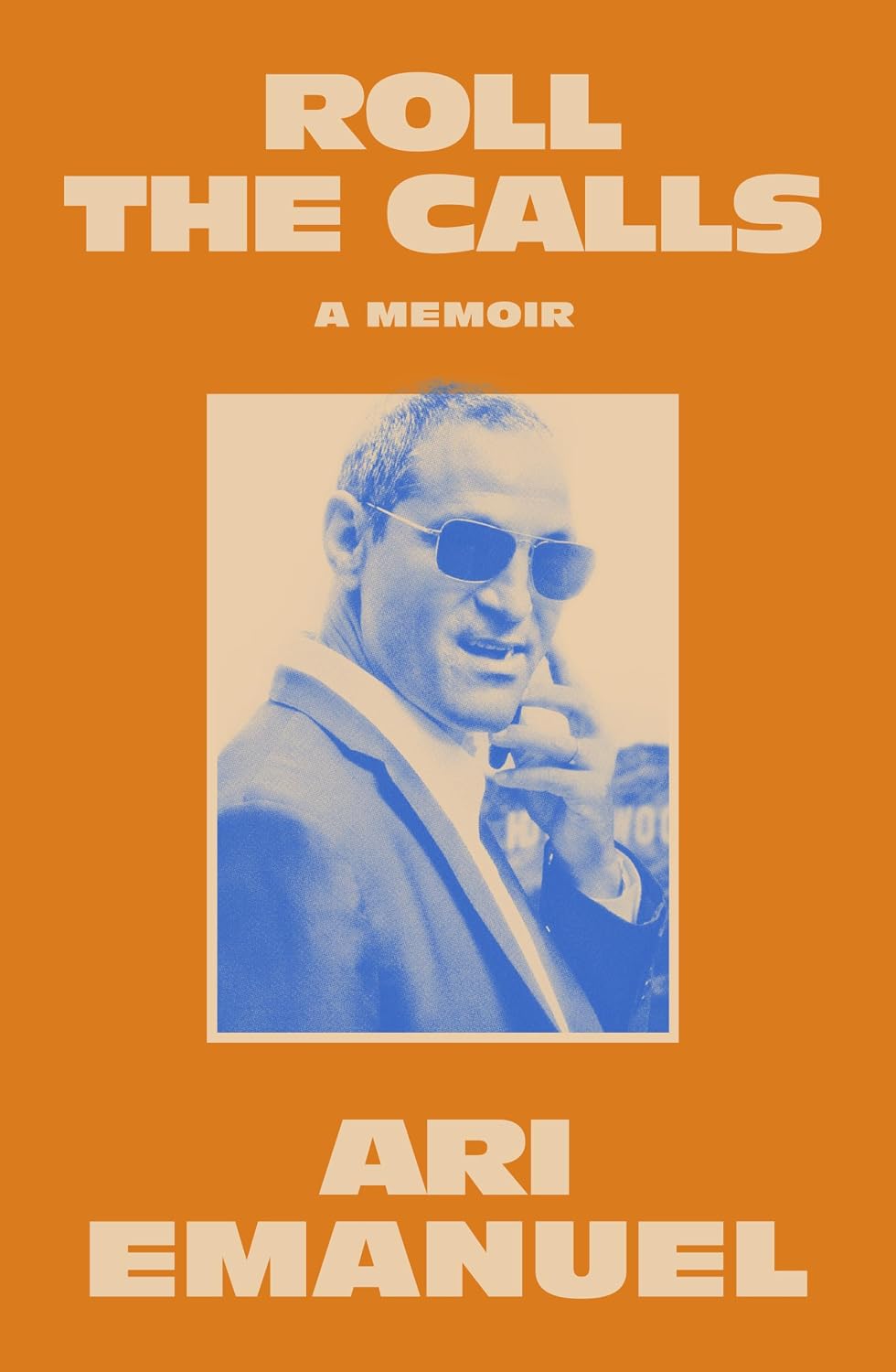
This book is hilarious. This man is the epitome of Ari Gold from Entourage. In fact, the character was actually based on Ari Emanuel. I fucking love this guy. For me, this was a fun, entertaining read with some big takeaways and reminders about persistence, passion, incredible tenacity, hard work, honesty, and taking shit personally. Essentially, how to get shit done. It’s a story about starting at the bottom and fighting his way to the top, tooth and claw. It’s about making deals, solving problems, being an agent, rage, not taking no for an answer, and fighting for your people and your business. Here are my highlights.
Highlights
Work. That’s the true story of Hollywood. But who wants to hear it?
Rage.
I’ve never had time for all that don’t-sweat-the-small-stuff crap. Because you know what? There’s no small stuff.
Ben Franklin said it. There is no little enemy. If I’d ever gotten a tattoo, I might’ve had that line done across my knuckles. ·
Rage means shit’s finally going to get done.
I decide to say the smartest thing I can think of, the smartest thing you can say in most interviews. Absolutely nothing.
It’s like telling the governor of Idaho I just saw a potato.
I know that sooner or later a basic rule of human nature is going to kick in: If you arrive at your desk every morning and find eleven messages from somebody, the same somebody who left eleven messages yesterday, you’ve got two options. Call the person back. Or call the police.
they ask the question all agents are taught to ask on day one of Agenting School— Are you happy? Devious gambit. Ask someone if they’re happy and nine times out of ten you’ll catch them by surprise, because people don’t like to think about whether they’re happy. And when they do, nine times out of ten the answer is not just no but fuck no. And there you are. Suddenly the Questioner
You can plan for a lot of things, but you cannot plan for crazy. Life. Fucking. Lesson.
The only way to do good agenting is to tune out all extraneous noise, and that’s what I do. Keep grinding, keep rolling the fucking calls, and sure enough it solves everything, as hard work always does. My list grows, my confidence. I still have much to learn about agenting, but I also have much to offer. I’m becoming the agent I’d recommend to someone I care about, someone I love, which makes me bolder, which makes me even better at agenting. A generative cycle.
With fresh eyes I look around and realize no one’s happy. Not one person. On the contrary, there’s an outbreak of low-grade depression. With the awesome new strength and positioning of this company there should be glee. Instead, all I see are long faces. Why? Because culture. ICM’s culture is dreck.
Long before coming to ICM, I’d heard the famous joke. Hey, you know what ICM stands for? International Creative Management? Nope. I Cover Myself! In other words, Me First, Me Last. Me Always.
After treating the head of CBS Entertainment to a day at Riviera, I put in for reimbursement. Request denied. I appeal the denial. Sorry, Ari. Company policy. No reimbursements for golf outings. I go berserk. Fuck policy! Fuck you! This wasn’t merely a legit business expense; it was a sound investment. For five hours I had Peter Tortorici, head of the nation’s most watched network, all to myself. The man’s time is worth a fortune, and I secured five hours of it for a measly ninety bucks. Hereafter, Tortorici is going to have good feelings about me, about ICM. He’s going to associate me—us—with a lovely day walking in the sunshine, breeze on his face, birdieing 14. He’s going to take my calls, give us loads of business.
His secretary tells me he’s too busy to take my call. Message, Mr. Emanuel? Um. Please have him call me back at his earliest. A day passes. No call. I call again. Mr. Cohn isn’t available right now, may I take a message? Yes. The message is: Please call Ari Emanuel. No callback. · Call again. Message, Mr. Emanuel? On the fifth day I ask my call roller to dial Cohn at 6:00 a.m. Pacific Standard Time, 9:00 on the East Coast. Ari, they say he’s unavailable. Tell them I’ll wait. They say it could be a while. Tell them I’ll stay on this phone until I die. Two hours pass. Midway through the third hour I hear Cohn’s raspy voice, mumbling something, his mouth presumably full of paper. Ari, what can I do for you?
Work has always been central to my identity, my physical and mental health, but right now it’s everything.
I’m also hazily aware that my anxiety isn’t about work. It’s about meaning. What do I want my life to mean? ·
We cling to the illusion of safety, or some facsimile of safety, and thereby fuck up our chance at real safety, which can only come from authentic happiness plus true meaning.
Money matters to me, as it does to everyone who grew up without it. But I’m not taking a hundred spins around the fucking sun just to pile up more chips than the other guy.
money isn’t the thing that makes me get up at 4:00 a.m. I’m just not sure yet what that thing is.
All my parents’ stories had the same moral: Life’s a fight. And not just any fight. It’s some gladiator shit, loser gets fed to lions. Save your white flags, your olive branches. Fuck your doves. The world doesn’t care. Keep your fists clenched and your head on a swivel, unless you want to find yourself lying in the street bleeding out. ·
I’ve wasted my one precious life. I’ve let other people discourage me, stop me. I’ve let my own anxiety control me and lead me away from my purpose. I’ve accepted the delusion that there’s time, plenty of time.
It’s so clear now: Life is not a dress rehearsal.
Opening night is right now.
five days after the accident, when I drag myself back to the office. Wobble down the hall on crutches, sweaty, shaky. Colleagues staring— Ari! You should be at home! This is home, asshole. · But I’m not just back in the office. I’m the first in the office every morning. Before the desks are filled, before the coffee maker is gurgling, I’m crying out to my assistant: Roll the fucking calls! Except my assistant isn’t in yet.
In one of our secret meetings Greenblatt makes the point that leaving ICM isn’t rebellious, or selfish, it’s taking care of ourselves and our clients. To stay is to die, and to let our clients die.
So I broker a meeting between the Korean execs and the DreamWorks guys, and then another meeting, and another, and after several meetings and two hundred phone calls I’ve got the architecture of a deal, which I bring to Jeff Berg for his sign-off. He signs off all right. With a wave of his pen he green-lights the deal and confers upon himself all commission.
don’t reveal to Ricky or anyone else that I’ve been waging my own battle with temptation. In the last few days Brillstein-Grey has offered me a job. Starting salary, three million. Three million is three times as tempting as one million. But after this chat with Ricky, I’m no longer tempted. After making my case to Ricky, I’m better able to make it to myself. I realize once again that I’m not in this thing for the money alone. If I were, I’d have no problems. I wouldn’t be wasting time on Ricky and the others. I’d be filling up the drawers of my huge new desk at Brillstein-Grey. · So what am I after? Power? Prestige? Some kind of validation? Is it revenge for being hassled over a $90 expense report? Or am I burning with desire to build something of my own, something the town’s never seen? A talent agency with a good culture? A talent agency with agents who are happy? Do I want to experience the same rush that my clients are always describing? The thrill of inventing something new out of thin air? · Or maybe it’s just the contrarian in me, determined to prove the naysayers wrong? So many people don’t want me to do anything. So many people don’t want anyone to do anything. And all those doubters and Debbie Downers get extra loud when you’re trying to be creative in a space not known for creativity. I despise how people assume that agents can’t be creative. Just as many tortured agents in Hollywood as tortured artists, and their reason for being tortured is the same: They want to be great. Lew Wasserman, the OG of agents, created something great at MCA, didn’t he? Mr. Ovitz too. Sure, with MCA it turned stagnant, and with Mr. Ovitz it turned into a gulag, but it doesn’t need to. I want to prove that.
On a typical day in November, I might roll a hundred calls. Now it’s three hundred.
I don’t really expect all that much from you— She smiles with relief. Only that you be perfect. The smile vanishes. Also, I need you to observe the same fluid border between work and nonwork as I do. We don’t stop when we leave the office. We don’t start when we arrive. The office mind, like the phone, is always on. I expect that total commitment and immersion from myself, how can I ask less from the kid on my desk? Okay. And one more thing. I expect you to read. Everything. ·
· It hits me that information is like loyalty. It begets itself. I send articles around to friends and colleagues, which inspires them to do likewise. I recommend books to people, they recommend books in return.
You don’t want to think about the future? Are you insane? It’s all I think about. My kid’s future, my company’s future. What else is there?
A friend points me to a line from an old philosopher: It is in changing that things find repose. Not sure that’s true. But it’s definitely in change that I find repose, that’s for damn certain, and that might be my biggest edge in this town. Change doesn’t scare me; it refreshes me. ·
I kind of understand people not liking change. Especially technological change. I just can’t understand them hiding from it.
Pretending that it wouldn’t happen, that it wasn’t happening, was more than a big fat waste of time, more than a tragic waste of opportunity, more than self-sabotage, suicide. It was stupid. Because every loss brings equivalent compensations.
Over breakfast they take turns telling me Vince’s origin story. Childhood filled with abuse and trauma. Much of it spent in trailer parks in the South. Never knew his father. Now, he dominates the world of wrestling. How? Being a stone-cold assassin, Vince says. Twenty years ago, Vince explains, wrestling was the opposite of the talent agency game. No competition. Every little wrestling outfit had its regional turf, and everyone respected everyone else’s turf. Vince said fuck all that. He saw cable coming, saw that it was going to change the game, that only the big would survive, and so he devised a plan to drive his competitors out of business. He started by promoting wrestling shows everywhere, turf or no turf. He marketed nationally, built up a national profile, a national audience, and once he was big, the clear leader in the wrestling world, he leveraged his power ruthlessly. He began blackmailing cable companies. He’d mount a huge event on the same night as an event mounted by a competitor and force the cable company to choose. Me or them. It wasn’t really a choice. Ultimately, if he couldn’t drive a competitor out of business, or steal their best talent, he’d just buy them out, fold them into his empire, then move on to the next victim. One day the wrestling world woke up and Vince McMahon was the only game in town. ·
Wrestling without rage is just cuddling. Business without rage, same deal.
We discover that we both have trouble sleeping, that we both obsess about the future, that we’re both focused on figuring out what comes next before anyone else.
When I was growing up, however, my dinner table was a debate society, and we went hard every night.
A friend tells me about a study. Scientists tried to figure out how people perform in negotiations when faced with someone angry.
Time and again the scientists found that angry negotiators had the edge. Angry negotiators always left the bargaining table with more dollars.
Harvard also did a study. To see how gratitude affects negotiations.
In carefully observed negotiations, grateful people got trucked.
There are two hundred talent agencies operating in Hollywood and I don’t know how most keep the lights on. Yes, we’re one of the biggest, one of the Big Five, but that’s not enough. We’re still not safe. Only the biggest one or two are going to survive the coming technological earthquake and mass corporate consolidation. Until we get bigger, much bigger, I can’t rest. · But how can we get bigger? And until we’re bigger, how can we appear bigger? · One way to appear bigger is to hang with giants.
But if you want to get anywhere in Hollywood, you need to show that you can color outside the lines, and that, once in a while, you might eat the fucking crayon.
As the door closes, before the HBO people can say whatever it is they want to say, I tell them that I’m not in the mood to hear no today. They stare. I’m not kidding, guys, I came here for a yes, I’m leaving with a yes.
The professor seizes on one essential truth. Our main product, talent, isn’t like other products that people sell. It’s not like furniture or jewelry or cars; it comes entangled with enormous egos. Thin skins, volatile tempers, mercurial natures, melodrama galore—our whole business model is built on emotion.
it’s less important which company you pick to merge with and more important that you accept one basic fact about all mergers. What’s that, Professor? They don’t exist. Come again? No such thing as a merger. I look at Patrick and Ricky. Is it just me? Like Bigfoot, Professor Nohria continues. I tilt my head. All the books devoted to mergers, the articles, the case studies, the men and women out there right now making a good living in mergers and acquisitions departments—you’re telling us there’s no such thing? Every merger, he explains, is a purchase. This dream of a perfect union of two companies, of symbiotic alignment, synthesis of strategic interests and cultures—it’s just that, a dream. Or, if you will, a lie. Sounds great in theory. Never works in practice. With every merger there’s a dominant and a submissive, an alpha and a beta, a winner and a loser. Why? Because every merger is really just one company swallowing the other. The rest is spin.
And isn’t realism intrinsically moral, the ultimate form of compassion?
Success is a state of mind, a moment you savor, not a mansion you own.
If I am not for myself, who will be for me? But when I am only for myself, what am I? —Hillel the Elder, rabbi and sage, 110 BC–AD 10
he does the Thing. The thing no one should ever do. He laughs. At me.
That deal is never happening! I stop walking. I look at him, genuinely surprised. Patrick, what the hell are you talking about? ARI! We were just supposed to feel it out, man! Meet and greet—remember? Get to know each other? Put them on notice? Maybe fire a few warning shots into the ceiling. Instead, you carpet-bomb the joint! So, yeah, that deal’s never happening. I’m standing a foot from him, but I take a half step forward so we’re only inches apart and say, Patrick. Listen very carefully. That deal is definitely happening.
Each day I rise at 4:30 a.m., thinking about Weintraub laughing, Wiatt nodding and smiling. Each night, after I tuck in the boys, I’m still thinking about it. It’s still on my mind as I fall to sleep.
I have many goals, many missions, many action items on my daily to-do list and my lifetime bucket list. I have two hundred phone calls to make every day. I have a growing family, a roster of clients who need my undivided attention. But near the top of my personal list of goals, my hierarchy of needs, is one thing that I must get done before I die. I need to make Irv Weintraub stop laughing. And I need to wipe that smile off Wiatt’s face. ·
Rolling calls every morning, telling myself, This is what I was born to do.
More, I discover that I can cold-call anyone now. I’ve always been a cold caller; I was never afraid to dial any number. But now the call always goes through.
Fame brings new clout; new clout brings new business, new business brings more clout.
Driving my kids to school one morning, wearing a headset, rolling calls like a fiend.
Make some calls, do my research. Learn that the guy in charge of UFC is someone named—Dana White? Again, never heard of him. I ask my assistant to get him on the phone right away.
should be drawing them out, asking questions about their backgrounds, their business. Like everyone in the world, they want to talk, tell their stories; they’re just waiting for the right prompts, the right listener.
Respect every hot streak.
Robby’s beautiful gesture, his real gift to me, isn’t the desk, but this important reminder—I’m not Robby Lantz. And I’m not Ari Gold. I’m not Ari Auerbach or Ari Emanuel, at least not the Ari Emanuel people think they know. I’m in the process of becoming myself, whoever that may be, and I need to trust the process. Let it play out.
I put the desk and chair into storage and return to my treadmill desk. Phew, my assistant says as he rolls the day’s first calls.
Kids growing so fast. They need clothes and food and toys and hugs, but of course what they need most is presence.
As hard as parenting can be, the job description is pretty simple. Be here. Now. Mentally and physically.
Torn between two desires. I want to show up for my family, but I also want to set an example for them. As my father did for me. Hell or high water, my father was out that apartment door every morning at six.
If possible, always start your day with a fucking metaphor.
Lastly I go into the office, where I roll the day’s first calls from my treadmill desk.
you want to win at life, then isn’t Job One having more life?
I’m a great believer in serendipity, and you’ve got to be there, in the room, at the table, sharing air with the person, for serendipity to kick in. ·
Networking, dealmaking, people have words for this sort of thing, but they all sound bloodless. To me it’s an art. An unsung form of creativity. It frustrates me when people don’t see the craft. Don’t see that you’re making something, just like a painter or a sculptor.
If you cheat at golf, you’ll cheat at anything, in which case I can’t do business with you.
Teddy’s greatest sin, however, was lack of curiosity.
He knew too much, or just enough—he didn’t want to know more.
In most careers a lack of curiosity is a hindrance; in agenting it’s disqualifying. To be a great agent, to run a great agency, you’ve got to get down in the trenches, grind it out, roll those calls. You’ve got to learn how deals are structured, how stuff gets made, how talent needs to be treated, how it won’t tolerate being treated.
Don’t let the perfect be the enemy of the good, that’s a favorite saying of Obama’s. My version: Don’t let the less be the enemy of the more. So at the last minute I ask for more.
Back in Hollywood, however, I fall right back into my old ways. Sleeping with the phone. Worrying. Obsessing. Last thought at night: buying IMG with Egon. First thought every morning: ditto. And my main job, still, is agenting.
Then I do what so many of the actors and writers and directors I represent are doing right now, this very minute, back home. I build an imaginary world and invite Oprah to walk around in it. A world in which she thrives, in which she’s doing work she loves, work that makes an impact. Makes her happy. Are you happy? Oprah admits she hasn’t been for some time.
When I get home from the retreat, I send a full-length mirror to Oprah’s house. A really nice one. Card: Take a good long look at yourself. · Oprah phones a few days later, thanks me for the mirror. We laugh about it. Have you been thinking about what I said, Oprah? Yes, Ari. I’ve been standing in front of your mirror…reflecting. I’ll call you tomorrow, see where your head’s at. Don’t bother, Ari, I’ll call you. No, no, I’m gonna call. Sigh. I know you will.
Get me Oprah, I tell my assistant every morning. Hi, Oprah. I have Ari for you.
When I’m tempted to be satisfied, I yell at myself. Idiot!
People used to be shocked by my obsessions, my irrationality, my inability to find contentment. Now it’s just my reputation.
I call him every morning for the next week, ask how his vacation is going, ask if there’s anything I can do to make it more enjoyable.
Please hold for the president… Ari, Shapiro says, let me tell them you’ll call right back! Fuck that, just hold the phone to my mouth. Ari, you’re getting a shot in the— I do not give a fuck if I’m having open-heart surgery, hold the phone to my mouth!
Even though she was a kid, accompanied by her mother, Swift radiated power. And owned that power. It didn’t own her.
Like Oprah she didn’t waste words. She explained her position. No change.
Ask if she’d like to get a drink or a cup of coffee sometime, maybe go see a— No. Excuse me? Thanks, really, but no. Can I just ask, Staud, why you’re so uninterested? No offense, she adds. You’re too old. Call ended. Three minutes later I call back. Call her every day. She sends all the calls to voicemail. Once in a great while she picks up. To say no. Call again. She says, Okay. Okay what? Aaagh. Okay. One drink. (long story short, they ended up getting married)
At the dinner table, you were expected to fight. When I say fight, I mean argue your position. Say what you believed.
It’s not that I don’t take no for an answer, because that implies choice, implies that I hear no and choose not to take it. But the fact is, I don’t hear the no.
Protecting yourself from disloyalists, having the courage to cut them loose—it’s a question of having your own back. It may seem abrupt, may seem cold, but it’s in fact the cornerstone of mental health.
At the outset of every important relationship, partnership, I aim for eternity. I’m ride or die for the people in my circle—family, friends. Someone hurts them? That someone becomes my mortal enemy. There is no little enemy. So why would I be any less loyal to myself? To betray yourself is the ultimate betrayal.