- Rating
- 10/10
- Read
- December 2013
- Why I read it
- What I took from it
- My favorite idea
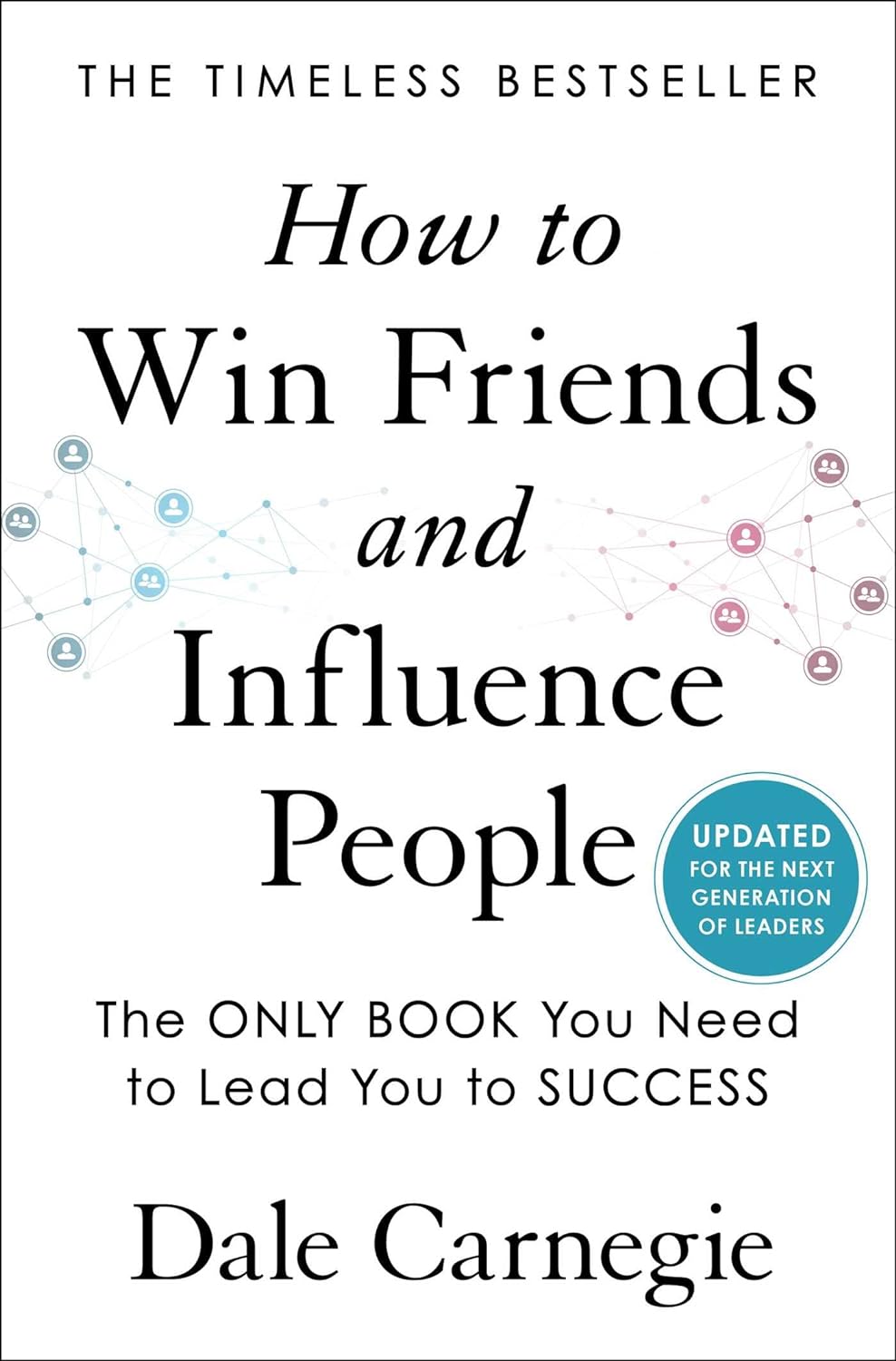
Dale Carnegie published this in 1936, and it’s still one of the best-selling books ever written. It’s a practical guide to dealing with people, built on simple principles and real stories. Don’t criticize, condemn or complain. Become genuinely interested in other people. Remember names, because a person’s name is the sweetest sound to them. Be a good listener and talk in terms of the other person’s interests. Make people feel important, and mean it. When it comes to changing minds, he argues the only way to win an argument is to avoid it, and that admitting your own mistakes quickly and letting others save face gets you further than being right. None of it is complicated, which is exactly why it works, and why it applies to sales, recruiting, leadership and everyday life.
Highlights
“If You Want to Gather Honey, Don’t Kick Over the Beehive”
ninety-nine times out of a hundred, people don’t criticize themselves for anything, no matter how wrong it may be.
Criticism is futile because it puts a person on the defensive and usually makes him strive to justify himself. Criticism is dangerous, because it wounds a person’s precious pride, hurts his sense of importance, and arouses resentment.
Theodore Roosevelt said that when he, as President, was confronted with a perplexing problem, he used to lean back and look up at a large painting of Lincoln which hung above his desk in the White House and ask himself, “What would Lincoln do if he were in my shoes? How would he solve this problem?”
“Don’t complain about the snow on your neighbor’s roof,” said Confucius, “when your own doorstep is unclean.”
When dealing with people, let us remember we are not dealing with creatures of logic. We are dealing with creatures of emotion, creatures bristling with prejudices and motivated by pride and vanity.
Any fool can criticize, condemn and complain—and most fools do. But it takes character and self-control to be understanding and forgiving. “A great man shows his greatness,” said Carlyle, “by the way he treats little men.”
Instead of condemning people, let’s try to understand them. Let’s try to figure out why they do what they do. That’s a lot more profitable and intriguing than criticism; and it breeds sympathy, tolerance and kindness. “To know all is to forgive all.”
There is only one way under high heaven to get anybody to do anything. Did you ever stop to think of that? Yes, just one way. And that is by making the other person want to do it. Remember, there is no other way.
“I consider my ability to arouse enthusiasm among my people,” said Schwab, “the greatest asset I possess, and the way to develop the best that is in a person is by appreciation and encouragement.
“There is nothing else that so kills the ambitions of a person as criticisms from superiors.
Emerson said: “Every man I meet is my superior in some way. In that, I learn of him.”
So the only way on earth to influence other people is to talk about what they want and show them how to get it. Remember that tomorrow when you are trying to get somebody to do something. If, for example, you don’t want your children to smoke, don’t preach at them, and don’t talk about what you want; but show them that cigarettes may keep them from making the basketball team or winning the hundred-yard dash.
the best piece of advice which can be given to would-be persuaders, whether in business, in the home, in the school, in politics, is: First, arouse in the other person an eager want. He who can do this has the whole world with him. He who cannot walks a lonely way.”
Here is one of the best bits of advice ever given about the fine art of human relationships. “If there is any one secret of success,” said Henry Ford, “it lies in the ability to get the other person’s point of view and see things from that person’s angle as well as from your own.”
Thousands of salespeople are pounding the pavements today, tired, discouraged and underpaid. Why? Because they are always thinking only of what they want. They don’t realize that neither you nor I want to buy anything. If we did, we would go out and buy it. But both of us are eternally interested in solving our problems. And if salespeople can show us how their services or merchandise will help us solve our problems, they won’t need to sell us. We’ll buy. And customers like to feel that they are buying—not being sold.
“People who can put themselves in the place of other people, who can understand the workings of their minds, need never worry about what the future has in store for them.”
First, arouse in the other person an eager want. He who can do this has the whole world with him. He who cannot walks a lonely way.
You can make more friends in two months by becoming interested in other people than you can in two years by trying to get other people interested in you.
It is the individual who is not interested in his fellow men who has the greatest difficulties in life and provides the greatest injury to others. It is from among such individuals that all human failures spring.
I have discovered from personal experience that one can win the attention and time and cooperation of even the most sought-after people by becoming genuinely interested in them.
If we want to make friends, let’s put ourselves out to do things for other people—things that require time, energy, unselfishness and thoughtfulness.
a famous old Roman poet, Publilius Syrus, remarked: “We are interested in others when they are interested in us.”
PRINCIPLE 1 Become genuinely interested in other people.
You must have a good time meeting people if you expect them to have a good time meeting you.
“There is nothing either good or bad,” said Shakespeare, “but thinking makes it so.”
Abe Lincoln once remarked that “most folks are about as happy as they make up their minds to be.”
The ancient Chinese were a wise lot—wise in the ways of the world; and they had a proverb that you and I ought to cut out and paste inside our hats. It goes like this: “A man without a smiling face must not open a shop.” Your smile is a messenger of your good will. Your smile brightens the lives of all who see it.
PRINCIPLE 2 Smile.
What was the reason for Andrew Carnegie’s success? He was called the Steel King; yet he himself knew little about the manufacture of steel. He had hundreds of people working for him who knew far more about steel than he did. But he knew how to handle people, and that is what made him rich. Early in life, he showed a flair for organization, a genius for leadership. By the time he was ten, he too had discovered the astounding importance people place on their own name. And he used that discovery to win cooperation. To illustrate: When he was a boy back in Scotland, he got hold of a rabbit, a mother rabbit. Presto! He soon had a whole nest of little rabbits—and nothing to feed them. But he had a brilliant idea. He told the boys and girls in the neighborhood that if they would go out and pull enough clover and dandelions to feed the rabbits, he would name the bunnies in their honor. The plan worked like magic, and Carnegie never forgot it. Years later, he made millions by using the same psychology in business. For example, he wanted to sell steel rails to the Pennsylvania Railroad. J. Edgar Thomson was the president of the Pennsylvania Railroad then. So Andrew Carnegie built a huge steel mill in Pittsburgh and called it the “Edgar Thomson Steel Works.”
People are so proud of their names that they strive to perpetuate them at any cost.
Napoleon the Third, Emperor of France and nephew of the great Napoleon, boasted that in spite of all his royal duties he could remember the name of every person he met. His technique? Simple. If he didn’t hear the name distinctly, he said, “So sorry. I didn’t get the name clearly.” Then, if it was an unusual name, he would say, “How is it spelled?”
During the conversation, he took the trouble to repeat the name several times, and tried to associate it in his mind with the person’s features, expression and general appearance. If the person was someone of importance, Napoleon went to even further pains. As soon as His Royal Highness was alone, he wrote the name down on a piece of paper, looked at it, concentrated on it, fixed it securely in his mind, and then tore up the paper. In this way, he gained an eye impression of the name as well as an ear impression.
PRINCIPLE 3 Remember that a person’s name is to that person the sweetest and most important sound in any language.
So if you aspire to be a good conversationalist, be an attentive listener. To be interesting, be interested. Ask questions that other persons will enjoy answering. Encourage them to talk about themselves and their accomplishments. Remember that the people you are talking to are a hundred times more interested in themselves and their wants and problems than they are in you and your problems.
Be a good listener. Encourage others to talk about themselves.
Everyone who was ever a guest of Theodore Roosevelt was astonished at the range and diversity of his knowledge. Whether his visitor was a cowboy or a Rough Rider, a New York politician or a diplomat, Roosevelt knew what to say. And how was it done? The answer was simple. Whenever Roosevelt expected a visitor, he sat up late the night before, reading up on the subject in which he knew his guest was particularly interested. For Roosevelt knew, as all leaders know, that the royal road to a person’s heart is to talk about the things he or she treasures most.
Talk in terms of the other person’s interests.
The law is this: Always make the
other person feel important. John Dewey, as we have already noted, said that the desire to be important is the deepest urge in human nature; and William James said: “The deepest principle in human nature is the craving to be appreciated.”
“Talk to people about themselves,” said Disraeli, one of the shrewdest men who ever ruled the British Empire, and they will listen for hours.”
Make the other person feel important—and do it sincerely.
IN A NUTSHELL SIX WAYS TO MAKE PEOPLE LIKE YOU PRINCIPLE 1 Become genuinely interested in other people. PRINCIPLE 2 Smile. PRINCIPLE 3 Remember that a person’s name is to that person the sweetest and most important sound in any language. PRINCIPLE 4 Be a good listener. Encourage others to talk about themselves. PRINCIPLE 5 Talk in terms of the other person’s interests. PRINCIPLE 6 Make the other person feel important—and do it sincerely.
As wise old Ben Franklin used to say: If you argue and rankle and contradict, you may achieve a victory sometimes; but it will be an empty victory because you will never get your opponent’s good will.
Buddha said: “Hatred is never ended by hatred but by love,” and a misunderstanding is never ended by an argument but by tact, diplomacy, conciliation and a sympathetic desire to see the other person’s viewpoint.
Distrust your first instinctive impression. Our first natural reaction in a disagreeable situation is to be defensive. Be careful. Keep calm and watch out for your first reaction. It may be you at your worst, not your best.
Listen first. Give your opponents a chance to talk. Let them finish. Do not resist, defend or debate. This only raises barriers. Try to build bridges of understanding. Don’t build higher barriers of misunderstanding. Look for areas of agreement. When you have heard your opponents out, dwell first on the points and areas on which you agree. Be honest. Look for areas where you can admit error and say so. Apologize for your mistakes. It will help disarm your opponents and reduce defensiveness. Promise to think over your opponents’ ideas and study them carefully. And mean it. Your opponents may be right. It is a lot easier at this stage to agree to think about their points than to move rapidly ahead and find yourself in a position where your opponents can say: “We tried to tell you, but you wouldn’t listen.” Thank your opponents sincerely for their interest. Anyone who takes the time to disagree with you is interested in the same things you are. Think of them as people who really want to help you, and you may turn your opponents into friends. Postpone action to give both sides time to think through the problem. Suggest that a new meeting be held later that day or the next day, when all the facts may be brought to bear. In preparation for this meeting, ask yourself some hard questions:
Could my opponents be right? Partly right? Is there truth or merit in their position or argument? Is my reaction one that will relieve the problem or will it just relieve any frustration? Will my reaction drive my opponents further away or draw them closer to me? Will my reaction elevate the estimation good people have of me? Will I win or lose? What price will I have to pay if I win? If I am quiet about it, will the disagreement blow over? Is this difficult situation an opportunity for me?
The only way to get the best of an argument is to avoid it.
Over three hundred years ago Galileo said: You cannot teach a man anything; you can only help him to find it within himself.
As Lord Chesterfield said to his son: Be wiser than other people if you can; but do not tell them so.
Socrates said repeatedly to his followers in Athens: One thing only I know, and that is that I know nothing.
2,200 years before Christ was born, King Akhtoi of Egypt gave his son some shrewd advice—advice that is sorely needed today. “Be diplomatic,” counseled the King. “It will help you gain your point.” In other words, don’t argue with your customer or your spouse or your adversary. Don’t tell them they are wrong, don’t get them stirred up. Use a little diplomacy.
Show respect for the other person’s opinions. Never say, “You’re wrong.”
Lincoln said that, in effect, over a hundred years ago. Here are his words: It is an old and true maxim that “a drop of honey catches more flies than a gallon of gall.” So with men, if you would win a man to your cause, first convince him that you are his sincere friend. Therein is a drop of honey that catches his heart; which, say what you will, is the great high road to reason.
Remember what Lincoln said: “A drop of honey catches more flies than a gallon of gall.”
PRINCIPLE 4 Begin in a friendly way.
The psychological patterns here are quite clear. When a person says “No” and really means it, he or she is doing far more than saying a word of two letters. The entire organism—glandular, nervous, muscular—gathers itself together into a condition of rejection. There is, usually in minute but sometimes in observable degree, a physical withdrawal or readiness for withdrawal. The whole neuromuscular system, in short, sets itself on guard against acceptance. When, to the contrary, a person says “Yes,” none of the withdrawal activities takes place. The organism is in a forward-moving, accepting,
open attitude. Hence the more “Yeses” we can, at the very outset, induce, the more likely we are to succeed in capturing the attention for our ultimate proposal.
“It took me years and cost me countless thousands of dollars in lost business before I
finally learned that it doesn’t pay to argue, that it is much more profitable and much more interesting to look at things from the other person’s viewpoint and try to get that person saying ‘yes, yes.’ ”
Socrates, “the gadfly of Athens,” was one of the greatest philosophers the world has ever known. He did something that only a handful of men in all history have been able to do: he sharply changed the whole course of human thought; and now, twenty-four centuries after his death, he is honored as one of the wisest persuaders who ever influenced this wrangling world. His method? Did he tell people they were wrong? Oh, no, not Socrates. He was far too adroit for that. His whole technique, now called the “Socratic method,” was based upon getting a “yes, yes” response. He asked questions with which his opponent would have
to agree. He kept on winning one admission after another until he had an armful of yeses. He kept on asking questions until finally, almost without realizing it, his opponents found themselves embracing a conclusion they would have bitterly denied a few minutes previously.
PRINCIPLE 5 Get the other person saying “yes, yes” immediately.
PRINCIPLE 6 Let the other person do a great deal of the talking.
Don’t you have much more faith in ideas that you discover for yourself than in ideas that are handed to you on a silver platter? If so, isn’t it bad judgment to try to ram your opinions down the throats of other people? Isn’t it wiser to make suggestions—and let the other person think out the conclusion?
Letting the other person feel that the idea is his or hers not only works in business and politics, it works in family life as well.
PRINCIPLE 7 Let the other person feel that the idea is his or hers.
In his book Getting Through to People, Dr. Gerald S. Nirenberg commented: “Cooperativeness in conversation is achieved when you show that you consider the other person’s ideas and feelings as important as your own. Starting your conversation by giving the other person the purpose or direction of your conversation, governing what you say by what you would want to hear if you were the listener, and accepting his or her viewpoint will encourage the listener to have an open mind to your ideas.”
PRINCIPLE 8 Try honestly to see things from the other person’s point of view.
Wouldn’t you like to have a magic phrase that would stop arguments, eliminate ill feeling, create good will, and make the other person listen attentively? Yes? All right. Here it is: “I don’t blame you one iota for feeling as you do. If I were you I would undoubtedly feel just as you do.”
PRINCIPLE 9 Be sympathetic with the other person’s ideas and desires.
Let Charles Schwab say it in his own words: “The way to get things done,” says Schwab, “is to stimulate competition. I do not mean in a sordid, money-getting way, but in the desire to excel.”
IN A NUTSHELL WIN PEOPLE TO YOUR WAY OF THINKING PRINCIPLE 1 The only way to get the best of an argument is to avoid it. PRINCIPLE 2 Show respect for the other person’s opinions. Never say, “You’re wrong.” PRINCIPLE 3 If you are wrong, admit it quickly and emphatically. PRINCIPLE 4 Begin in a friendly way. PRINCIPLE 5
Get the other person saying “yes, yes” immediately. PRINCIPLE 6 Let the other person do a great deal of the talking. PRINCIPLE 7 Let the other person feel that the idea is his or hers. PRINCIPLE 8 Try honestly to see things from the other person’s point of view. PRINCIPLE 9 Be sympathetic with the other person’s ideas and desires. PRINCIPLE 10 Appeal to the nobler motives. PRINCIPLE 11 Dramatize your ideas. PRINCIPLE 12 Throw down a challenge.
Beginning with praise is like the dentist who begins his work with Novocain. The patient still gets a drilling, but the Novocain is pain-killing. A leader will use…
This could be easily overcome by changing the word “but” to “and.” “We’re really proud of you, Johnnie, for raising your grades this term, and by continuing the same conscientious efforts next term, your algebra grade can be up with all the others.”