- Rating
- —/10
- Read
- July 2023
- Why I read it
- What I took from it
- My favorite idea
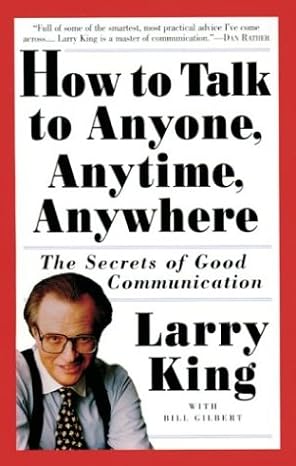
A good book on how to be a better conversationalist. Much of what’s shared is basic communication skills, but there’s enough good stuff in here to make it worth the read.
Highlights
Besides the willingness to work on it, you need at least two other ingredients to be a good conversationalist: a sincere interest in the other person and an openness to them about yourself.
I make sure to look my guests right in the eye. (The failure to do this is the downfall of many people and one we will talk about later.) Then I lean forward on my chair and I ask them a question about themselves.
You cannot talk to people successfully if they think you are not interested in what they have to say or you have no respect for them.
The remaining ingredient in my formula for success is an openness about yourself while you are talking to others, like my candor with my audience when I developed that severe case of mike fright my first morning on the air. The golden rule—Do unto others as you would have them do unto you—applies to conversation, too. You should be as open and honest with your conversational partners as you’d want them to be with you.
At the same time, you should be willing to reveal the kind of information that you’d ask of another person. Telling people what your background is, what your likes and dislikes are, is part of the give and take of conversation. It’s how we get to know people.
Anybody I’ve ever talked to for more than a few minutes knows at least two things about me: 1) I’m from Brooklyn, and 2) I’m Jewish. How come they know that about me? Because I share my background with everyone I come in contact with. It’s a part of me, deep inside.
Whether the setting is social or professional, one of the first things to accomplish in talking to people is to put them at ease.
The best way I’ve found to overcome shyness is to remind yourself of the old saying that the person you’re talking to puts his pants on one leg at a time. Sure it’s a cliché, but like most clichés, it happens to be true, which, of course, is why they become clichés in the first place.
Always remember this: People you’re talking to will enjoy the conversation more if they see you are presenting yourself as someone who’s enjoying it, too, whether you consider yourself their equal or not.
It also helps you to overcome your shyness if you remember that the person you’re talking to is probably just as shy as you are. Most of us are. Reminding yourself of this will do wonders for your ability to shed your own shyness.
You can use the same technique in breaking the ice with someone you’re talking to for the first time. How? Simple—get them on comfortable ground. Ask them about themselves. That will give you something to talk about, and your conversation partner will consider you a fascinating talker. Why? Because people love to be talked to about themselves. Don’t take my word for it. The same advice comes from Benjamin Disraeli, British novelist, statesman, and prime minister: "Talk to people about themselves and they will listen for hours."
What do you suppose the chances is a great question. "The way the stock market has fluctuated so wildly this year, you have to wonder whether our economy is as stable as we like to think. What do you suppose the chances are that we might be headed for another recession?" "I’ve been a Redskins fan ever since I moved to Washington, but I have to admit they have a rebuilding job to do, and the Cowboys are always a threat. What do you think the ’Skins chances are this year?"
My first rule of conversation is this: I never learn a thing while I’m talking. I realize every morning that nothing I say today will teach me anything, so if I’m going to learn a lot today, I’ll have to do it by listening.
To be a good talker, you must be a good listener. This is more than just a matter of showing an interest in your conversation partner. Careful listening makes you better able to respond—to be a good talker when it’s your turn. Good follow-up questions are the mark of a good conversationalist.
When I interview guests on the air, I make notes ahead of time about the kinds of questions I will ask them. But often I’ll hear something in one of their responses that leads me into an unexpected question—and a surprising answer.
Dale Carnegie put it effectively in his book How to Win Friends and Influence People, which has now sold fifteen million copies: "To be interesting, be interested."
Encourage people to talk about themselves and their accomplishments. Remember that the people you are talking to are a hundred times more interested in themselves and their wants and problems than they are in you and your problems.
A person’s toothache means more to that person than a famine in China which kills a million people.
A new requirement for being a good talker in our culture is staying informed.
To be a successful conversationalist, you have to be ready to talk about what’s on people’s minds—and it may be the subject they just heard about on the radio and saw on the evening news.
Today the key word in being successful in your social conversation is relevance.
Be open. Find the common ground with your partner. And, always, listen.
With such a group you should have several topics that will open a conversation.
Remember, asking questions is the secret of good conversation.
My favorite question: "Why?" If a man tells me that he and his family are moving to another city: "Why?" A woman is changing jobs: "Why?" Someone roots for the Mets: "Why?" It’s the greatest question ever asked, and it always will be.
How to Get out of a Conversation If you find yourself stuck with a real bore, or simply feel it’s time to end a long conversation and move on, there’s always one guaranteed way to get out of the conversation: "Excuse me. I have to visit the restroom." Or, if you spot someone you know nearby, you can make your escape with, "Stacey! Have you met Bill?" As Stacey is shaking hands with Bill, you can say, "I’ll be back in a minute, but I know you two will have a lot to talk about." Other good exit lines: "This food is delicious. I’m going to go help myself to seconds." "Would you excuse me? I’m going to go say hello to our host." (Or "... to a friend I haven’t seen in a while.") "Well, I guess I’d better go and mingle some more."
Don’t just offer your own opinions. You’ll be remembered as a better conversationalist if you ask the opinions of others around you.
Even on a subject on which he’s an expert—and you can imagine there are a lot of them—he will often turn and ask, "What do you think?"
Another idea is to segue to a topic that you know that person will talk about. If the conversation is about education, you can say, "That reminds me, your daughter is at Washington High. How’s she liking it?"
"What If?" "What if" questions are a can’t miss way of starting a conversation in a social setting or picking it up during a lull: "What if North Korea keeps on stonewalling the UN on inspecting its nuclear plants. Think we’ll have another Korean War?" "So Barry Switzer is the new coach of the Dallas Cowboys. What if they have two bad years in a row under him. Would Jerry Jones fire him?" "What if you had just built your dream house in California, and you were told scientists had suddenly discovered an earthquake zone in the area. Would you move?"
If conversation is flowing right along, forget the what-if question. Who needs it? But if the talk starts to drag and sputter, and threatens to stall out altogether, then you wheel in a what-if as a means of reviving things.
if you want to continue the conversation. You do it simply by mentioning a subject of interest to you: "Well, everybody seems to have an opinion about the verdict in the Menendez trial. What’s yours?" "I just heard on the car radio coming over here that the stock market dropped another fifty-eight points today. Do you think we’re headed for another October 1987?"
Most successful people are successful talkers. Not surprisingly, the reverse is also true.
Successful people who cannot express themselves well? I can’t think of one. Zero.
WHAT THE BEST TALKERS HAVE IN COMMON They look at things from a new angle, taking unexpected points of view on familiar subjects. They have broad horizons. They think about, and talk about, a wide range of issues and experiences beyond their own daily lives. They are enthusiastic, displaying a passion for what they’re doing with their lives and an interest in what you’re saying to them at that moment. They don’t talk about themselves all the time. They are curious. They ask "Why?" They want to know more about what you’re telling them. They empathize. They try to put themselves in your place, to relate to what you’re saying. They have a sense of humor. And they don’t mind using it on themselves. In fact, the best conversationalists frequently tell stories on themselves. They have their own style of talking.
There’s a saying that you broaden your horizons through travel, but if you are curious enough to listen to other people, you can broaden your horizons without leaving your backyard.
To hold up your end of the conversation, you obviously have to tell your partner something about yourself and answer questions he or she may ask. But don’t go on too long. Instead, turn the conversation around, as in "How about you, Mary? Where do you work?"
The best conversationalists are curious about everything. That’s why they are good at listening and why they have broad horizons—they’re always learning something new.
The people we most enjoy talking to are ones who show empathy for us—who make clear they relate to what we’re feeling as well as what we’re saying.
When I’m giving a speech, one of my own cardinal rules is "Never stay too serious too long." That same applies to conversation, maybe more so. But humor, like anything else, doesn’t work if it’s forced.
"The difference between the almost-right word and the right word is really a large matter—it’s the difference between the lightning bug and the lightning."
The same basic principles apply in business talk as in social conversation. Be direct and open, and be a good listener if you want to be a good talker.
Think ahead of time about the subject, what points you want to drive home, and what questions you can expect and the most convincing way to answer them.
And remember what the other person wants and needs to know.
But you don’t need to give a briefing every time you talk to somebody. You want to avoid that old complaint that if you ask so-and-so what time it is, he tells you how the inside of the watch works.
He was successful because he followed two rules of sales: Know what you’re selling; and once you’ve closed the deal—don’t keep selling.
There is another key rule in talking to make a sale: Sell the advantages of the product, not the features of the product. Don’t talk about how the toaster has this dandy microchip for consistent "doneness." Talk instead about sitting down to breakfast with a steaming cup of coffee and a golden-brown English muffin. Don’t talk about the premiums and payouts of the insurance policy. Talk about the security your client will feel and about the gratitude of his or her spouse and children in knowing that the cornerstone of their financial future is in place.
You’ll never sell any product that is as important as yourself, so you want to do it right.
What do you bring that’s unique? To paraphrase President Kennedy, ask not what your employer can do for you, but what you can do for your employer.
other words, sell your advantages, not your features. You do that by talking about your knowledge and your skills—the expertise and contacts you have developed in your field and the abilities you have developed over your career.
Don’t be so businesslike in your demeanor that you stifle your openness. Communicate your enthusiasm for the job. This is a refreshing characteristic that employers don’t always find in job interviews, and the applicant who displays it sometimes will find out later it was the one quality that made a difference.
I know a former Washington public affairs director who was told later that one of the features about him that stood out in his interview was, as his new boss told him, "You told us clearly that you wanted the job, you showed a lot of enthusiasm for it, and you told us you had the experience to do it successfully. You didn’t play games with us."
A film producer I know placed a classified ad for a secretary. After listing the requirements for clerical skills, the ad said, "Must care." Of all the applicants who were interviewed, only one said, "By the way, I care." She got the job.
If you’ve changed jobs three times in the past seven years, expect to be asked why.
Asking questions is how you learn, and in a job interview you definitely want to learn about the company just as much as the company wants to learn about you.
employers respect someone who displays the initiative to ask intelligent questions about the company. That shows you possess two of the most persuasive qualities that we just talked about: you are prepared, and you care.
Sharkproof underscores the importance of asking good questions when you’re in a job interview and offers excellent advice about the kinds of questions to ask. As an example, he mentions that every company likes to be asked about its values. "If you can ask a positive question that links the company’s values to its performance, you’ve already gone a long way toward demonstrating that you’re with the program."
In the day-to-day working atmosphere, tell your employees how they’re doing. Give clear instructions. If time is a factor, make sure they understand that, and give them a deadline. Encourage them to ask questions so you can be sure they understand.
Be generous with your praise for good work. If you’re unhappy with something, tell them.
Don’t avoid a confrontation by hoping the problem will dry up and blow away or solve itself, and don’t postpone action for a week while your blood pressure goes through the top of your head and you wind up exploding at the employee.
The employees who used to be called secretaries or even "girl Fridays"—why do I get the feeling I’m dating myself?—are more often called "assistants" now. But whatever title they prefer, such people are the secret weapon in many offices, the link that makes the whole operation successful. They save time and get things done more effectively not only for their bosses, but also for their co-workers, and they can do the same for you.
In my own case, people who work with me know that Judith Thomas, my personal assistant and one of my associate producers on the Larry King Live staff, is the first person to talk to about matters involving my schedule. Someone could spend a week trying to get me on the phone, but in almost every case Judy can field your question herself and work you onto my calendar, a skill at which she is unsurpassed. She keeps threatening to write a book about this and give it the title Call Judy, because that’s what I tell everybody if we’re trying to set up an appointment or even make a decision over the phone.
He was perfectly willing, however, to make it clear that we had other options,
The three most important things in running a meeting are preparation, preparation, and preparation. So have an agenda, even if it’s an informal one consisting of just a few notes in front of you to make sure you cover what you want to in the meeting.
Let the small talk get finished in the hallway before and after the meeting.
Be decisive. You’ve established what the issues are. The last two questions for each item are: What action is to be taken, and who’s going to do it? If you leave this vague, there was no point in having the meeting in the first place.
Be firm.
Here’s what I look for in a potential guest: A passion for his or her work The ability to explain that work clearly and in a way that our viewers will find interesting, something they find themselves wanting to know more about A chip on the shoulder A sense of humor, preferably self-deprecating
Openness, enthusiasm, and a willingness to listen will make you a popular conversationalist in any medium.