- Rating
- —/10
- Read
- September 2019
- Why I read it
- What I took from it
- My favorite idea
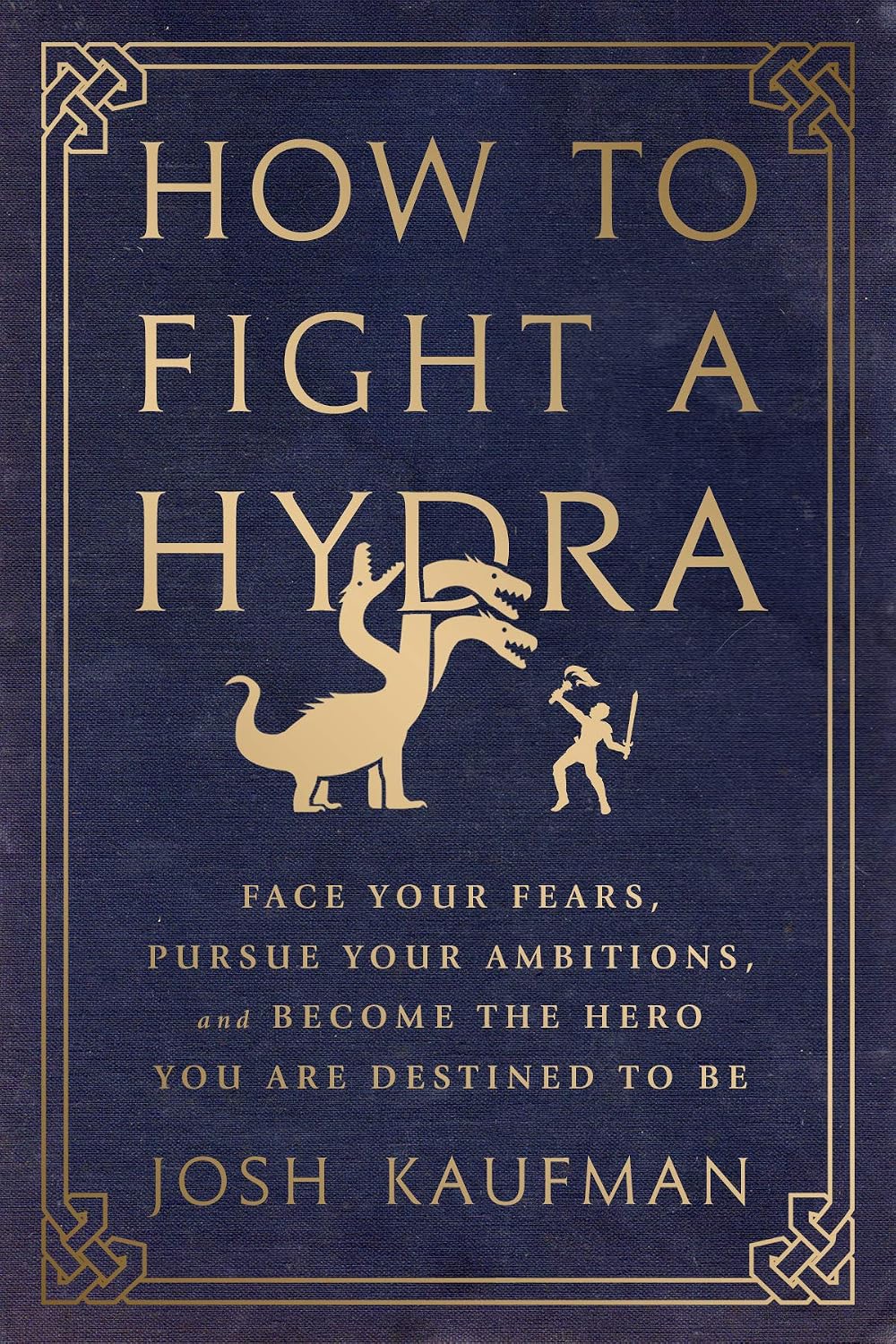
Josh Kaufman, best known for The Personal MBA, wrote this short book as a fable. A would-be hero sets out to fight a hydra, the mythical beast that grows two heads for every one you cut off, and learns along the way what any big ambition takes. It’s a quick read built around ideas that apply to starting a business, changing careers or any project that scares you: deciding to begin, preparing without stalling, accepting that setbacks are part of the fight, and keeping going when the problem seems to grow faster than you can solve it.
Highlights
Adventuring is dangerous, but if I continue my present course, I will go insane.
I cannot fault them. They do not know what will happen. Neither do I. That’s the problem: so many uncertainties, so many anxieties, so many unknowns.
If I try, and they don’t, what does that say about them?
I cannot control the outcome of my quest. I can only control myself: how I prepare, how I manage my fears, and how I conduct myself in the battle to come.
I am afraid. That is not a reason to avoid the beast. Courage means being afraid and acting anyway. I leave at dawn.
I am wandering, but wandering with a purpose. I have an outcome in mind, but the future is impossible to know. I suppose this is the essence of adventuring. You know what you want, but the only way you can get it is to abandon what you know, set off into the world, and trust in preparation, skill, and Fortune to see you through to a good end.
I always have a reason to delay: I need to sharpen my sword. I need to make better torches. I didn’t sleep well last night. I may be coming down with a sickness. It’s too cold, too windy, too rainy. All excuses designed to fool myself into avoiding the confrontation. Where is the courage I felt when I set out on this journey? No more excuses. My fears are justified, but not useful: I will proceed, even though I still feel afraid. This Hydra is not going to fight itself.
Sometimes it is good to be small: you can move faster than the behemoth.
I don’t have to overpower it: I can outlast it.
I am still afraid, but less so than before. I have seen the enemy, I know the terrain, and I have a plan of action. It is still a difficult task, but I can see the path to victory, and that gives me hope.
I must try: any chance of a swift victory is worth testing.
It was a worthy experiment, but it cost me a valuable arrow, and the result is clear. I can’t kill the beast from a distance. Still, I am glad I tried: this information is valuable and could be learned no other way.
examine your environment and circumstances, and see if there’s anything you can use to your benefit. What could I do? What could I try?
The Hydra wasn’t guarding a treasure: it was the treasure.
I have never done this work before. It’s interesting, and I’m learning.
I’ve seen the lack of adventuring destroy more souls than a Hydra ever will. For every adventurer who has been defeated by a Hydra in combat, thousands have been defeated by their own minds and refuse to face the Hydra at all.
The world is full of caverns. How can you know which ones hold treasure? You can’t know for sure, but there are clues.
Invest your gold in well-forged weapons. Keep your sword sharp, your torches ready, and your armor well-maintained. Take care of your tools, learn how to use them, and they’ll serve you well.
My note: Invest in tools that will eliminate me from the process (automate) or tools that will 2x + my efforts i.e. Hubspot’s Plan for 2x and Calendly for automation b
Fear doesn’t mean you’re weak: it means you’re sane. Unpleasant emotions do not dictate your actions.
Instead, they say to themselves, “I don’t feel like it. Maybe tomorrow.”
Always tomorrow. Always later. Always any time but right now.
Your mind can invent horrors beyond those that actually exist.
The root of all fear is the unknown and unknowable future, which cannot be predicted or controlled.
Fear of the unknown will always be with you, no matter what you do. That’s comforting in a way: if there’s nothing you can do to change it, there’s no reason to let it stop you.
Some attacks will hit. Others will miss. You can’t predict which will be which in advance.
The wise adventurer spends just as much time learning how to evade being hit as they invest in improving their skill with the sword and torch.
Wisdom consists of anticipating and preventing avoidable mistakes.
No matter how careful you are, you will make mistakes. After every engagement, there will be a hundred things that, looking back, you could’ve done better. Since that’s the case, the best approach is to make valuable mistakes: experiments that give you useful information and help you improve.
Only take advice from people who have faced the beast.
Everyone wants a guaranteed reward before they put themselves at risk. The world does not work that way.
Ending a chapter of your life on your own terms is a feat worthy of respect and admiration.
Who am I? Who do I want to be?
Is this a once-in-a-lifetime opportunity, or an unnecessary distraction? Are the circumstances of this venture actually to my advantage? If I accept this invitation, will I come to regret giving up everything I value to pursue someone else’s dream? If I decline and the party succeeds, will I regret my choice? How will I react if I learn that I
was offered a chance at lasting glory but didn’t have the nerve to take it? Is my caution a sign of wisdom, or am I just scared? Some Hydras exist only in the mind. I must claim victory over this one before first light.
What separates the adventurer from the bulk of humanity is the willingness to fight in spite of the risks:
There are no certainties and no guarantees. The hero fights anyway. So rise, noble adventurer. Take up your sword and torch. Explore the wild, unknown corners
of the world. Find hidden treasures and challenge the monstrosities that guard them. The world needs you.
We live in an uncertain, complex, ambiguous, and changing world with shifting demands, unexpected (often unwelcome) developments, and variable rewards. There is no crystal ball to show you the most direct path to victory,
and no method of divination to guarantee you’ll avoid making costly mistakes. People strive to make their world comprehensible, predictable, and rewarding, but their locus of control extends only so far. No matter who you are, what you do, or the resources you have at your disposal, you have to learn to live with uncertainty, complexity, ambiguity, and fear of the unknown. That’s the cause of our discontent: we want to be assured of the outcome before we invest. We want to know what’s going to happen before it happens, so we can enjoy the good and avoid the bad. We want the maximum rewards for a minimum of effort and cost, and we want the path forward to be clear and unobstructed, free of pitfalls and branching paths. We want the benefits without the risks, without experiencing any form of emotional distress. We want the world to bend to our wishes, but the world is under no obligation to give us what we want.
The metaphors we use determine how we understand and relate to everything we experience in our daily lives.
Resistance is not a peripheral opponent. Resistance arises from within. It is self-generated and self-perpetuated. [...] Resistance is like the Alien or the Terminator or the shark in Jaws. It cannot be
reasoned with. It understands nothing but power. It is an engine of destruction, programmed from the factory with one object only: to prevent us from doing our work. [...] Resistance aims to kill. Its target is the epicenter of our being: our genius, our soul, the unique and priceless gift we were put on earth to give and that no one else has but us. Resistance means business. When we fight it, we are in a war to the death.
Ambitious projects require that you handle competing demands, which are constantly changing in unpredictable ways. Immediate victory is not possible: completing the project requires substantial risk and sustained effort.
You know it’s going to be difficult before you begin, and you prepare accordingly. You can’t be sure of the outcome until you invest your time and effort, and there is no guaranteed return on your investment. The best general strategy is to focus on completing one critical task at a time.
Uncertainty, complexity, variability, and ambiguity are unavoidable parts of adventuring: you will not be able to guarantee victory in advance. You have to decide on a course of action, prepare as best you can, move forward, and hope for the best.
Every adventurer feels afraid, and has doubts about their ability. That's normal, not a sign of weakness or cowardice.
Every adventure requires a certain amount of exploration. You will spend time lost in the wilderness, uncertain about which way to go. You can't eliminate it: exploration is an unavoidable part of adventuring.
The struggle will always take longer, and feel more difficult, than you expect. Knowing it's going to be difficult makes it easier to keep going.
Stories are embellished to make the telling more interesting: they contain only the highlights, and omit extended periods of trepidation, anxiety, and toil. Take heart: every hero struggles with the same difficulties.
Sharpening your abilities and learning new skills are excellent uses of your time and energy.
Take care of your health: perseverance depends on your physical, mental, and emotional fortitude. Experiment with different approaches until you find something that works.
Pay attention to your environment, and look for opportunities to put yourself in advantageous circumstances.
Beware the dangers of inattention, impatience, and hubris.
Often, the reward at the end of the journey is not what you expect. Be open to the possibility of finding treasure in unexpected places and in uncommon forms.