- Rating
- 10/10
- Read
- March 2021
- Why I read it
- What I took from it
- My favorite idea
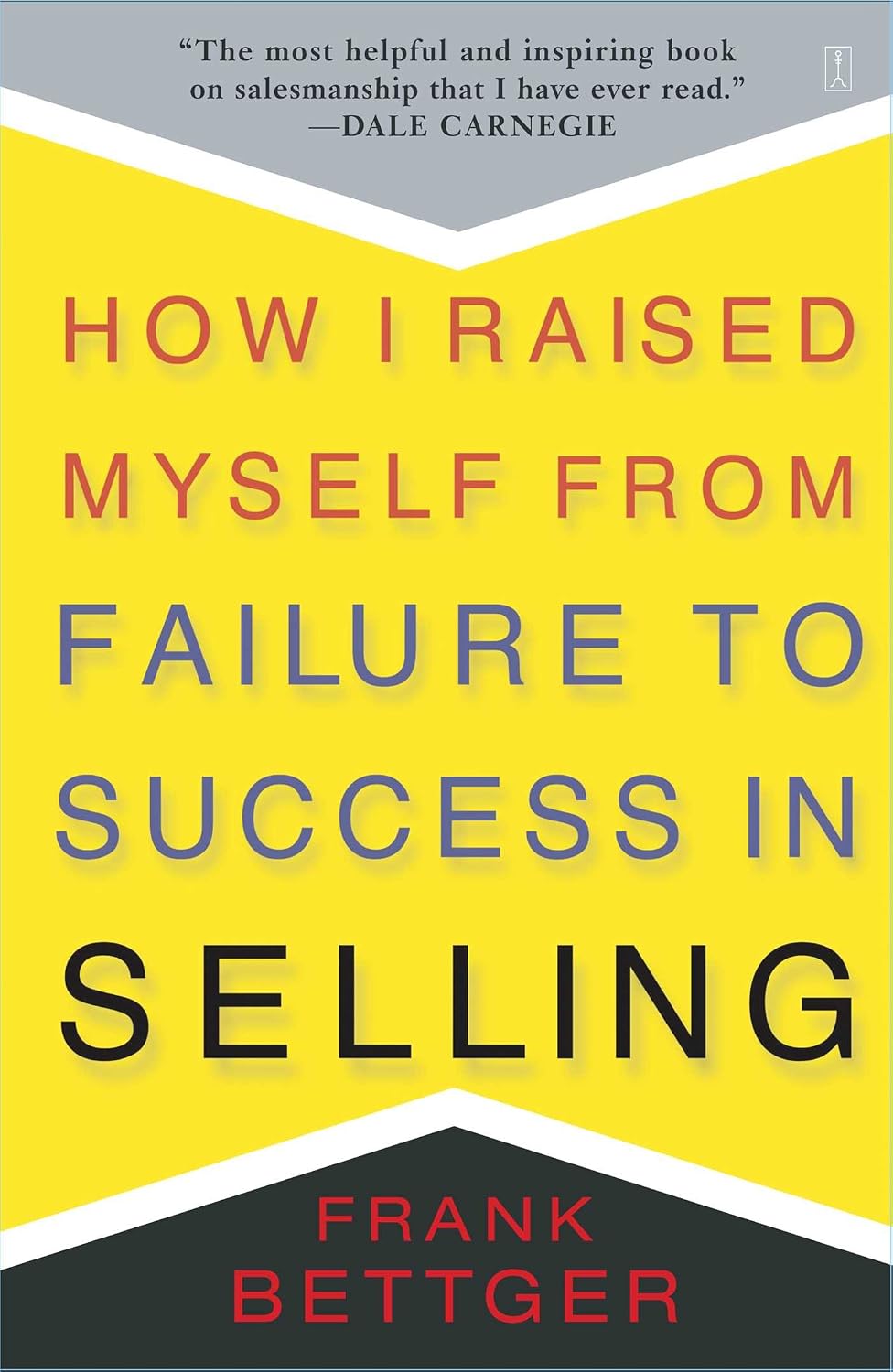
Frank Bettger played professional baseball until an injury ended his career, then went into selling life insurance and nearly quit after a miserable first year. This book, first published in 1949, is how he turned it around and became one of the top salesmen in the country. His lessons are simple and practical. Act enthusiastic and you’ll become enthusiastic. Keep records of every call, because the numbers show you where your time is actually paying off. Find out what the customer really wants by asking questions and listening, instead of talking. And prepare for every meeting as if it’s the only one that matters. Bettger was a friend of Dale Carnegie, who wrote the introduction, and the book reads like a sales-floor companion to How to Win Friends and Influence People.
Highlights
This seemed like a great tragedy to me at the time, but I now look back on it as one of the most fortunate events of my life.
When I force myself to act enthusiastic, I soon feel enthusiastic.
During my thirty-two years of selling, I have seen enthusiasm double and triple the income of dozens of salesmen, and I have seen the lack of it cause hundreds of salesmen to fail.
I firmly believe enthusiasm is, by far, the biggest single factor in successful selling.
To become enthusiastic—act enthusiastic. Put this rule into action for thirty days and be prepared to see astonishing results. It easily may revolutionize your entire life.
I decided during that time to keep a record of the number of calls I made, just to be sure that I did see at least four people every day.
“How am I going to make myself see the people?” I thought. “I certainly have incentive enough. I need the money. I’m not lazy.” Finally, I determined to go back to keeping records. One year later, I proudly stood up before our agency and enthusiastically told my story. I had secretly kept complete records of my calls for twelve months. They were accurate, for the figures were put down every day. I had made 1,849 calls. Out of these calls, I had interviewed 828 people and closed 65 sales. My commission amounted to $4,251.82.
How much was each call worth? I figured it out. Each call I had made netted me $2.30. Think of it! One year previously, I had been so discouraged that I resigned. Now, every call I made, regardless of whether I saw the man or not, put $2.30 in my pocket.
The records showed that 70 percent of my sales were made on the first interview, 23 percent on the second, and 7 percent on the third and after. But listen to this: 50 percent of my time was spent going after the 7 percent. “So why bother with the 7 percent,” I thought. “Why not put all my time on first and second interviews?” That decision alone increased the value of each call from $2.80 to $4.27.
Without records, we have no way of knowing what we are doing wrong.
Selling is the easiest job in the world if you work it hard—but the hardest job in the world if you try to work it easy.
You can’t collect your commission until you make the sale; You can’t make the sale ’til you write the order; You can’t write the order ’til you have an interview; And you can’t have an interview ’til you make the call!
The best way I ever found to help overcome fear and rapidly develop courage and self-confidence is by speaking before groups. I discovered that when I lost my fear of speaking to audiences, I lost my fear of talking to individuals, no matter how big and important they were. This training and experience in public speaking got me out of my shell, opened my eyes to my own possibilities, and widened my horizons. It was one of the turning points in my career.
It is surprising how much I can get done when I take enough time for planning, and it is perfectly amazing how little I get done without it.
Our number-one tool is the “Weekly Work Sheet,” which must be completed by the salesmen, giving the names of all the people they plan to see during the coming week, and a copy must be turned over to us in advance of each week’s work.”
Show me any man of ordinary ability who will go out and earnestly tell his story to four or five people every day, and I will show you a man who just can’t help making good!”
The most important secret of salesmanship is to find out what the other fellow wants, then help him find the best way to get it. In
Finding out what people want, and helping them get it. I can’t begin to tell you the new kind of courage and enthusiasm this gave me. Here was something more than a sales technique. It was a philosophy to live by.
“these top salesmen are all hungry for new ideas and always hunting for ways to do their job better. Attend as many sales conventions as you can. If you get only one idea, the time and money you spend will be the best investment you’ll ever make. Besides, it will give you an opportunity to meet some of the big fellows. Meeting them personally and hearing them talk will inspire you. You’ll go back home with a new confidence and enthusiasm.”
When you show a man what he wants, he’ll move heaven and earth to get it.
He met these objections by asking questions.
Elliott Hall’s questions had only one purpose: To help the other fellow recognize what he wants, and then help him decide how to get it.
Now, Mr. Booth, my job is to help you arrive at a final decision. In order to help you do this, I must ask you some questions. Is that all right?
BOOTH: Mr. Bettger, whom do you represent? ME: I represent you!
1. Make Appointments. Be expected! You gain a big advantage when you make an appointment. It tells the other person you appreciate the value of his time. Unconsciously, he places more importance on the value of your time.
2. Be Prepared.
3. What Is the Key Issue? Or, what is the major point of interest? Or, what is the most vulnerable point?
That sale taught me a big lesson: Never try to cover too many points; don’t obscure the main issue. Find out what it is; then stay right on the beam.
Ask Questions.
6. Explode Dynamite! Do something startling, surprising. It is often necessary to arouse people and stir them to action for their own benefit. You’d better not do it, however, unless you are prepared to back up the explosion with facts, not opinions. I said to Mr. Booth: “Knowing what I do about the insurance business, if you were my own brother, I would tell you to take all those proposals and immediately throw them into that wastepaper basket!”
7. Arouse Fear. Basically, there are only two factors that move men to action: desire for gain, and fear of loss. Advertising men tell us that fear is the most motivating factor where risk or danger is involved. The entire talk to Mr. Booth was based on fear and the unnecessary risk he was taking of losing $250,000 of credit.
(a) Be an Assistant Buyer. In preparation for the interview, I imagined myself a salaried employee of Mr. Booth’s company. I assumed the role of “assistant buyer in charge of insurance.” In this matter my knowledge was superior to Mr. Booth’s. Feeling this way, I didn’t hesitate to put all the enthusiasm and excitement I could command into what I said.
People don’t like to be sold. They like to buy.
(b) “If you were my own brother, I’d say to you what I’m going to say to you now….” A powerful confidence-gainer, if you can use it with absolute sincerity.
looked him steadily in the eye and spoke them with feeling. Then I waited for him to say something. He asked the question most prospects do: “What is that?”
(c) Praise Your Competitors.
I’ve found it is one of the quickest confidence-gainers. Try to say something good about the other fellow.
(d) “I am in a position to do something for you this morning that no other living person can do for you.” A powerful selling phrase.
See things from the other person’s point of view and talk in terms of his wants, needs, desires.
Putting my ideas in the form of questions showed him how I felt about what he should do, but at the same time kept him in the buyer’s seat. Each time he offered an objection or comment, I passed the ball right back to him with another question. When he finally got up, took his hat and said: “Let’s go!” I know he felt that the idea was his.
“If it’s insurance you want to talk about, I’m not interested. I just bought more insurance about a month ago.”
I was sincere in wanting to know this man better, so I ventured one question:
“Mr. Allen, how did you ever happen to get started in the building construction business?”
Never once have I felt that I’ve “sold” them anything. They’ve always “bought.” Instead of trying to give them the impression that I knew all the answers—as was my habit before I heard J. Elliott Hall—I made them give me the answers, largely by asking questions.
For a quarter of a century I’ve found this way of handling people a hundred times more effective than trying to win them to my way of thinking.
Then, he became interested in studying the Socratic method.
The “don’t you think” habit is a little aid which I find helps me avoid making so many positive statements. For example, if I say to you: “We should avoid making so many positive statements. We should ask more questions,” I have merely stated my opinion. But if I say to you: “Don’t you think we should avoid making so many positive statements? Don’t you feel we should ask more questions?” haven’t I shown you how I feel? But haven’t I, at the same time, made you happier by asking your opinion? Isn’t your listener likely to have ten times as much enthusiasm if he thinks the idea is his?
Six Things You Can Gain by The Question Method Helps you to avoid arguments. Helps you avoid talking too much. Enables you to help the other fellow recognize what he wants. Then you can help him decide how to get it. his Helps crystallize the other person’s thinking. The idea becomes his idea. Helps you find the most vulnerable point with which to close the sale—the key issue. Gives the other person a feeling of importance. When you show that you respect his opinion, he is more likely to respect yours.
Lincoln said: “Much of my success as a trial lawyer lay in the fact that I was always willing to give the opposing attorney six points in order to gain the seventh—if the seventh was the most important.”
I have talked with thousands of salesmen, and find that many of them pay no attention at all to the key issue. Oh yes, they have read about it. But what is the key issue? Let’s simplify it. Isn’t it just this: What is the basic need? or What is the main point of interest, the most vulnerable point? How can you get at the key issue? Encourage your prospect to talk. As soon as a man gives you four or five reasons why he won’t buy, and you try to argue each one, you aren’t going to sell him. If you just get him to keep on talking, he will help you sell him. Why? Because he will pick out of these four or five things, the one thing that is the most important, and stick to it.
“I was about to buy a home in Detroit. I called in a real estate man. He was one of the smartest salesmen I have ever met. He listened as I talked, and after a while found out that, all my life, I had wanted to own a tree. He drove me about twelve miles from Detroit and into the backyard of a house in a nicely wooded section. He said, ’Look at those gorgeous trees, eighteen of them!’ “I looked at those trees; I admired them, and asked him the price of the house. He said, ’X dollars.’ I said, ’Get out your pencil and sharpen it.’ He wouldn’t shade the price a nickel. ’What are you talking about?’ I said. ’I can buy a house just like that for less money’ He said: ’If you can, more power to you, but look at those trees—one … two … three … four …’ “Each time I talked price, he counted those trees. He sold me the eighteen trees … and threw in the house! “That is salesmanship. He listened until he found out what I wanted, and then sold it to me.”
The main problem in the sale is to Find the basic need, or The main point of interest. Then stick to it!
The most powerful word in the English language, I believe, is the little word why—but
I don’t know whether you realized what you were doing, Frank, but the first time you called on me, I told you that I was going to tell you the same thing I told every other insurance salesman who came to see me: ’I don’t believe in life insurance.’ “Instead of launching into a long argument, like other salesmen did, you merely asked, ’Why?’ As I explained why, you encouraged me to keep on by repeating, ’Why, Mr. Walker?’ The more I talked, the more I realized that I was on the wrong side of the argument. Finally I convinced myself that I was wrong. You didn’t sell me. I sold myself.
“Now, Frank, the point of the story is this: Since I got back, I’ve sat in my office and sold more lumber, right over the telephone, than I ever sold before, just by asking ’why.’ So I wanted to let you know, in case you didn’t already know how you sold me my first policy.”
this morning a man walked into our place and priced a large machine. I told him it was $27,000. He said, ’That’s too much money for me.’ I said: ’Why?’ ’Because,’ he said, ’it would never pay for itself ’Why?’ I asked. ’Do you think it would?’ he asked frankly. ’Why not? It has been a wonderful investment for everyone who has bought them,’ I replied. ’I couldn’t afford it,’ he said. ’Why?’ I asked. Each time he offered an objection, I asked him ’why.’ He then elaborated on his reasons. I let him talk. He talked enough to find that his reasons did not add up right, so he bought that machine.
I kept a record one time of more than five thousand interviews to try to find out why people bought, or failed to buy. In 62 percent of the cases, the original objection raised against buying was not the real reason at all. I found that only 38 percent of the time did the prospect give me the real reason for not buying.
“A man generally has two reasons for doing a thing—one that sounds good, and a real one.”
Eventually, I hit on a simple little phrase that produced surprising results and which has literally been worth thousands of dollars to me. It’s a common everyday phrase. That’s why it’s good. That phrase is: “In addition to that …”
After a few moments of silence, I said: “Bob, in addition to that, isn’t there something else in the back of your mind?
Now, why did I ask this man that question? Because I doubted his word? No, not at all. His first objection was so logical and real, I had no reason to doubt his word. In fact, I believed it. But years of experience had taught me the odds were two to one that something else was in the picture. My records proved it. So it became habitual with me to ask this question anyhow, just as a routine checkup. I don’t recall ever once having anyone resent my asking it.
“You’ve been a very successful businessman, Mr. Lindsay,” I said. “You must have a good reason for not buying life insurance. Would you mind telling me why?”
I paused as I thought about what he said. Then: “Mr. Lindsay, in addition to that, isn’t there some other reason why you’ve never bought life insurance?”
“In addition to that, isn’t there something else in the back of your mind?” often requires a little additional urging for the other person to open up and talk.
The best formula I ever found to draw out the real one is built around those two little questions: “Why?” and “In addition to that … ?”
a lesson which I’ve had to learn: the importance of being a good listener, showing the other person you are sincerely interested in what he is saying, and giving him all the eager attention and appreciation that he craves and is so hungry for, but seldom gets!
Cicero said two thousand years ago: “There is an art in silence, and there is an eloquence in it too.” But listening has become a forgotten art. Good listeners are rare.
The most important secret of salesmanship is to find out what the other fellow wants, and then help him find the best way to get it. If you want to hit the bull’s-eye, remember the sage advice of Dale Carnegie: “There is only one way under high heaven to get anybody to do anything. Just one way. And that is by making the other person want to do it. Remember, there is no other way.” When you show a man what he wants, he will move heaven and earth to get it. Cultivate the art of asking questions. Questions, rather than positive statements, can be the most effective means of making a sale, or winning people to your way of thinking. Inquire rather than attack. Find the key issue, the most vulnerable point, then stick to it. Learn how to use the most important word in selling, that powerful little one-word question, “why?” Remember that Milton S. Hershey, who failed three times before he was forty, thought this word was so important in business that he dedicated his life to it. To find the hidden objection, the real reason, remember what J. Pierpont Morgan said: “A man generally has two reasons for doing a thing—one that sounds good, and a real one.” It is probably two to one that something else is in the picture. Ask those two little questions: “Why?” and “In addition to that.. ?” Try using them for one week. You will be surprised with your results in overcoming objections. Remember the forgotten art that is magic in selling. Be a good listener. Show the other person you are sincerely interested in what he is saying; give him all the eager attention and appreciation that everyone craves and is so hungry for, but seldom gets. It is one of the most important principles of the formula for success in selling. Yes, it is magic in selling!
“I believe this contract gives you the protection you need and I would like you to give it serious consideration.”
My greatest source of courage, whenever things have looked dark, has come from believing in the wisdom of this philosophy: Not—Will the other person believe it. The real test is, do you believe it?
Frank Taylor, purchasing agent of General Motors many years ago, said: “I like to do business with the fellow who informs himself about his own business, who can tell exactly what he has that I can use, and goes at his work without wasting my time or his. I like the man with useful ideas, the man who can show me how to get more goods or better goods for the same amount of money. He helps me handle my job to the satisfaction of my employers. I try to favor any salesman who is absolutely honest about his goods, and who sees their limitations as well as their virtues. I have never had a misunderstanding with such a man.”
One time I asked one of them where he got all the information. He said: “I subscribe to services that give all the legal answers, sales ideas, etc., and I read the best journals and magazines.”
I’ve always noticed that the leaders are men who know their business.
Henry Ford said: “Anyone who stops learning is old—whether at twenty or eighty. Anyone who keeps learning stays young. The greatest thing in life is to keep your mind young.”
So if you want to have confidence in yourself, and win and hold the confidence of others, find it an essential rule to: Know Your Business and Keep On Knowing Your Business.
Benjamin Franklin: “I will speak ill of no man—and speak all the good I know of everybody.”
So, Rule Three is: Praise Your Competitors.
Why don’t you get your hair cut like a businessman? Have it trimmed every week, so that it will always look the same.
Your color combinations are positively funny! Why don’t you put yourself in the hands of an expert? He’ll teach you how to dress.”
Nobody should wear the same suit two days in succession. If you only have two suits, alternate each day. After each wearing, your coat and vest should be hung on a hanger and your trousers hung straight, not over the hanger’s crossbar. If you do this, the creases will disappear and your clothes will rarely need pressing, until you send them to the dry cleaners.”
Later, after I could afford it, Joe proved to me that it is a great economy to invest in several suits. That enabled me to let each suit hang several days after wearing.
My friend, George Geuting, a real shoe man, told me that these same rules apply to wearing shoes. “If you alternate pairs every day,” George said, “shoes feel better, hold their life and shape better, and last much longer.”
Someone has said: “Clothes don’t make the man, but they do make ninety percent of what you see of him.” Unless a man looks the part, people won’t believe what he says is important. And there is no doubt about it; when you feel well dressed, it improves your mental attitude toward yourself, and gives you more self-confidence.
Deserve Confidence. The real test is: do you believe it, not will the other person believe it? To have confidence in yourself, and win and hold the confidence of others, an essential rule is to: Know your business … and keep on knowing your business! One of the quickest ways to win and hold the confidence of others is to apply the rule of one of the world’s greatest diplomats, Benjamin Franklin: “ I will speak ill of no man—and speak all the good I know of everybody.” Praise Your Competitors! I’ll Cultivate the habit of making understatements; never exaggerate! Remember Karl Collings’ philosophy: “Yes, but I’ll know it .” An infallible way to gain a man’s confidence quickly is to: Bring on your witnesses. And they are as close as the telephone. Look Your Best. “Put yourself in the hands of an expert.”
There seems to be something magic in this question: “How did you ever get started in this business?”
Telephone companies have proved by actual test that the voice with a smile wins.
I am a great admirer of Abraham Lincoln, and one reason I am is because he came to the point so quickly.
Overtalking is one of the worst of all social faults.
Now, where do you suppose I got some of the best advice on how to approach? Not from salesmen at all. I got it by asking the prospects themselves. Here are two things I learned from them that helped me:
They dislike salesmen who keep them in suspense about who they are, whom they represent, and what they want.
They admire the salesman who is natural, sincere, and honest in his approach, and who comes right to the point about the purpose of his call.
If the salesman calls without an appointment, they like him to ask if it is convenient to talk now, rather than start right off on a sales talk.
“There is little use telling a sales story to a prospect who hasn’t first been sold on the importance of listening to you. So use the first ten seconds on every call to purchase the time you need to tell your complete story. Sell the interview, before you attempt to sell the product.”
If I should drop in on a man, without an appointment, I simply say: “Mr. Wilson, my name is Bettger, Frank Bettger, of the Fidelity Mutual Life Insurance Company. Your friend, Vic Ridenour, asked me to stop in and see you the next time I was in your neighborhood. Can you talk for a few minutes now, or would you rather I call later?” Usually he will say: “Go ahead” or, “What did you want to talk to me about?” “You!” is my reply. “What about me?” he generally asks.
“the best approach I ever found was to first find out about a prospect’s hobby, and then talk about that hobby.”
Me: Mr. Kothe, I can’t tell by the color of your hair or the color of your eyes what your situation is, any more than a doctor could diagnose my condition if I walked into his office, sat down, and refused to talk. That doctor couldn’t do much for me, could he? Mr. KOTHE(usually with a grin): No, that’s right. Me: Well, that’s my position with you, unless you are willing to take me into your confidence to a certain degree. In other words, in order that I may show you something at a future date that might be of value to you, would you mind if I ask you a few questions? Mr. KOTHE: GO ahead. What are the questions?
My last question is (with a smile): “What do you do when you are not working, Mr. Kothe? In other words, do you have a hobby?”
After I complete the information, I get out as soon as I can. I say: “Thank you for your confidence, Mr. Kothe. I am going to give this some thought. I think I’ve got an idea that may be of value to you, and after I work it out, I’ll give you a call for an appointment. Is that satisfactory?” And his answer generally is: “Yes.”
interview. sale before the sale. The approach must have only one objective: selling the sales interview—not your product, your interview. It is the sale before the sale.
First, sell the appointment Second, sell your product.
“Mr. Zeigler, my name is Bettger. I’m in the life insurance business. A mutual friend gave me your name with the understanding that I wouldn’t mention his name. He told me that you have been very successful, and that you should be a good man for me to talk to. Could you spare me five minutes now, or would you rather I stop some other time?”
Welcome objections It took me a long time to understand that the best prospects are the ones who object. I was surprised when I learned that many of the objections which had been getting rid of me were really buying signals. For example: “I can’t afford it…. See me in January…. See me in the spring…. I want to think it over…. I want to talk it over with my wife…. Your price is too high. I can do better than that.”
Prospect:… See me after September fifteenth. Salesman: Mr. Carroll, if your boss called you into his office tomorrow morning and offered you a raise in pay, you wouldn’t say: “No, see me after September fifteenth,” would you? Prospect: No, of course not. He’d think I was nuts. Salesman: Well, isn’t that practically what you’re telling me now? Just write your name here (pointing to dotted line) just as it’s filled in at the top, and you’ll have several lessons completed by September fifteenth. Prospect (picking up application form): Leave this and any literature you’ve got with me. I’ll think it over and let you know next week. Salesman: Why don’t you sign it now? Prospect: I don’t think I should take this course right now. Salesman: Why? Prospect: Well … I really can’t afford it. Salesman (pause):… In addition to that, isn’t there something else in the back of your mind? … Isn’t there something else holding you back from making this important decision? Prospect: No, that’s the only reason. I always seem to be short of money. Salesman: Mr. Carroll, if you were my own brother, I’d say to you what I’m going to say to you now. Prospect: What’s that? Salesman: Write your name here now, and let’s get started! Prospect: What’s the smallest amount I can pay now, and how much would I have to pay each month? Salesman: You state the amount you can pay now, and I’ll let you know whether you can begin. Prospect: Would $25 now and $10 a month be all right? Salesman: It’s a deal. Write your name here (x….) and you’ve made the first step. Prospect: (signs application form) 6. Ask prospect to write his name here
The foundation of sales lies in getting interviews. And the secret of getting good, attentive, courteous interviews is in selling appointments! The secret of making appointments is to stop swinging for a home run, and merely try to get on first base. First, sell the appointment. Second, sell your product.
170
“Babe,” he asked, “what do you do when you get in a batting slump?” Babe replied: “I just keep goin’ up there and keep swingin’ at ’em. I know the old law of averages will hold good for me the same as it does for anybody else, if I keep havin’ my healthy swings. If I strike out two or three times in a game, or fail to get a hit for a week, why should I worry? Let the pitchers worry; they’re the guys who’re gonna suffer later on.”
we now read of the amazing record of the immortal Babe Ruth, with his unapproached total of 714 home runs; but another unapproached world’s record of his is carefully buried in the records, never to be mentioned—striking out more times than any other player in history. He failed 1,330 times!
Dick said, “In this world, we either discipline ourselves, or we are disciplined by the world. I prefer to discipline myself.”
“My great concern,’ said Lincoln, “is not whether you have failed, but whether you are content with your failure.”
Thomas Edison had ten thousand failures before he invented the incandescent bulb. Edison made up his mind that each failure brought him that much closer to success.
Here is my list, and the order in which I used them: Enthusiasm. Order: self-organization. Think in terms of others’ interests. Questions. Key issue. Silence: listen. Sincerity: deserve confidence. Knowledge of my business. Appreciation and praise. Smile: happiness. Remember names and faces. Service and prospecting. Closing the sale: action.
I made up a 3″ x 5″ card, a “pocket reminder,” for each one of my subjects, with a brief summary of the principles, similar to the “pocket reminders” you have found throughout this book. The first week, I carried the card on Enthusiasm in my pocket. At odd moments during the day, I read these principles. Just for that one week, I determined to double the amount of enthusiasm that I had been putting into my selling, and into my life. The second week, I carried my card on Order: self-organization. And so on each week. After I completed the first thirteen weeks, and started all over again with my first subject—Enthusiasm— I knew I was getting a better hold on myself. I began to feel an inward power that I had never known before. Each week, I gained a clearer understanding of my subject. It got down deeper inside of me. My business became more interesting. It became exciting! At the end of one year, I had completed four courses. I found myself doing things naturally, and unconsciously, that I wouldn’t have attempted a year before. Although I fell far short of mastering any of these principles, I found this simple plan a truly magic formula. Without it, I doubt whether I could have maintained my enthusiasm … and I believe if a man can maintain enthusiasm long enough, it will produce anything!
If I were your own brother, I would say to you what I’m going to say to you now … you haven’t got much more time!
by now you may be confused. You don’t know what to do about it. Well, there’s one of three things you can do about it:
THIRD: YOU can take the advice of one of the greatest minds this continent has ever produced, Benjamin Franklin. I know exactly what he would say if it were possible for you to sit down alongside of him today and ask his advice. He would tell you to take one thing at a time, and give a week’s strict attention to that one thing, leaving all the others to their ordinary chance.
let’s assume that you select thirteen subjects best suited to you. By concentrating on one thing at a time, you will get farther with it in one week than you otherwise would in a year. A new confidence will take hold of you. At the end of thirteen weeks, I know you will be surprised with your progress. If your friends, business associates, and your family fail to tell you they have noticed a big change come over you—then I know, by the time you repeat the second thirteen weeks, everybody will see in you a greatly different person.