- Rating
- —/10
- Read
- December 2023
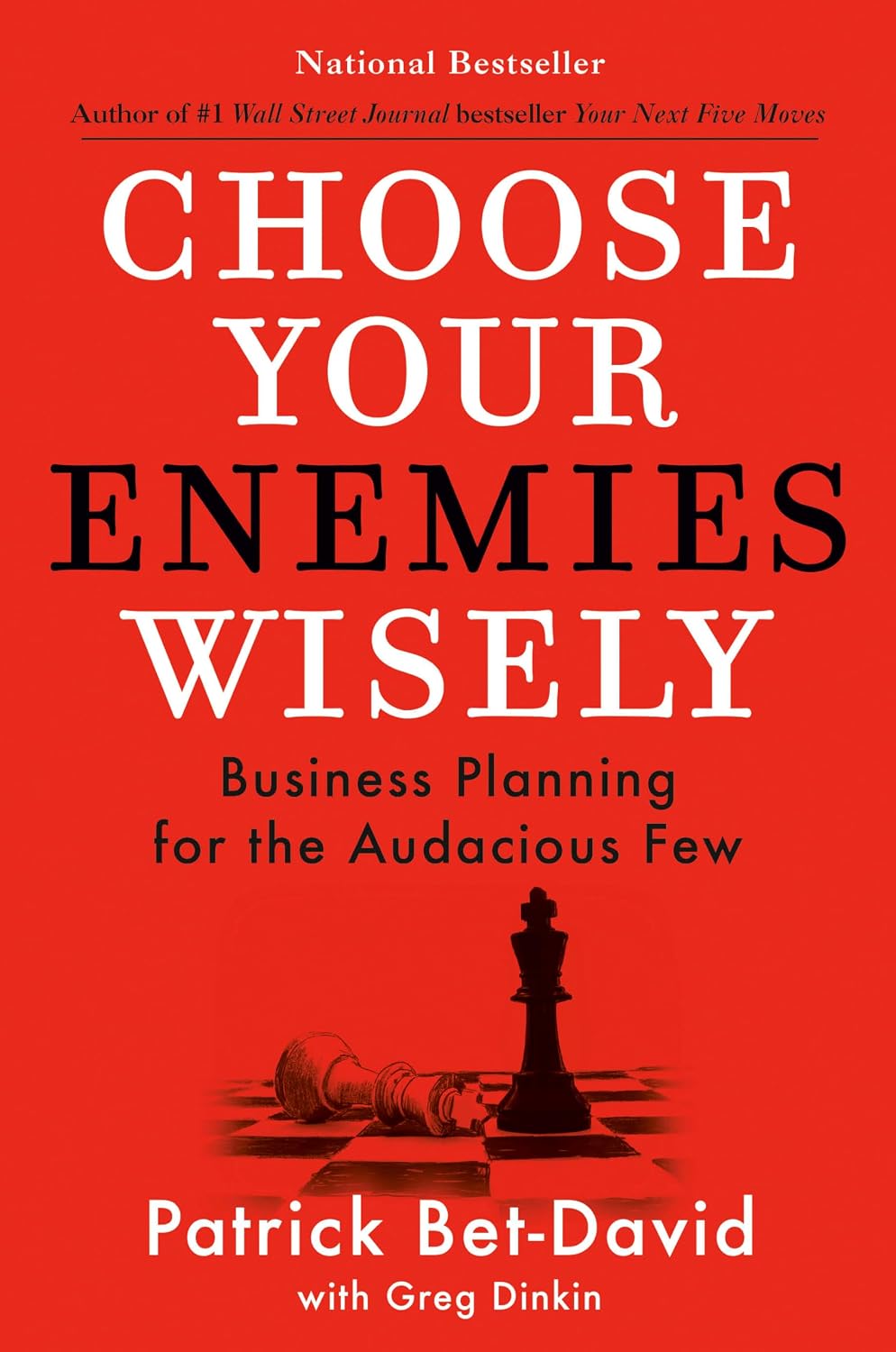
Patrick Bet-David, the founder of Valuetainment, wrote this with Greg Dinkin as a guide to business planning, with a twist. Most planning books start with the market. Bet-David starts with the person: what you want, what drives you, and who you’re trying to beat. His argument is that the right enemy, whether a rival, a doubter, or an earlier version of yourself, gives a plan its fuel. From there the book works through vision, strategy, and execution, with a planning framework you can apply year by year.
Highlights
What if you could turn shame, guilt, anger, disappointment, and heartbreak into the fire that propels you toward your wildest dreams?
The man who insulted my dad created a fire that would move me in ways that I didn’t know I could be moved.
When many bad things happen at once and we can no longer handle the stress, we have either a breakdown or a breakthrough.
With the goal of showing the world what the Bet-David name is all about, I immediately dropped all bad habits. I was done with clubs. With my free time, all I did was read books on investments, sales, and anything that had to do with business.
Whenever things got really tough for me, I could always go back to the image of those men making my dad feel small. The desire to prove them wrong was stronger than the urge to quit.
The key is to choose your enemies wisely. As you will see, there’s a process to it. You must identify the right target and get emotional when you think about why you must defeat this enemy.
your business plan must be both emotional and logical.
If you’re only logical, you have probably struggled to inspire people.
If you’re only emotional, you have struggled to develop systems and stay organized.
Do I sound like a broken record yet? Good. I’ve learned from decades of leading people and making more mistakes than I’d like to remember that repetition is key.
adjectives are often a poor substitute for a concrete strategy.
That’s why business partnerships that check both the emotional and logical boxes are so effective. Steve Jobs/Steve Wozniak, Warren Buffett/Charlie Munger, Mark Zuckerberg/Sheryl Sandberg, and Bill Gates/Paul Allen (and later, Bill Gates/Steve Ballmer) are excellent examples of balanced business partnerships.
the 4:59 club, the underachievers who are so anxious to leave work that they can’t even wait for the clock to strike five o’clock.
The challenge is knowing how to leverage your superpowers while addressing your shortcomings.
I can’t tell you how many times I’ve recommended the book The 5 Love Languages. I even made a video called “The 9 Love Languages of Entrepreneurs” because it’s so important to understand what makes people tick.
The person who recommended The 5 Love Languages to me conducted an interesting survey. He asked every divorced person he knew what their ex’s love language was. Almost none of them had a clue. Imagine being married to someone and not knowing what makes them feel loved and appreciated. Is it any wonder they got divorced?
They only looked forward. Before you write a business plan, you must first look back.
Whether it’s dating or business, there’s a simple explanation. An important question was not asked: What should I have done differently? You either avoided seeing your role in the problem or you rationalized your role. You didn’t bother looking at trends or searching for your own weaknesses. In short, you failed to see yourself as the common denominator.
It took a lot of failure for me to understand that the most important data for you is found in the year that just passed.
In order to predict the future, you have to study history.
What happened last year for you? What went right? Judge your year based on what percentage of your goals became a reality.
Once you identify who you need to beat, you will naturally raise the standard for what you must achieve.
There’s an entire book called Debrief to Win, written by Robert “Cujo” Teschner, a former Air Force Top Gun, to show businesses how to study the past.
take the time to think about the last year and answer these questions: Did you have New Year’s resolutions or a personal plan for last year? Did you hit your goals? What did you learn from what you did or did not do? Did you have a clear focus? Did you include business and personal goals? Were there clear metrics on how to measure success? For a more detailed way to look back at the previous year, go to Appendix A.
if you want to do something big, you must eliminate distractions.
Take the time now to think about what events have consumed your mind over the past year. What are your time and energy leaks?
Take a look at this list and ask yourself if anything resonates with you: One bad Yelp or Google review An event that should have taken three days to handle took three weeks Toxic relationships Unreliable vendors Vengeful former employees Did any events consume you for months at the expense of your business? Did your ego take over and seek revenge so much that you lost focus?
Marcus Aurelius said, “Let no one rob me of a single day who isn’t going to make a full return on the loss.”
“What will my life look like if I eliminated most of my distractions?”
Make a list of five to ten events that consumed your mind in the past year. Now think ahead to the coming year. What could weigh you down? What can you clear? How will you clear it?
As you look back at your previous year, get really honest about what stole your time and energy. This may be a little uncomfortable for some of you. Giving up drinking, porn, gambling, or even Instagram, ice cream, and internet dating might make all the difference in the world.
When I was twenty-six, I made a promise to myself to give up sex until I made my first million dollars. I ended up going seventeen months without sex and my results, both financially and spiritually, were better than at any point in my life up until then.
My drinking days started in the army and are now nearly two decades behind me. It seems so obvious to me now to avoid alcohol, yet I get asked about it all the time. My answer: Why would I drink? If I drink, I give away too much information. I’m not focused. I don’t retain information. I don’t learn. I do stupid things. I want to minimize the amount of stupid things I do. I want every edge I can get to make the best decisions at all times. Once I realized all this, it was a no-brainer for me to eliminate alcohol.
“You need to eliminate. You can’t get something for nothing. Over the years, I’ve given up soda, ice cream, alcohol, and sleeping in. I didn’t have a TV for many years. Before I had kids, I gave up my Sundays.”
Before moving forward, you must answer this question: What must I eliminate from the previous year?
I constantly remind people that not making any commitments and choosing a safe route in life is riskier. The key point is to choose your commitments wisely.
Every Business Owner Falls into One of Three Categories: 1. Wingers 2. Thinkers 3. Doers
Which one are you? Be honest and be specific. You may be a big thinker and doer for sales campaigns but wing it when it comes to systems. You may be great planning for momentum but lousy at preparing for a crisis. Give some thought about what you are winging, and how you plan to fix it.
I read The Toyota Way, which stressed the importance of casting a long-term vision. From day one, I said that our company would have U.S. presidents, A-list actors and comedians, and Hall of Fame athletes speak at our conventions. I boldly announced that our twenty-year plan was to have five hundred thousand licensed agents by 2029. Since we started with only sixty-six, that sounded ridiculous.
Fail to think long-term and create a business plan that looks far enough into the future, and your success will be short-lived.
Let’s also take a cue from The Toyota Way and remember that the bigger picture is to have at least a twenty-year time horizon. To get there, you must use the six building blocks of emotion and the six building blocks of logic.
“Those who cannot remember the past are condemned to repeat it.”
The greatest pleasure in life is doing what people say you cannot do. Walter Bagehot, English journalist and businessman
When you look back at your previous year, search carefully for where you got in the way. Take the time to see your patterns and keep a close eye out for self-sabotage.
Be honest about where you fell short in the previous year and why you couldn’t keep your promises.
Choosing the right enemy is the first and most important step. Once you identify who you need to beat, you will have the fuel to get to work on the rest of the plan. When you want to beat someone or something bad enough, all the building blocks become important to you. It’s not like one day you wake up and, for no good reason, you start to love spreadsheets or exit interviews. What actually happens is that you get so tired of losing, so sick of feeling ashamed, and so determined to beat your enemy that what you once saw as annoying tasks you start to see as tools for winning.
After you choose your enemy, you can let go of your pen or your keyboard. All you need to do is consider duration, depth, and magic. Visualize what it will look and feel like to create something that continues to excite you and will endure in the marketplace. Take the time to think at least twenty years out so that your actions align with long-term success.
Long-term thinkers place value over profit.
For some of you, the thought of creating a multigenerational business will make you think long-term. Taking the time to consider your kids or grandkids running the company will force you to think more about the next two decades than the next two quarters. Be patient and sit with this for a while. Step three doesn’t require you to write. It only requires you to imagine what the future will look like.
I often say that those who don’t look at their business plans after February didn’t write a business plan; they wrote a wish list.
A vital part of the plan is to course-correct at least every quarter. You’re not writing a plan so it can gather dust for a year. You are creating a document that needs to be continually updated.
You projected doing $3.5 million in revenue in Q1 and you actually did $2.8 million. Now what? How do you explain to your board that you missed revenue projections by 20 percent? I can tell you from experience that the only thing that will make that meeting less painful is showing that you performed a detailed analysis. When you go to your board with logical explanations—this is how we miscalculated, this is how the market changed, this is how new trends are impacting us—along with revised projections and updated strategies, you’ve done yourself a favor and put the business back on track.
The 6 Biggest Mistakes of Business Planning 1. Not having a plan 2. Not examining last year’s plan 3. Not having an enemy that acts like rocket fuel 4. Failing to integrate logic and emotion in the current plan 5. Not making it a living document—don’t use it to manage 6. Not sharing it (so no one could hold you accountable)
All the biggest and best companies had an enemy. Microsoft had to defeat IBM. The developers of the iPhone had to kick BlackBerry’s ass. Apple’s music division continues to compete with Spotify and Mixcloud. The process for you is the same one these great companies used. It’s also the formula that Nike used to unseat Converse and Adidas in the basketball-shoe market. In 1984, Converse had 56 percent of the basketball-shoe market. With Adidas in second place, Nike was a distant third.
One of your building blocks is your mission, which includes your principles and values. In the film, Phil Knight kept this mission front and center with a blackboard in his office. For Nike, the ten principles were: 1. Our business is change. 2. We’re on offense. All the time. 3. Perfect results count—not a perfect process. Break the rules: fight the law. 4. This is as much about battle as about business. 5. Assume nothing. Make sure people keep their promises. Push yourselves, push others. Stretch the possible. 6. Live off the land. 7. Your job isn’t done until the job is done. 8. Dangers a. Bureaucracy b. Personal ambition c. Energy takers vs. energy givers d. Knowing our weaknesses e. Don’t get too many things on the platter 9. It won’t be pretty. 10. If we do the right things we’ll make money damn near automatic.
Knowing your principles makes decisions easier. There’s less temptation to take shortcuts and go for short-term profits over value when you’re clear on your principles.
You can follow this map for any endeavor. Most people start a project by listing their goals and objectives. There are two problems with this approach. First, you don’t have any data to analyze. Even for an entirely new project, you need to at least reflect on your own history and identify your weaknesses. And second, without identifying an enemy, you won’t have the emotion that will carry you through all the challenging times.
To be a winner, you must learn from winners. It’s by design that I have studied Tom Brady like a hawk.
Outside enemies unify and inspire a team. Internal enemies tear apart a team.
As a leader, I build a culture of intense competition.
But who pisses you off? Who’s the person who said you’d never make it?
As a leader, you must find out what moves people. Whether you are interviewing a job candidate or giving a sales presentation, logical questions lead to rote answers that offer no clues about what drives someone.
When I meet new people, I ask questions about their upbringing, heartache, regrets, and fears. I also ask what they dreamed about as a kid and how alive those dreams still are. I want to know what moves them, so together we can identify their enemy.
I want you to remember why you used to sprint out of bed in the morning. I want you to tap into the meaning behind what you do. Right enemies = Relentless drive. Enemies don’t have to be people. They can also be things like government institutions, religious persecution, or censorship. You can also view enemies as the roadblock to your success or the success of your customer. Alex Banks, an expert on AI and technology, shared on Twitter “10 simple storytelling tips [from Elon Musk] to nail your next pitch.” Not surprisingly, the first step was “Name the enemy.”
Your enemy could be predatory lending, the obesity epidemic, or the failure of public schools to teach the right values. As long as you can tap into the emotion from that enemy, you have the chance to be unstoppable.
A great example was a residential real estate agent in South Florida who I interviewed when I was looking at houses. She was a calm, personable, and professional woman. It was no surprise that she was number three in her market, which netted her a multi-seven-figure income. I bet you can guess the first question I asked her after I learned she was third in the market. That’s right, I asked her how she felt about the number one real estate agent in her market. I said, “How badly do you want to beat him?” She turned red. I saw the fire in her eyes as she said, “I want to kill him!”
Do you have someone like that in your life? How about your business? Once you know your enemy, here are three important questions to ask: 1. Why do you want to defeat this enemy? 2. What will it feel like when you defeat this enemy? 3. What reward will you give yourself when you defeat this enemy?
Still searching for an enemy? If you need another reminder, think about the haters, the doubters, the people who rejected you, the unimpressed family members, and the trolls. The people who made you feel small or like you weren’t part of the club are also great motivators. Did it hurt when your old girlfriend called you a loser before she dumped you, or when your guidance counselor said you had a future digging ditches? Those people and those words are the catalysts. They ignite your insecurities that sting the most. What insecurities sting the most? The ones that you fear to be true.
Now let’s look at a list to see if you can identify your enemies. 14 Types of Enemies OUTSIDE YOURSELF 1. Someone you hate 2. Relatives who try to hold you back 3. Manipulators 4. Gossipers 5. Someone to prove wrong 6. Your ex-spouse or former business partner 7. Someone who doubts you 8. People who quit on you WITHIN YOURSELF 9. Scarcity mindset 10. Your own limited thinking 11. Your ego 12. Contentment/mediocrity 13. Fear of success MY VOTE FOR THE MOST POWERFUL ENEMY THAT DRIVES WINNERS 14. People who are beating you because their vision and accomplishments are greater than yours
The most powerful enemy is people who are beating you because their vision and accomplishments are greater than yours.
Since many people can’t stand airport security, flight delays, and baggage restrictions, we’re going to offer a luxury bus with Wi-Fi, high-end TVs, and beverages. This will cost less than a tank of gas and eliminate the hassle of driving. The party will start the minute you step on the bus, and it will be a fun and economical way to get to Vegas with all your stuff. Your job is to identify the pain points of consumers, and then position yourself to solve those pain points. With a statement like the one written above, instead of pretending you don’t have competition, you have devised a strategy to beat them.
Who are your direct competitors? 2. Who are your indirect competitors? 3. What competitors aren’t so obvious but still need to be monitored? 4. Who are you underestimating? The people who get underestimated the most are those without much experience. They have nothing to lose. 5. Where are your opponents strong? What markets/areas will you concede? 6. Where are your opponents weak? What markets/areas will you attack? 7. Who can you acquire? What strategies will you employ to acquire them at the lowest valuation? (Weaken them to drive down the price.) 8. Who could acquire you? What strategies will you employ to get acquired at the highest valuation? When you can identify the competition, you can devise a strategy to beat them.
When I delegate anything to my team—whether it’s buying computers or office equipment, hiring lawyers, or choosing a convention hotel—they know to always come to me with at least three options.
As you plan for the upcoming year, do an audit of all your expenses. For anything above $1,000, make sure you are getting at least two bids. If it’s over $5,000, three bids, and if it’s over $25,000, four bids. This is especially important for all your service providers like IT consultants, insurance companies, and attorneys. Tell them exactly what you’re doing. You’ll find out quickly that their prices change when they know you are shopping their competition.
I never stop looking for people who drive me. Each year I identify at least one specific enemy. I’ve got stories for days about enemies who motivated me: A public hospital administrator who shamed me when my dad got sick. She wouldn’t attend to my dad when he needed her after another heart attack. A company that didn’t listen to my suggestions and basically told me to “shut up and sell.” A company that sued me when I started my own company. My high school guidance counselor, Ms. K., who said, “I feel sorry for your parents. If I was your parent, I’d also have heart attacks. You’ve brought a lot of pressure on them.” Let me remind you that all my stories are to get you to think about your own life.
Immediately after this confrontation, I went on a massive run. I thought about Harry many times a day. I printed out his words and laminated them: “Bet-David, you’re full of shit. You’re not willing to work as hard as me. You’re not as focused as me. You’re not as great of a leader as me. And you never will be.”
Sports teams are always looking for “locker-room material.” Any bad word uttered by an opponent gets printed and placed on the bulletin board or written on the chalkboard.
The goal isn’t to be ridiculous; it’s to find ways to keep that enemy top of mind and in your face—until you graduate to the next enemy. I keep a list of all the bad things people have ever said about me. I pull it up in my mind all the time.
“Hustle until your haters ask if you’re hiring.”
YOUR BLOCKS ENEMY Actions: 1. Go back through your life to identify your enemies. The ones who produce the most emotion get the highest grades. 2. Write out specifically what was said by an enemy that stung the most. The look. The smirk. The more details, the better. 3. Pick a specific enemy for this year, season, or campaign. Name at least one for you personally and one for your business. 4. Remove any unworthy enemies. Check your ego. Identify who you’re holding a grudge against or who is below you now and let them go. 5. Decide right now how you will celebrate when you defeat your enemies.
COMPETITION Actions: 1. Who are your direct competitors? Who are your indirect competitors? 2. Make a list of other solutions that compete to meet the needs of your current and prospective customers. 3. Ask the right questions and identify the competition that doesn’t yet exist. 4. Become a detective and study your competitors to see how they position themselves against you. Watch how they answer calls and email requests. Study their social media and their websites. Analyze their approach to learn your own weaknesses and how to differentiate yourself from them. 5. Go through expenses and make sure you are getting multiple bids on all your products and services.
The f-word (fear) gets a bad rap. Fear can drive you to do whatever it takes. You need to make two sales to hit your quota? Big deal. What happens if you need two sales to pay for life-saving surgery for your kid?
After I read Robert Greene’s 33 Strategies of War, I bought the audiobook, and for two years, I kept it on repeat while I was driving. I probably listened to it a hundred times from beginning to end.
The next question is, What must he do to develop those skills? To fill in the next two building blocks, I want you to ask yourself two questions: What makes you want success so bad? And what skills must you add to achieve this type of success?
Money can only move you so far. If your motivation is solely money, you’ll stop at some point. You’ll become lazy or complacent. If you want to do something big with your life, you have to tap into something more powerful than wealth.
Some questions to ask yourself as we continue: Where does will come from? Why must you succeed? What does it mean to have “heart”? How can I push past limitations?
I wasn’t there to record his words, but you can bet Ray Kroc didn’t say, “I want to build an iconic American business.” He said will.
For your business plan to work, you have to get to the root of your issues. You identify them so you can address them. Skill-building means anything that contributes to your life, whether it’s joining a gym or starting marriage counseling. Yes, in your building block for skill, I want you to write down the exact actions you must take to overcome your weaknesses, whether they are related more to your business or your life. When you improve, your business improves.
What skill sets do you need to make this your year?
Peter H. Diamandis, founder of the X Prize Foundation, wrote on his blog, “There will be two kinds of companies at the end of this decade. Those who are fully utilizing AI, and those who are out of business.”
Here are three questions to ask to continue constructing your skill block: 1. Who do I need to be to hit next year’s forecast? 2. What three to five skill sets are required? 3. What will I commit to for training and personal and professional development?
I can confess to you now that, for years, I was terrible at conflict resolution. The way I improved on that skill is exactly what I’m about to suggest for you. I made it one of my three topics of emphasis and read six books on conflict resolution in one year. Those books included Leading with Emotional Courage, Difficult Conversations, The Hard Truth about Hard Things, and, my favorite, Crucial Conversations: Tools for Talking When Stakes Are High, which has sold more than five million copies. All this effort, and believe me it was hard, transformed a weakness into a strength.
At a minimum, ask your direct reports the following: 1. In what three areas did you excel this year? 2. What were three areas that need work? 3. What do you think you need to do in order to address those areas and/or skill deficiencies?
In both my organizations, at the beginning of 2022, I made Crucial Conversations the book of the month. For the top leaders, they were required to send me their key insights and then meet to discuss. I then hired a consulting team from Crucial Learning to lead a two-day workshop for both companies. At $30,000 a pop, I spent $60,000 for the two events.
Yes, your plan needs to include ways for everyone who impacts your business to add new skills. When you help others win, you win. That’s why one of the best things you can do for others is to lead them to invest in skills.
I invested $16,000 in sending Maral to Harvard Business School to take executive courses when she was still the director of finance. The decision was easy, since she followed the above six steps in her previous trainings—and kept building skills that helped the firm. She was also constantly asking what her blind spots were, how she could improve, and what books I would recommend. And because she took the advice to heart and kept improving, I kept saying yes to more training.
You do not want to have a reputation for running boring meetings. If you do have this reputation, how can you improve your skill in this area? What action steps must you take to make meetings better? Here is where you start to seamlessly integrate will and skill. Start with these three questions: 1. Why is this meeting so important? 2. What is my intention? 3. What behavior and attitude do we want people to have after this meeting?
Read the HBR Guide to Making Every Meeting Matter. Study how Jeff Bezos leads meetings, including these three tips: 3 Rules for Meetings According to Jeff Bezos 1. Keep the group size manageable. Bezos said, “We try to create teams that are no larger than can be fed by two pizzas. We call that the two-pizza team rule.” 2. No PowerPoint. Use actual memos that tell stories instead of recite data. 3. Start with silence. Give people time to read the memos or relevant information before starting the discussion.
You have to know how to poke people. To be effective, sometimes you have to make it hurt. The best leaders know how to disturb people.
Ask yourself the hard question about what your reputation is—in the marketplace, with your friends, and with your family. Be honest. Do you step up when someone questions your will? What words move you? “Coward,” “quitter,” “winger”? Do you notice a pattern of quitting too soon?
What elicits your willpower? What words trigger you? Is there likely some truth to them?
What do your friends say about you? What do your coworkers say about you? What does your family say about you? What does your spouse say about you when he or she lies next to you, and you know they’re thinking something about you but they’re not telling you what it is? By the way, if three, four, or five people say the same thing about your reputation and they all know you very well, it’s probably true. Are you okay with that?
What three words don’t you ever want to hear said about you? What three words do you want attributed to you? Once you’ve figured these out, you can start figuring out what skills you need to build to make the reputation you want for yourself. Once you find your will, you’ll learn the corresponding skills.
either gain the skill or recruit people who have it.
On the skill side, think about who you need to recruit or what tasks you need to delegate. Let’s say you can’t stand cooking or grocery shopping and want to eat healthier. It doesn’t mean you have to enroll in culinary school or hire a personal chef. What you can do is sign up for a meal delivery service or hire someone for a few hours to do meal prep.
What skills are crucial to your success that you lack the time, interest, or ability to perform? What’s your strategy to bring those skills to your company and/or to your life?
Back in 2011, I identified four people who were at the top of the trust axis but had skill gaps. Their names were Patrick, Maral, Mario, and Tigran. Yes, that Patrick was me—I was at the top of that list! Since I needed to work on leadership and on how to be a better CEO, I enrolled in a leadership course at Harvard. It killed me to step away from the business for a month, but it turned out to be one of the best decisions I ever made.
Henry Ford said, “The only thing worse than training your employees and having them leave is not training them and having them stay.”
Richard Branson said, “Train people well enough so they can leave; treat them well enough so they don’t want to.”
What about the highly skilled people you don’t trust? If you’re saying that you have no choice but to take the good with the bad, this is a sign that an area you need to work on is leadership development. If you believe you are stuck with these people, it means you haven’t developed the skills of the people you do trust to do the job. Who do you think Maral, Mario, and Tigran replaced? I can’t go to war with people I don’t trust.
Let’s just say you have a full-on genius of a person who is the best coder but horrible with people. Or you have a CFO who is highly skilled but puts everyone to sleep in his meetings. What do you do with these people? It depends on how coachable they are. In other words, do they have the will to want to get better? If so, make the investment to build their skill block.
YOUR BLOCKS WILL Actions: 1. What makes you want success so badly? What’s your plan to convert wantpower to willpower? 2. What do you fear most? What thoughts or emotions make you so emotional that you want to do everything in your power to avoid feeling them? 3. What three words don’t you ever want to hear said about you? 4. What three words do you want attributed to you? 5. How can you lead in such a way that elicits willpower in others? 6. What patterns and limiting beliefs do you see in yourself, and what will you do (or who will you seek for guidance) to be the one to stop them? SKILL Actions: 1. Who do you need to be to hit next year’s forecast? What three to five skill sets are required? 2. What type of skills/training will you commit to that has the potential to change your identity? 3. Where do your leaders or team members lack skills? How will you address them? 4. For skills you’re not going to address yourself, how will you delegate or who will you recruit? 5. What choices will you make after looking at your Performance vs. Trust Matrix? Who will you invest in and which skills will you emphasize? 6. Fill in the blank: I want my reputation to be defined by the words ____________. 7. Fill in the blanks: If I keep having a reputation for _____________ (fill in biggest weakness), I won’t get to the next level, which will nullify all my hard work. I will address this deficiency by _____________.
true. Mission is highly emotional, and plan is highly logical. Neither is optional. Having a mission creates endurance.
without a strong mission, you’re not going to attract the right people to you. You’re just another company to work for, another person solely driven by money.
When we’re talking about your mission, “recruiting” is an inside job. I use the word “recruit” differently than most. To me, everything is recruiting; it’s going out and making things happen, whether it’s finding talent for your company or gaining clarity about your mission. With your mission, it’s not always right in front of you, which is why you have to recruit it and bring it toward you. To be more specific about recruiting your mission, there are four things you can do to make it come alive for you. 4 Ways to “Recruit” Your Mission 1. Take the time to see what moves you. 2. Determine what you’re sick and tired of. 3. Ask, “What sets me off?” 4. See what bothers you so much that you won’t be able to live with yourself if you don’t do something about it.
At Valuetainment, we spent years not just thinking about our mission but finding the exact words to articulate it. The mission is to enlighten, empower, and entertain current and future leaders around the world.
Here are excellent examples of mission statements from three very different companies: Patagonia: We’re in business to save our home planet. TED: Spread ideas. Tesla: To accelerate the world’s transition to sustainable energy. Here are the personal mission statements of three popular people: Oprah Winfrey: “To be a teacher. And to be known for inspiring my students to be more than they thought they could be.” Walt Disney: “To make people happy.” Denise Morrison, former CEO of Campbell Soup Company: “To serve as a leader, live a balanced life, and apply ethical principles to make a significant difference.”
Rather than think about formulas, I want you to feel what actually moves you. Now is the time to get real about what you really want to do with your life. Here are a few questions to guide you: 1. What cause are you fighting for? 2. What injustice are you correcting? 3. What crusade are you leading?
One of those exercises comes from a book called The Leaderless Revolution: How Ordinary People Will Take Power and Change Politics in the 21st Century, written by a former British diplomat to Iran named Carne Ross. Ross says that the people who start revolutions or do something big or disruptive are those who take action based on three things: 1. What they love 2. What they hate 3. What bothers them
What do you hate? What is something you can’t stand? Who is getting bullied that you want to stand up for? If it’s you or the people close to you, you will really be on to something. Who do you love that needs help? What bothers you produces juice. It creates the emotion that you need. Finding something that bothers you doesn’t always have to be this deep or personal. Maybe you love the smell of a clean bathroom or can’t stand toxic fragrances. With this thought, a lucrative business may be waiting to be discovered.
Keep asking these questions: What do you love? What do you hate? What bothers you?
At the end of 2008, I started thinking about the upcoming year and wondering, “Is this all there is to life? All these things I had to go through, were they just to make money? Is this all there is? Why do I need to get out of bed every morning when I’m already wealthier than my wildest dreams?” I knew in my gut that there had to be something bigger than the life I was living. Looking back, I was dancing around the real question: What is my mission? I tried to rededicate myself. I read motivational books and signed up for motivational workshops. But nothing changed. I couldn’t find anything to get me going. Looking back, the one area where I can give myself credit is that I was actively recruiting my mission. I asked a lot of questions. I sat down with mentors. I sought the counsel of my pastor, Dudley Rutherford. I asked friends to tell me where my blind spots were.
to being a man on a mission. My mission was, and still is, to use entrepreneurship to solve the world’s problems and teach capitalism because the fate of the world depends on it.
When I started my financial services firm, our mission statement was to bring back the free enterprise system and hope to American families. To this day, I’m convinced that the more people I can show how to make their own money through business, the more problems we will solve and the freer we will be.
You may be asking, “Pat, is that a good enough mission?” Only you can answer that question. Say it out loud and see what emotion it stirs up. Say it while looking in the mirror and see what happens to your body language. If it feels good, it probably works. Say it to others and see how you feel. If you’re self-conscious, that’s telling you something. If you feel a sense of pride, that’s also valuable information.
recommend you do this for yourself and for your business, knowing there will be some crossover. For your business, you can do this with a team. For now, focus on the personal so you can start to build your own plan for the year. Strengths Work ethic Coachability Industry knowledge Laser-sharp focus Weaknesses Leadership The ability to manage multiple projects Disorganization Listening Opportunities Scaling the business Opening new markets Being more productive Developing new leaders Threats Poor health/low energy Losing employees to competitors Running short on capital Interest rates/market conditions
Strengths For strengths, leverage what you do best. Looking at your strengths is a great way to identify your opportunities.
Weaknesses For weaknesses, build skills, delegate, or mitigate.
Opportunities For opportunities, keep asking what’s possible, don’t worry about the “how.” Opportunities are exciting. This is where you ask a lot of “what if” questions. What if we can raise our price by 15 percent without losing any market share? What if we can find a sales leader who can make our existing team better and free me up to work on leadership development? What if we can hire a personal assistant for a few of our executives—how much more productive will they be? What if we can add a new product to our mix? What if we can hire a producer who is so talented that our page views triple?
Threats For threats, cultivate a paranoia mindset. What are your threats for the upcoming year and for the next decade? You’ve brought family into the business. What happens if they start arguing? Like with weaknesses, either you deal with threats directly or you delegate. Do you need to research every topic? Is it better to do it yourself or is it worth paying someone else to do that research?
If poor health, burnout, or low energy are threats, you build that into your plan. It might mean hiring a personal trainer or it could be installing a gym at your office and hiring someone to teach yoga twice a week. In that case, you are mitigating both a personal threat and a threat to your organization.
I’m surprised at the number of hands that don’t go up when I ask who reads The Wall Street Journal. We all need to be reading it. Even if you’re in a specialized industry, you need to be aware of business and geopolitical news.
Your ability to see five to fifteen moves ahead allows you to anticipate a crisis. When it’s already been addressed in your business, it allows you to handle it with precision. I put plans in place for all scenarios, both good and bad, to happen.
If I lose my biggest customer, what happens? When I ask that question, I start working on how I can prevent that from happening. Maybe I’ve taken that customer for granted. It’s a common but reckless mistake to put all your energy into customer acquisition and neglect your current customers. You fall into the bad habit of letting everybody else on your team deal with your customers. Maybe you have to pick up the phone more, schedule an in-person meeting, or send a gift. Do you see the pattern? Identify the threat or potential crisis. Then create a plan to address it before it happens. Keep asking yourself questions like, If I lose my biggest sales rep or biggest revenue producer, what happens? That question takes you down a similar path. What do you need to do to prevent a superstar from leaving you? How’s your relationship with her, on a scale from zero to ten? Let’s say you rate it a five. Well, maybe you’ve got to take her out to an event and spend some time with her and her family to show her how much you care about her. She needs to know that. That’s part of your plan. Here are some other “what ifs” to consider: 1. If my current office doesn’t work out and I’m forced to relocate, what happens? 2. What if we run short on cash? 3. If I go on disability for three months, what’s the replacement plan? 4. What’s the impact of labor or material costs rising? 5. What if we get sued? 6. If we have to scale up quickly to hire more staff, how do we speed up the process? Are we better off adding to our HR team or hiring a recruiting firm? An even better way to ask questions is to build in solutions to the question. When you frame a question this way, you move directly to action. For example: If my staff tries to unionize or goes on strike, what are my first three moves? See how you created a better question? When you frame the question by asking what your next three to five moves are, it gets you moving to create concrete plans. Consider question five, “What if we get sued?” Do you see how this question doesn’t put you in solution mode? It’s better to ask, “If we get sued, what are our first three moves?” If move one is finding an attorney and you don’t have one, you’ve exposed a weakness. You need to act now so you have legal counsel standing by.
One way to keep your mission current is with your language. Even as things change, be vigilant about being a person who says “I just want to” versus one who says “I’m on a mission to” person.
YOUR BLOCKS MISSION Action: 1. How will you recruit your mission? What questions must you ask to find the fire inside of you? 2. What cause are you fighting for? What injustice are you correcting? What crusade are you leading? 3. What are the things you love? What are the things you hate that you would finally feel brave enough to fight against? What are the things that bother you that you would want to change? 4. Write out a mission without the word “just” and with the word “because.” 5. Do at least two litmus tests to see how it feels: a. Say it out loud. b. Say it in front of the mirror and watch your body language. c. Say it to others and make note of how you feel. 6. Be honest about getting complacent. If you feel bored, have plateaued, or are distracted by toys, it’s a sign to revisit your mission. PLAN Action: 1. Complete a SWOT analysis. Be honest about your weaknesses/leaks and get excited asking “what if” questions. 2. Based on the SWOT analysis, plan out improvements for three areas in your business. 3. List the three to five moves you would make if you suddenly had to go on disability or sick leave, or if a disaster occurred and you were no longer there to run your company. 4. Ask “if” questions for at least seven scenarios and make sure you map out at least your first three to five moves.
In this chapter, I invite you to dream big. I challenge you to come up with ideas that will make people question your sanity. It’s only by thinking this way that the impossible can happen. I’m talking about something as crazy as my becoming an owner of not just any major league franchise but the one in the Bronx that has won twenty-seven World Series titles.
I think of systems as dream-making machines. You could also call systems hero-making machines. The dream may be to win the Mr. Olympia competition. The systems are the workouts, nutrition, supplements, recovery, and stretching. Equally important is the sequencing of these systems and the commitment to refining and reinforcing each step. 7 Steps to Create a Dream-Making Machine 1. Speak the dream language at least 20 percent of the time. 2. Turn your dreams into specific goals. 3. Make your goals visual. 4. Create the systems to make your dreams and goals a reality. 5. Analyze data and trends to improve the systems. 6. Keep refining existing systems and look to create new ones. 7. Remember to always speak the dream language—and make it emotional!
A great prompt is “Imagine if one day . . .” That’s how my dream to own part of the Yankees started. Take a moment now to fill in what comes next. Allow yourself to dream: “Imagine if one day I . . .” Win the Nobel Prize Launch a billion-dollar IPO Discover a cure for cancer Revolutionize secondary-school education Love what I do so much that it doesn’t feel like work Another simple prompt for the dream language is “It would be incredible to . . .” Live in a house with a view of the ocean Send my kids to the best private school Look at my bank balance and see another zero Never have to look at the prices on a menu or travel site Here are a few other prompts to tap into your dreams: 1. What would my life look life if . . . 2. What I’m aiming to get for myself and my family is . . . 3. What I most look forward to is . . . 4. My bucket list includes . . .
Thinking about how you will celebrate makes your dreams come alive.
The emotion generated by this building block comes from picturing what your life will look like when you achieve your dreams.
You program your psyche by using a reward to reinforce your dream. When you decide on the award in advance of achieving your dream, you are programming your mind to believe I’m willing to pay a price because this reward is going to happen. This is a continuous feedback loop that you must integrate into your plan.
Goals are the specific outcomes we aim for on our way to achieving our dreams. Dreams direct our energy; goals take that direction and create a laser focus. When goals are specific and measurable, giving us deadlines and putting rewards in place, they work.
Effective Goals Specific Measurable Have a deadline Rewards in place When I do X, I will treat myself to Y. When I do X, I will treat my friends and family to Y.
My definition of future truth is to live in the present as if what you’re aiming for has already become a reality. I express my dreams with the conviction that they are going to happen. I’ve seen time and time again how that conviction is contagious. If you don’t 100 percent believe it, no one will.
How will you create visuals that are constantly connecting you to your dreams? Because I was once a Hummer mechanic, I had a dream of one day buying a yellow Hummer. I gave myself the goal of increasing my savings to $1 million in twelve months. If I hit this goal, I told myself, only then could I begin the process of buying the yellow Hummer. My first step? I put a picture of a yellow Hummer in twenty different places. I couldn’t even see the speedometer on my car because there was a picture of a yellow Hummer there! On my phone, a yellow Hummer. On my mirror, a yellow Hummer. When I would open up my wallet, a yellow Hummer. I used every visual I could think of to imprint this yellow Hummer in my conscious and subconscious mind. And guess what? A year later, I got the yellow Hummer. It has to be in front of your face all the time.
If your dream, for example, is to retire your parents, on the screen saver for your phone or computer, put a picture of them with big smiles sitting on the porch of the house you’re going to buy them.
There is a Jewish tradition in which a mezuzah, a parchment with religious text, is placed on the doorframe of a home. What’s written on the parchment comes from this passage in Deuteronomy 6:9: “And you shall inscribe them upon the doorposts of your house and upon your gates, in order that your days and the days of your children shall increase, on the land which the Lord swore to your forefathers to give to them, as the days of heaven above the earth.” After the mezuzah is placed on the doorframe, every time a Jewish person enters their home, they have a visual reminder of their dreams. What symbol or visual will you use to keep your dreams constantly in front of you?
In the conference room at Valuetainment, we had an artist paint the following quotation from William Goldman: “Nobody knows anything . . . Not one person in the entire motion picture field knows for a certainty what’s going to work. Every time out it’s a guess and, if you’re lucky, an educated one.” We did this because we want to make visual our dream of being a company that encourages creativity and risk-taking. We want the idea that every creative endeavor requires risk inscribed on our walls, so it becomes inscribed in our subconscious minds. Here are some other places for visuals: Bathroom mirror Photos in your wallet Vision boards placed in strategic locations Phone and computer screen savers Art you create for your home and/or office
Peter Drucker, the author and founder of modern management, said, “If you can’t measure it, you can’t change it” and “What gets measured gets managed.”
You need data to answer the following questions: What trends did you notice? Were there spikes/dips in revenue/production? Once you’ve analyzed that data, how will you address these trends? You’ve done some of this work in chapter 2 when you looked at the previous year. The next step is to create systems to gather data, analyze it, and plan strategies based on what you’ve learned. The engineers and accountants love this section, and the visionaries are smart enough to see its importance. The audacious few understand that only with efficient systems can dreams be achieved.
Your first resolution as you start your new business plan has to be getting better at tracking data. If you’re sitting here a year from now without a system to gather, analyze, and utilize data, you’re leaving tons of money on the table. Numbers to measure: Every month’s record Every quarter’s record Next year’s goals Revenue/net profit New subscribers/customers You need data to answer the following broad questions: 1. What will you measure? How will you measure? 2. What’s your strategy for analytics next year? 3. What trends did you notice? 4. How do you create incentives to balance spikes/dips in revenue/production? 5. Why will next year be different?
When you see a problem or an opportunity, I want you to shift your thinking from “We need a solution for that” to “We need a system for that.” A solution is a onetime fix that requires you to keep reinventing the wheel and puts you in a reactionary place. A system is an ongoing activity that becomes duplicatable.
A major part of systems is having the right people manage projects for me so I can be as…
wasn’t until I realized how valuable my time was that I had to stop doing these things myself. Then, gradually, I started asking, “What’s the next thing I can have someone else do that I no longer need to do?” The formula is the following: What do you know for a fact that your hour is worth? If next week you were able to…
It takes a small leap of faith to start spending money on things you used to do yourself. It only took me four weeks to realize how valuable those hours were for me. As my hourly rate increased, so did the number of tasks I delegated. I went from one personal assistant to two. Now all I think about is how I can get my hours back to increase my efficiency. That’s why I’m constantly in the process of finding strong project managers. Project managers come in different shapes and forms. It’s not just…
Doctor’s appointments are a drain on productivity, especially when they are spaced out. That’s why, for me and our C-suite, we do executive health testing. At places like the Mayo Clinic, UCLA Medical Center, or the Cleveland Clinic, you can see nine doctors in one day, from 6:00 a.m. to 5:00 p.m., instead of having to schedule nine different appointments over a span of six weeks and driving to nine different locations. How many wasted hours have I saved by doing that? Counting driving time? Gas cost? Waiting nine different times for doctors…
I saved the most important question in this chapter for last: What makes you feel like a child again? What makes you feel like a kid on Christmas morning? How can you get to a…
YOUR BLOCKS DREAM Action: 1. What dream gets you fired up? What specific words will you use to articulate this dream that force you to stretch, yet still allow the dream to feel attainable? 2. Declare your dream as a future truth and start to live in the present as if your future truth has already become a reality. 3. Convert dreams into goals by making them specific and measurable, with a deadline and a reward once you achieve. 4. Pay attention to your language. See if you are casting dreams at least 20 percent of the time when you are speaking to your team . . . and even speaking to yourself. 5. Make a list of five to seven statements beginning with “Imagine if one day . . .” and/or create a bucket list to drill down and find your true dreams. SYSTEMS Action: 1. Put systems in place for every quarter. Right now, go into your calendar and list two actions that will support your dreams in your personal life and two in your business for every change of season. 2. Put systems in place to gather, analyze, and implement data. 3. How can you automate your life and business? What systems will allow you to buy back time so you can be more efficient? 4. Find ways to buy back time. Figure out your hourly rate and delegate all activities that cost less than what you make.
As you plan your upcoming year, first think about the culture you want to create. That’s a thought exercise, and it’s worth gathering your leaders for a discussion. Then you want to plan the rituals and traditions that actually breed the culture that you say you want. There’s a direct tie-in from your mission to your culture. Culture is your mission coming to life.
Now that you can see what it means to identify a culture, ask these questions to create your own: What defines your company culture? What are you actively doing to create it? How do you sell it to customers? How do you sell it to employees and partners?
If you have a business, the question is “Who do you want your business to be?” In answering it, choices about your behavior—your traditions and rituals—will get answered.
Culture is in the doing. It’s the rituals and traditions that get repeated that create a culture.
I can say from experience that especially if you’re going to drive people hard, they’d better feel five things: 1. They are part of something. 2. They are cared for and supported. 3. They are making a difference. 4. They are having fun and celebrating success. 5. They are being recognized for their contribution and feel needed.
22 Ways to Build Culture 1. Encourage feedback so people are radically honest and transparent. 2. Make everything about how to make things better. 3. Pranks: they keep the environment fun and loose. 4. Have contests (at least monthly) to encourage competition. 5. Music: it energizes people and adds excitement. 6. Hire people who fit the culture. Don’t force people who don’t fit. 7. Add your personality and what makes you unique. 8. Create rituals and traditions. 9. Invest in personal and professional development. 10. Read together. Have a book-of-the-month club. 11. Celebrate birthdays and special occasions together. 12. Send personalized, handwritten cards for birthdays and important milestones. 13. Know people’s dreams and create a merit-based system for them to realize them. 14. Get feedback from all sides of the company—genders, ages, experience, etc. 15. Surprise your team with spontaneous events. 16. Value leadership over titles. Titles matter, but examples of leadership matter more. 17. Recognize the right behaviors—give heroes the hero treatment for exceptional performance. 18. Allow for crazy things to happen—funny videos, etc. 19. Everyone has to be held accountable—and is subject to being called out. 20. Make high standards nonnegotiable. 21. Send meaningful gifts that show you know and care about the person. 22. Treat people so well that they don’t want to leave.
14 Things to Look for in an Inner Circle 1. Confidentiality: what’s said stays in the inner circle. 2. Zero tolerance for games: manipulation leads to loss of trust, and trust is the foundation of the inner circle. 3. Accessible: easy to get a hold of. 4. Opportunity magnet: good attitude. 5. Lacks drama: doesn’t see themselves as a victim. 6. Someone who gives insight (constantly teaches): shares insights on new books, interesting articles, and new ideas. 7. Pays attention to details: special touch and goes above and beyond. 8. Strong Rolodex and high credibility: they know people, and because of their credibility, these people take their calls and respond to their proposals. 9. Respect in their approach: the way feedback is given; the way they deal with others. 10. Defends you: tells you what’s said about you behind your back; protective of the relationship and your credibility. 11. Dependability: you can bank on their word. 12. Exchange of value: not one-sided; picks up their share of the checks. 13. Fun and humble: zero tolerance for arrogance. 14. Presentable in appearance: never sloppy.
What are the benefits of working with you? 1. What benefits are you currently offering to others? 2. In what ways do people improve by associating with you? 3. How many lives have you changed positively in the past year? Put even more simply, do people around you win big?
You need to answer the question: What benefits do you offer? By doing so, you will know how much value you are really bringing to people. If you don’t like your answers, you’re not going to attract people. If you’re not attracting people, it’s a sign you have more work to do to create success for others.
It’s the surprise events and memorable activities that offer the highest return on investment. Make those events count and do them irregularly so they break up the routine and infuse your company with energy. You also want to have a good number of events that need to be earned. This keeps people excited and builds a culture in which success is based on merit.
Reasons for Building a Great Culture 1. Excellence and high standards 2. Retention 3. Fun and excitement 4. Scalability and sustainability 5. Becomes bigger than you
Questions People Ask When Deciding to Work with You 1. What makes your company distinct from your competition? 2. What separates your leadership from that of others? 3. Do you have a code of honor? Do you embody it?
How are people talking about you? What are you going to do this year, and every year, to both recruit and retain people? What rituals and traditions will you put in place?
Before the sun came up, I texted three leaders of our company—Mario, Tom, and Robert—and asked them to jump on an emergency call together. I told them, “I plan on making a five-year, hundred-million-dollar offer to Tucker Carlson. Let me sell it to you for ten minutes. Then I want you to tear it apart. Give me every reason not to do it.” After a half hour, we all agreed it was a good idea.
Needing to overpay people or offer best-in-class benefits is often a symptom of not having a strong culture, just like needing to have the lowest price is a symptom of not having anything unique about your product. You can pay people all the money in the world, and they still won’t look forward to coming to work.
A culture that fosters retention is when people say: I can’t wait to be there. I’m making a difference and an impact. I’m having fun. The leaders are delivering on their culture’s promise.
The next part of your planning process requires you to look back at your team from the previous year. Here are some questions to consider: 1. Who, in the previous year, proved they don’t belong? 2. Who proved they can be trusted and should play a bigger role? 3. Who do I need to recruit? 4. Who (bookkeeper, personal assistant, etc.) allows me to buy back time? 5. Who (employees) allows me to grow? 6. Who do I need to collaborate with? 7. Who turns a weakness into a strength?
Your supporting cast should take stuff off your plate. They should help you double your time and never become a distraction or a burden.
I can’t believe how many people don’t have personal assistants. Even if you can’t afford someone full-time, you have to find ways to minimize administrative tasks or time-consuming ones that don’t bring much value to the business.
In terms of recruiting, think of both offense and defense. Legal and compliance are examples of defense. Technology and analytics (data science) are both. Cybersecurity is defense. Better software that speeds up processes is offense. Analytics will help you see both leaks and opportunities. The minute you can afford to hire data scientists—or even if you’re not sure you can—you need to hire these people. That could easily turn a weakness into a strength, just like hiring a great personal assistant will do for you if you’re disorganized.
Since Netflix is such an excellent case study for culture, it’s valuable to examine what they have done to build their team. Netflix cofounder and former CEO Reed Hastings follows the “rock-star principle”: paying a significantly higher salary to hire one rock-star software engineer rather than hiring ten competent engineers. No Rules Rules: Netflix and the Culture of Reinvention by Reed Hastings and Erin Meyer is a must-read. It will change the way you think about who you hire and how you compensate them. Hastings writes: In the first few years of Netflix, we were growing fast and needed to hire more software engineers. With my new understanding that high talent density would be the engine of our success, we focused on finding the top performers in the market. With a fixed amount of money for salaries and a project I needed to complete, I had a choice: hire 10 to 25 average engineers, or hire one “rock-star” and pay significantly more than what I’d pay the others, if necessary. Benefits of Hiring a Rock Star 1. Sets the tone 2. Raises the bar and brings out the best in others 3. Shows what’s possible 4. Elevates performance 5. Expedites results To hire rock stars, you must be a rock star: other rock stars want to join a team led by a rock star, especially one with the confidence to challenge them. This ties back to your “benefits package,” and you’d better be able to answer these questions: 1. Have those around you made more money than they ever have? 2. How does your plan incorporate making others around you wealthy? 3. What do you want your top leaders/sales reps to make in the coming year? (Make a list for two to six of these top players.)
What benefits, both financial and nonfinancial, do others derive from being around your best self in the upcoming year and decades that follow?
I believe in high standards. No one ever won anything without high standards. That’s why I call people out during Zoom meetings when I see them getting distracted. It’s why I lock the doors at conferences and company meetings the second a scheduled break ends. I don’t care if the people with low standards who can’t be on time think I’m a hard-ass. I care that the people who are on time think that I set the bar high.
YOUR BLOCKS CULTURE Action: 1. Choose the word or words that embody your culture. 2. Assign each new hire to read a book and write a one-page report so you can see how serious they are about working there. 3. Create an initiation ritual for new hires that embodies the culture, like a barbecue, hike, or sporting event. 4. Create rituals and traditions that align with your culture. 5. Build your reputation by being authentic so you retain the people who share your values. 6. Find people who believe in your culture. For example, it starts with you being the prophet evangelizing the concept of reading books as a tradition in your company.
Then you look for those you trust to promote this culture. TEAM Action: 1. Go back to your SWOT analysis and identify the key people you need to recruit to play better offense and defense. 2. Find rock stars who can elevate your company and happily pay them well above market rate. 3. Evaluate people hired on a scale from 0 to 60 using the Running Mate Scorecard. 4. Invest in developing the competencies of true believers lacking skills. 5. Hire people who allow you to buy back time.
Good business leaders create a vision, articulate the vision, passionately own the vision, and relentlessly drive it to completion. Jack Welch
Jeff Bezos put it more succinctly when he said, “Be stubborn on vision but flexible on details.” Did you get that? Do you know the core of your vision, and are you stubborn about it? Have you identified the nonnegotiables that apply to everything you do? If I get an opportunity that pays a ridiculous amount of money but isn’t aligned with my vision, it’s easy to say no.
The expression “When it absolutely, positively has to be there overnight” has become synonymous with FedEx. That vision guided everything. It created an obsession with logistics, technology, and systems. If it meant losing money for a few years or sacrificing the quality of the packaging, it didn’t matter.
Earlier in the book, we talked about making your dreams visual for yourself. You do the same for your vision, except you expand the reach by constantly putting it in front of your employees, customers, and partners. For Schnatter, that meant using slogans internally like “Keep the Main Thing, the Main Thing,” and “P.A.P.A.” (People Are Priority Always). Of course, most of us have heard their ads, which repeat the vision over and over, “Better Ingredients, Better Pizza.”
For Schnatter, “Better Ingredients, Better Pizza” was never just a goal or an ideal. It was a vision that transcended profitability and short-term goals. It was an obsession that drove every detail of the business.
When I started my financial services business in 2009, I laid out a specific vision. I dressed like Doc (Christopher Lloyd’s character) from the 1985 film Back to the Future to let everyone know that we were going to create our own future. When you’re announcing a big vision, the setting helps. Where you speak and how you dress can amplify the effect. Having a vision means answering these questions: How big are we going to be? What markets are we going after? What history will we create? Who is going to write about us and what will they say? How will the world look “one day” based on this vision?
Like you do with dreams, when it comes to vision, you want to use the phrase “Imagine one day if . . .” Imagine one day if: Entrepreneurship and financial literacy are part of grade-school curriculums. No one will have to use an insulin pump, and diabetes will be easy to manage. Seniors have peace of mind knowing their health care is taken care of. You can seamlessly connect to a world-class expert and be billed by the minute.
Having a vision is an essential part of your business plan. Your vision statement needs to check three boxes: Describes what you will create. It’s the link between your imagination and the future reality where you change the status quo. Creates real impact on your customers and/or on the world. Clarifies priorities that ground all your choices and provide direction.
When Brunson was asked who the best younger poker players on the circuit are, he said, “Ask me in twenty years.”
At the end of 2022, I brought my wife to the Business Planning Workshop. I made all of my leaders watch the full-day workshop online. My wife cleared off a twenty-two-foot wall and made it a board to write on, and we wrote out our vision. I knew it was a hundred percent necessary to not just do a vision board, but also to get a hundred percent clear on our vision. We needed to write down the justification for why we’re all here. And it couldn’t just be about the money. What is our dream? Why are we treating ourselves like the underdog? Why can’t we see ourselves as killers who are just getting started? Let’s do a highlight reel of the past fifteen years to remind ourselves how we got here.
If you only write down your values and principles, you will get almost no value from them. If you print them and post them somewhere in your office, you’ll still get little value from them. To create real impact, you must ritualize how they are created—only then will they start to inform your full vision.
My Business Principles 1. Never compromise our nonnegotiables. 2. Micromanage until there is trust. 3. What brought us here won’t take us to the next level. 4. No one has 100 percent job security, including the founder or CEO. 5. Create positive peer pressure by challenging one another. 6. Beat your prior best. 7. Treat the company’s money like it’s your own. 8. Be radically open-minded but not easily persuaded. 9. Fight any temptation to lower expectations and standards. 10. Create an environment where our team is taken care of financially and professionally.
I repeat these values and principles so many times because I know they will eventually stick. A message heard once is not plenty. Repetition is how things get ingrained in people’s minds. How many times do you think the slogan “Better Ingredients, Better Pizza” was repeated by Papa John’s? Visuals help as well. In the foyer of my house, there is a massive painting with these words: Lead, Respect, Improve, Love.
Remember that people don’t quit jobs; they quit leaders.
I encourage you to create a special event where you and your inner circle can define your vision and ensure its staying power. Here are seven guidelines to make your own: How to Make Your Values and Principles Spread and Stick 1. Choose a meaningful place to create your values and principles. 2. Bring all the key stakeholders. 3. Allow everyone there to participate. 4. Narrow the list of values and principles to no more than twelve. 5. Make it your own with a preamble, or whatever works for your team’s culture. 6. Create an impressive visual. 7. Put that visual in all appropriate places after the event.
No matter who you are talking to, your vision must be convincing. Author Simon Sinek said, “People don’t buy what you do. They buy why you do it.” I want you to keep that in mind because even though much of this block is logical, it’s the belief and emotion that spring from your vision that provide the fuel and win people over.
As Sinek points out, you need to understand and express the why behind your product or service. What you do and who you are is one thing. Why you are better is another. Timing is everything. You’d better have answers for why now and be prepared to back that up with data.
Here are the “why” questions that you must answer before pitching your company. Why Questions 1. Why is it different? 2. Why is it needed today? 3. Why hasn’t it been invented yet? 4. Why is it hard to copy your idea? 5. Why are you the right person to build it? 6. Why is someone going to buy it? 7. Why will it hit revenue projections? (How big is the market? How many of those people are going to buy it?)
You also want to use phrases like “Let me paint you a picture” and “Imagine one day if . . .” To cast a vision, you want to ignite people’s senses, especially sight. You must make them see and feel. The best way to do this is to rehearse answering key questions, using clear and concise language. The reason we’ve been able to win is . . . What customers love about us most is . . . Our situation is unique because . . . We’re growing quickly because . . .
This is how I answered these questions when I started my financial services company. The reason we’ve been able to win is . . . Demographics and marketing have changed, and the industry has not. The average insurance agent is a fifty-seven-year-old white male who is uncomfortable with technology. Our average agent is a thirty-four-year-old Latina who grew up on social media. What customers love about us most is . . . They see themselves in us, and we relate to their needs. We refined our systems so there is less paperwork for the customer and the process is easy. Our situation is unique because . . . We limited our product to life insurance so we can recruit more efficiently and decrease the time and expense to become a moneymaker. Our customer acquisition costs are much lower because of how we leverage social media. We’re growing quickly because . . . Our culture resonates with young, ambitious people, and we offer a path to financial freedom that’s attainable and duplicatable.
Rules for Elevator Pitches for Your Business 1. Understandable. Any investor, partner, or customer should be able to easily understand your pitch—no technobabble! Your listener shouldn’t have to think too hard to understand it. Somebody who is not in your industry should be able to follow the pitch. No buzzwords, acronyms, or industry jargon. Save those for internal meetings. 2. Quantified. Numbers win—size the market, state your sales, etc. Not just a concept. There are some proof points. 3. Succinct. The pitch needs to flow nicely in thirty seconds. 4. Compelling. The first three must state who you are, what you do, and why you win in a way that’s: EASY for the listener to grasp! HARD for the listener to ignore!
To craft your elevator pitch, start by filling in the blanks: My Elevator Pitch: The problem: The problem we see/What’s missing in the market/What’s frustrating people is: ______________________________________________ The solution: Our company solves this problem by: ______________________________________________ The core differentiator: What makes us unique and what allows us to win is: ______________________________________________ Some statistics (numbers): We earn our revenue by: ______________________________________________
THE PITCH DECK—OVERVIEW The next step is creating and sharing a concise presentation of fifteen slides with a compelling verbal narrative that’s wrapped in contagious emotion. The pitch deck has three sections, all designed to follow the flow in a typical investor’s mind: Part 1: Problem, Solution, and Timing The problem: What’s the customer’s pain point? How do they work around or solve it now? Your solution (product/service and the magic that differentiates it): How will you deliver value that fixes the problem or meets the need and makes the customer’s life better? What’s the use case? Your business model: How do you get paid? Why do this NOW? What leads you to build it at this hour? Are the customers ready? What’s the history that leads us to this being the right moment?
Part 2: Market, Competition, and Timeline The market you serve The competition: Who are they? Never say there’s no competition. The consumer has had a work-around. Before Reddit, there was CompuServe and AOL chat rooms. Before that, there was the town square. The timeline: How long have you been doing this? What key milestones have you accomplished to date? Part 3: Team, Financials, and the Ask Team: Where did you get the experience from? You’d better be able to explain your bio. You need to prove that you can execute. Finance: Results so far and the forward forecast. You need some results and a practical assessment. The ask! How much do you need? Equity, debt. How long will it last?
Now is the time to put everything together into one plan. Though I recommend that you write at least something in every block, it’s more important that you make the business plan your own. Sometimes you need to learn the rules before you can break them.
You want to break down your business plan into the smallest parts possible. Ideally, it will fit on three pages—a cover page and then all 12 Building Blocks on adjoining pages.
QUESTIONS AND PROMPTS TO COMPLETE YOUR BUSINESS PLAN The Year of _________ (Magic, Scaling, Growth, Clarity, Commitment—What’s the One Word That Sums Up Your Year?) This plan is for: me my team investors all of the above This plan is for the _____ (calendar/fiscal) year and it builds the foundation for a __-year run. Previous Year Review: Biggest takeaways from the previous year are ______. I allowed ______ to consume my mind. I will replace these thoughts with ____…
Enemy The enemies that produce the most emotion are ______ . The specific enemy for this year for me is ______ . The specific enemy for this year for my business is ______ . When we crush this enemy, I am going to feel ______ . We will celebrate by ______ . Competition Key direct competitors are______. Key indirect competitors (alternative solutions) are ______ . I’m not going to underestimate ______…
Will I will succeed because ______ . I must succeed because ______ . Tapping into my heart looks like ______ . I never want to hear ______ said about me. I want my reputation to be synonymous with ______ . Skill My three areas of focus are ______ . I will read ______ books on these topics. I will attend ______ conferences and workshops. I will improve upon ______ (weaknesses) by ______ . I will make key hires in ______ (areas) to address weaknesses. To hit next year’s forecast, I need to add ______ skill sets. I commit to personal and professional development in ______ . Mission The cause I am fighting for is ______ . The injustice I’m correcting is ______ . The crusade I’m leading is ___…
Plan I have completed a SWOT analysis. List one for each: Strength = ______ . Weakness = ______ . Opportunity = ______ . Threat = ______ . The key people I’m watching are ______ . The key topics I’m watching are ______ . My crisis plan is complete. I’m prepared for worst-case scenarios and have anticipated crises such as ______ . My calendar for the year is complete, and I’m looking forward most to these three dates: ______ . Dreams The dreams that get me most fired up are ______ . My list of 5 to 7 “Imagine if one day ______” statements and/or bucket list items are ______ . Be specific and set deadlines and rewards for…
Systems I automate my life and business by ______ , which allows me to buy back time and duplicate myself. The 3 most important formulas in my business are ______ . My 3 specific strategies to drive consistent revenue this year are ______ . I have put systems in place to gather, analyze, and implement data. These are . Culture Our company culture is defined by ______ . To actively create this culture, I ______ . I sell it to customers, employees, and partners by ______ . The…
Team I have evaluated key people on the team from 0 to 60 using the Running Mate Scorecard. My most trustworthy employees are ______ . I keep people accountable by ______ . I will find ______ rock stars for roles in ______ and happily pay them well above market rate. Vision The impact I will make on my customers and/or on the world is ______ . My key principles and values are ______ . My nonnegotiables are ______ . I will create a…
My key personal differentiators are ______ . My key business differentiators are ______ . My elevator pitch is ______ . I have a crisp pitch deck with a compelling narrative presentation. I use this when recruiting talent, building…
QUESTIONS AND PROMPTS TO COMPLETE YOUR BUSINESS PLAN Solopreneur Example This business plan is written by a solopreneur. Notice how this business plan incorporates both his personal and professional life; I encourage you to mix the two or to even make one just for your personal life, if that’s what you need. Every business plan is going to be different. Again, the most important thing is to make it your own. THE YEAR OF MAGIC This plan is for…
Previous Year Review: Biggest takeaways from previous year: focus is key, discipline breeds freedom. I allowed projects I wasn’t passionate about to consume my mind. I will replace these thoughts with projects that light me up and make an impact on others. I will not allow fear to stop me. This year will be different because I am committed. I know…
Enemy The enemies who produce the most emotion are the ones who are in the same field and beating me because they are working smarter than I am. The specific enemy for this year is inconsistency. The specific enemy for this year for my business is industry leaders who surpassed us in revenue last year. When I crush this enemy, I am going to build a state-of-the-art home fitness center. I will prove them wrong by being my best self. Competition Key competitors are other influencers targeting the same problems. Indirect competitors are apps and DIY solutions. I’m not going to underestimate the impact of AI and how it can commoditize information. Will I will succeed because I’m talented, generous, and deliver value for people. I must succeed because time is running out. I’m not getting any younger. Tapping into my…
Skill My three areas of focus are fulfillment, marketing, and relationships. I will read 8 books on these topics. I will attend 3 conferences and workshops. I will improve upon acting small by being bold. I will make a key hire, a marketing firm, to address my weakness in outreach. To hit next year’s forecast, I need to add AI, writing, and marketing skill…
Mission The cause I am fighting for is living a fulfilled life (and showing others how to do the same). The injustice I’m correcting is marketers succeeding at controlling people so that they make poor decisions. The crusade I’m leading is being fulfilled. What bothers me is seeing others unhappy. What I hate is knowing what to do and not doing it. What I love is seeing the light go on for people and watching their lives improve. If I won the lottery, I would commit my life to guiding people to lead a…
I have completed a SWOT analysis. Strength = Caring Weakness = Marketing Opportunity = New book Threat = Discipline The key people I’m watching are James Clear, Andrew Huberman, and Joe Rogan. The key topics I’m watching are influencer marketing and work-life balance trends. My crisis plan is complete. I’m prepared for worst-case scenarios and have anticipated crises such as hyperinflation, supply-chain issues, and escalating marketing costs. My calendar for the year…
Dreams The dreams that get me most fired up are having an incredible partnership and impacting tens of millions of lives. Imagine if one day: I have a home that feels like paradise and is also a retreat center; I host Saturday Night Live; I have a prime-time talk show. I have made my dreams visual by creating a vision board. I declare my dream as a future truth and will live in the present as if it has already become a reality. Systems I automate my life and business by being hyper-organized, paying myself first with investments, and hiring a personal trainer, which will allow me to buy back time and duplicate myself. The 3 most important formulas in my business are writing 1,000 words a day, posting 3 articles per week, and investing 3 hours per week in public service. My 3 specific strategies to drive…
Culture My culture is defined by holistic health and the idea that everything matters. To actively create this culture, I have a consistent routine and constantly seek out magic. I sell it to customers, employees, and partners by embodying it. The rituals and traditions that align with my culture are self-care, music, and bringing people together. Our “benefits package” can best be described as: your life gets better because of my presence. Team I keep people accountable by speaking kindly, directly, and authentically. I hold people to the goals and…
Vision The impact I will make on my customers and/or on the world is guiding people to make decisions that create fulfillment. My key principles and values are kindness, gratitude, love, and appreciation. My nonnegotiables are violence, walking on eggshells, and being inauthentic. I will create a monumental event to create my company’s vision, values, and principles on July 10 in Sedona. Capital My key personal differentiators are walking in other people’s shoes and having unique experiences. My key business differentiators are personal touches. My elevator pitch…
Now that you’ve seen an example, let’s review strategies for how to best tackle your own plan. Ways to Make a Business Plan Effective 1. Make time with your team and with your family to create the plan. 2. Know who you are writing it for (personal, your team, investors). 3. Make it emotional so it fires up you and your team. 4. Share it strategically—employ the right strategy to roll it out. 5. Build KPIs and incentives into your strategy and track religiously. 6. Make it simple enough for you to look at it weekly and not get bogged down. 7. Identify…
Steps Once Building Blocks Are Assembled Here are your next nine moves: 1. Share it with one trusted person, ideally outside your organization, to get feedback. 2. Edit and polish the plan. Rehearse it out loud until you have it down cold. 3. Set up meetings with key stakeholders. Choose the locations wisely (outside the office is typically best, even better if it ties into your theme for the year). 4. Deliver a well-rehearsed presentation that balances logic and emotion. First tell them why. Then show them how. 5. Set key performance indicators and short- and long-term goals. 6. Agree on bonuses, prizes, and incentives for hitting goals. 7. Calendar out the entire year for everyone. Assign responsibilities. 8. Make the plan visual (laminate it, create signs and T-shirts, etc.). 9. Create regular intervals to gauge progress and course-correct.
I asked one of our junior marketing people these questions. I had to probe a bit, and as you may have guessed, I asked him if he had any enemies or if there was anyone who doubted him. Then I asked, “Do you want to live a chill life, or do you want to make more money and advance in your career?” He said he just wanted to live a chill life.
I can’t say enough times that it’s impossible to be a great leader without knowing someone’s building blocks. I’ve been told by my peers that I’m great at pushing buttons. Well, how do you think I know which buttons to push? I ask people what their vision is, who their enemies are, and what people they are working for. I don’t manage people to my dreams and goals, I manage people to their dreams and goals—the ones they have taken the time to write down in their business plan. Without gathering this data and taking inventory of a person’s building blocks, you can’t lead effectively.
In terms of the rollout, if your team is fired up, don’t assume they are going to stay fired up and on task. Leadership and commitment to the plan has to be consistent. A minimum of once a week, you need to be selling these building blocks, reminding your team that with the blocks, they can achieve the goals they’ve laid out and hit those rewards. You don’t enroll people once and assume they’re on board. It’s constant. That’s why you create visuals, laminate them, and make T-shirts with your word of the year. If your nature isn’t to be a visionary, you won’t wake up one day and think vision. That’s why you put your vision in front of you and your team, and reward them as they strive toward it.
HOLDING PEOPLE ACCOUNTABLE Language matters. Just as you speak the dream language and use phrases like “Imagine one day if . . . ,” you also need a language of accountability. The right language gets the right results: “Where are you at? What’s the status? Are you ahead of the deadline?” There’s no magic in those particular phrases. It’s the fact that you are asking the question. Who holds you accountable? How? How often? Who do you hold accountable? How? How often? As part of your plan, you need to create accountability partners and checks and balances. Start by taking stock of how well you do this now. Are you good at holding people accountable? Why or why not? If you’re not, the most common reasons are that you don’t have the tools to manage conflict and/or you always want to be liked. In order to hold people accountable, you need to fix both of these leaks immediately, but both are necessary. You are welcome to copy a phrase that I use a lot, which is “You may hate me now, but you’ll love me twenty years from now.”
Rate how well you do the following (from 1 to 5): ___ Build relationships ___ Inspect what you expect ___ Give deadlines and hold people accountable ___ Develop mindsets ___ Lead from the front ___ Instill a competitive environment
Fu**in’ bet against me. Bet against me. Tell me it’s not going to happen. Tell me it’s going to fail. I love it. I love every minute of it. Dana White, president of the UFC
We’re talking about Musk because he realized his vision and his audacious goals. It would be wise to ask, what were the keys to his success? Was it because he could identify his competition or because he had enemies (internal and external) that we didn’t know about? Was it because of his relentless pursuit of adding skills or his will to succeed? Was it because he had a brilliant strategic plan or a compelling mission? Was it because he created systems to scale companies or because his dreams were so captivating? Was it because he assembled the right team or because he built the right culture? Was it because he raised so much capital or because he knew how to get others to buy into his vision? It’s tempting to want to choose a side. It’s natural to think in terms of either/or, emotion or logic. But we know better than to pick a side. Hopefully you spotted all twelve Building Blocks in the preceding questions and quickly understood that it took all twelve for Musk to succeed.
One question that’s worth asking is: What came first for Musk? Did he have a logical plan to get to space and then use emotion to fuel him? Or did his desire start during childhood, when he was reading A Hitchhiker’s Guide to the Galaxy while dealing with the emotional wounds of an abusive father?
What took you away from your goals in the previous year? What could take you away from your goals in the upcoming year? What will you put in place to prevent (or at least mitigate) distractions and cut the fat? What important activities don’t seem to get done? How will you fix this? What activities will you schedule? 1. Study trends 2. Good/bad/ugly 3. Month to month 4. Quarter to quarter 5. Missed opportunities 6. What you failed to anticipate (but should have seen coming) 7. Software failing 8. Hiring challenges 9. People quitting (Why didn’t you see the signs?) 10. Supply chain issues 11. What you failed to anticipate (but could not have seen coming) 12. Black swan (unusual event)
What Events Have Consumed Your Mind over the Past Year? Relocating Company growth New office or return-to-office policy changing the ability to come into the office Getting healthy—low energy from poor habits Relationship—with current partner or looking for someone Kids High-maintenance employees Lawsuits Alcoholic brother who keeps asking to borrow money Fear about supply issues (without a plan to deal with it)
Cut the Fat What could weigh you down? What can you clear? How will you clear it? What actions will you take today? Sign up for couples counseling TODAY. Start looking for a personal assistant TODAY. Hire a personal trainer TODAY. Work on repairing your credit TODAY. What would your life look like if you got rid of distractions? If you want to do something big, you can’t focus on the distractions: One bad Yelp review One former employee who wrote a bad review on Glassdoor An event that should have taken three days to handle took three weeks Toxic relationships Unreliable vendors Make a list of the five to ten events that consumed your mind.
Rate Yourself on the Following (1 to 10): ___ Health/energy/stamina ___ Family relationships ___ Spouse/romantic relationships ___ Personal finances ___ Learning/personal growth ___ Spirituality/faith Rate Yourself on the Following (1 to 10): ___ Hitting overall business goals ___ Developing leaders ___ Driving growth and revenue ___ Analytics and systems ___ Operations, tech, and logistics ___ Finance and managing cash flow ___ What did you do well? ___ What did you do poorly? ___ Why did you hit or miss your goals? ___ Did you overestimate? (wishful, delusional, lazy) ___ Did you underestimate? (playing it safe, not detailed enough to be accurate)