- Rating
- —/10
- Read
- September 2012
- Why I read it
- What I took from it
- My favorite idea
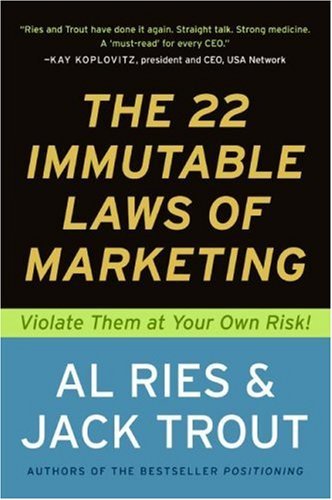
Al Ries and Jack Trout are the marketers who popularized the idea of “positioning,” and this short book from 1993 boils their thinking down to 22 rules, each a few pages long with real company examples. The big ones come early. The Law of Leadership says it’s better to be first than to be better, because the first brand in a category tends to stay on top. The Law of the Category says that if you can’t be first, create a new category you can be first in. The Law of Perception says marketing isn’t a battle of products, it’s a battle of perceptions in the customer’s mind. And the Law of Focus says the most powerful thing a brand can do is own a single word. Some examples have aged, but the core ideas still explain why some brands win and others don’t, and they apply just as well to building a name for yourself in a crowded field.
Highlights
The Law of Leadership It’s better to be first than it is to be better.
The basic issue in marketing is creating a category you can be first in. It’s the law of leadership: It’s better to be first than it is to be better. It’s much easier to get into the mind first than to try to convince someone you have a better product than the one that did get there first.
The leading brand in any category is almost always the first brand into the prospect’s mind. Hertz in rent-a-cars. IBM in computers. Coca-Cola in cola. After World War II, Heineken was the first imported beer to make a name for itself in America. So four decades later, what is the No. 1 imported beer? The one that tastes the best? Or Heineken? There are 425 brands of imported beer sold in America. Surely one of these brands must taste better than Heineken, but does it really matter? Today, Heineken is still the No.1 imported beer, with 30 percent of the market.
The first domestic light beer was Miller Lite. So what is the largest-selling light beer in America today?
So what’s the name of the leading college in America? Most people would probably say Harvard, which is also the name of the first college founded in America.
what’s the name of the leading college in America? Most people would probably say Harvard, which is also the name of the first college founded in America.
People tend to stick with what they’ve got. If you meet someone a little better than your wife or husband, it’s really not worth making the switch, what with attorneys’ fees and dividing up the house and kids.
The law of leadership also applies to magazines. Which is why Time leads Newsweek, People leads Us, and Playboy leads Penthouse.
Jeep was first in four-wheel-drive off-the-road vehicles. Acura was first in luxury Japanese cars. IBM was first in mainframe computers. Sun Microsystems was first in workstations. Jeep, Acura, IBM, and Sun are all leading brands. The first minivan was introduced by Chrysler. Today Chrysler has 10 percent of the car market and 50 percent of the minivan market.
The first desktop laser printer was introduced by a computer company, Hewlett-Packard. Today the company has 5 percent of the personal computer market and 45 percent of the laser printer market. Gillette was the first safety razor. Tide was the first laundry detergent. Hayes was the first computer modem. Leaders all. One reason the first brand tends to maintain its leadership is that the name often becomes generic. Xerox, the first plain-paper copier, became the name for all plain-paper copiers. People will stand in front of a Ricoh or a Sharp or a Kodak machine and say, “How do I make a Xerox copy?” They will ask for the Kleenex when the box clearly says Scott. They will offer you a Coke when all they have is Pepsi-Cola. How many people ask for cellophane tape instead of Scotch tape? Not many. Most people use brand names when they become generic: Band-Aid, Fiberglas, Formica, Gore-Tex, Jello, Krazy Glue, Q-tips, Saran Wrap, Velcro—to name a few. Some people will go to great lengths to turn a brand name into a generic. “FedEx this package to the Coast.” If you’re introducing the first brand in a new category, you should always try to select a name that can work generically.
Unfortunately, benchmarking doesn’t work. Regardless of reality, people perceive the first product into the mind as superior. Marketing is a battle of perceptions, not products.
Neil Armstrong was the first person to walk on the moon. Who was second? Roger Bannister was the first person to run a four-minute mile. Who was second? George Washington was the first president of the United States. Who was second? Thomas’ was the first brand of English muffin. What was second? Gatorade was the first sports drink. What was second?
The Law of the Category If you can’t be first in a category, set up a new category you can be first in.
If you can’t be first in a category, set up a new category you can be first in.
What’s the name of the third person to fly the Atlantic Ocean solo? If you didn’t know that Bert Hinkler was the second person to fly the Atlantic, you might figure you had no chance at all to know the name of the third person. But you do. It’s Amelia Earhart. Now, is Amelia known as the third person to fly the Atlantic Ocean solo, or as the first woman to do so?
It’s Amelia Earhart. Now, is Amelia known as the third person to fly the Atlantic Ocean solo, or as the first woman to do so?
After Heineken became a big success, the people at Anheuser-Busch could have said, “We should bring in an imported beer, too.” But they didn’t. Instead they said, “If there’s a market for a high-priced imported beer, maybe there’s a market for a high-priced domestic beer.” And so they started to promote Michelob, the first high-priced domestic beer, which today out-sells Heineken two to one.
Miller Lite was the first domestic light. It took an importer five years to say, “If there’s a market for a domestic light beer, maybe there’s a market for an imported light beer.” The result was Amstel Light, which became the largest-selling imported light beer.
If you didn’t get into the prospect’s mind first, don’t give up hope. Find a new category you can be first in. It’s not as difficult as you might think.
If you can’t be first in a category, set up a new category you can be first in.
There are many different ways to be first. Dell got into the crowded personal computer field by being the first to sell computers by phone. Today Dell is a $900 million company. When you launch a new product, the first
When you launch a new product, the first question to ask yourself is not “How is this new product better than the competition?” but “First what?” In other words, what category is this new product first in?
question to ask yourself is not “How is this new product better than the competition?” but “First what?” In other words, what category is this new product first in?
Charles Schwab didn’t open a better brokerage firm. He opened the first discount broker. Lear’s was not the first woman’s magazine. It was the first magazine for the mature woman. (The magazine for the woman who wasn’t born yesterday.)
This is counter to classic marketing thinking, which is brand oriented: How do I get people to prefer my brand? Forget the brand. Think categories.
How do I get people to prefer my brand?
Everyone is interested in what’s new. Few people are interested in what’s better.
When you’re the first in a new category, promote the category. In essence, you have no competition.
The Law of the Mind It’s better to be first in the mind than it is to be first in the marketplace
It’s better to be first in the mind than it is to be first in the marketplace
It’s better to be first in the prospect’s mind than first in the marketplace. Which, if anything, understates the importance of being first in the mind. Being first in the mind is everything in marketing. Being first in the marketplace is important only to the extent that it allows you to get in the mind first.
The law of the mind follows from the law of perception. If marketing is a battle of perception, not product, then the mind takes precedence over the marketplace.
More money is wasted in marketing than in any other human activity (outside of government activities, of course).
The single most wasteful thing you can do in marketing is try to change a mind.
The Law of Perception Marketing is not a battle of products, it’s a battle of perception.
All that exists in the world of marketing are perceptions in the minds of the customer or prospect. The perception is the reality. Everything else is an illusion.
Most people think they are better perceivers than others.
Truth and perception become fused in the mind, leaving no difference between the two.
People cling firmly to the belief that reality is the world outside of the mind and that the individual is one small speck on a global spaceship. Actually it’s the opposite. The only reality you can be sure about is in your own perceptions.
Most marketing mistakes stem from the assumption that you’re fighting a product battle rooted in reality. All the laws in this book are derived from the exact opposite point of view.
Only by studying how perceptions are formed in the mind and focusing your marketing programs on those perceptions can you overcome your basically incorrect marketing instincts.
And who is the expert? It’s someone who is perceived to be an expert in the mind of somebody else.
People are seldom, if ever, wrong. At least in their own minds.
Marketing is a battle of perceptions.
Why is Campbell’s soup No. 1 in the United States and nowhere in the United Kingdom? Why is Heinz soup No. 1 in the United Kingdom and a failure in the United States? Marketing is a battle of perceptions, not products. Marketing is the process of dealing with those perceptions.
Marketing is not a battle of products. It’s a battle of perceptions.
The Law of Focus The most powerful concept in marketing is owning a word in the prospect’s mind.
A company can become incredibly successful if it can find a way to own a word in the mind of the prospect. Not a complicated word. Not an invented one. The simple words are best, words taken right out of the dictionary.
Federal Express was able to put the word overnight into the minds of its prospects because it sacrificed its product line and focused on overnight package delivery only.
The most effective words are simple and benefit oriented.
You can’t stand for something if you chase after everything.
Does any company proclaim itself as the “unquality” corporation? No, everybody stands for quality. As a result, nobody does.
(To be a leader you have to have followers.)
The Law of Exclusivity Two companies cannot own the same word in the prospect’s mind.
When a competitor owns a word or position in the prospect’s mind, it is futile to attempt to own the same word.
The Law of the Opposite If you’re shooting for second place, your strategy is determined by the leader.
In strength there is weakness.
Wherever the leader is strong, there is an opportunity for a would-be No. 2 to turn the tables.
a company should leverage the leader’s strength into a weakness.
don’t try to be better, try to be different.)
by positioning yourself against the leader, you take business away from all the other alternatives to No. 1. If old people drink Coke and young people drink Pepsi, there’s nobody left to drink Royal Crown cola. Yet, too many potential No. 2 brands try to emulate the leader. This usually is an error. You must present yourself as the alternative.
(One whiff of Listerine and you know that your mouth would smell like a hospital.) Then quickly twist the sword. (Scope is the good-tasting mouthwash that kills germs.)
“You’ve tasted the German beer that’s the most popular in America. Now taste the German beer that’s the most popular in Germany.”
“For the millions who should not take aspirin,” said the Tylenol advertising. Today Tylenol outsells aspirin and is the largest-selling single product in American drugstores.
Marketing is often a battle for legitimacy.
The Law of Division Over time, a category will divide and become two or more categories.
A category starts off as a single entity. Computers, for example. But over time, the category breaks up into other segments. Mainframes, minicomputers, workstations, personal computers, laptops, notebooks, pen computers.
In the television industry, ABC, CBS, and NBC once accounted for 90 percent of the viewing audience. Now we have network, independent, cable, pay, and public television, and soon we’ll have instore and interactive television. Beer started the same way. Today we have imported and domestic beer. Premium and popular-priced beers. Light, draft, and dry beers. Even nonalcoholic beer.
Categories are dividing, not combining.
The Law of Line Extension There’s an irresistible pressure to extend the equity of a brand.
When you try to be all things to all people, you inevitably wind up in trouble.
The Law of Sacrifice You have to give up something in order to get something.
There are three things to sacrifice: product line, target market, and constant change.
Take Emery Air Freight.
Anything you wanted to ship you could ship via Emery. Small packages, large packages, overnight service, delayed service. From a marketing point of view, what did Federal Express do? It concentrated on one service: small packages overnight.
The power of the sacrifice for Federal Express was in being able to put the word overnight in the mind of the prospect. When it absolutely, positively had to be there overnight, you would call Federal Express.
Marketing is a game of mental warfare. It’s a battle of perceptions, not products or services.
The world of business is populated by big, highly diversified generalists and small, narrowly focused specialists.
The target is not the market.
Even though Pepsi-Cola’s target was the teenager, the market was everybody. The 50-year-old guy who wants to think he’s 29 will drink the Pepsi.
The Law of Attributes For every attribute, there is an opposite, effective attribute.
Too often a company attempts to emulate the leader. “They must know what works,” goes the rationale, “so let’s do something similar.” Not good thinking. It’s much better to search for an opposite attribute that will allow you to play off against the leader. The key word here is opposite—similar won’t do.
Coca-Cola was the original and thus the choice of older people. Pepsi successfully positioned itself as the choice of the younger generation.
Since Crest owned cavities, other toothpastes avoided cavities and jumped on other attributes like taste, whitening, breath protection, and, more recently, baking soda.
Marketing is a battle of ideas. So if you are to succeed, you must have an idea or attribute of your own to focus your efforts around.
Your job is to seize a different attribute, dramatize the value of your attribute, and thus increase your share.
The Law of Candor When you admit a negative, the prospect will give you a positive.
Every negative statement you make about yourself is instantly accepted as truth. Positive statements, on the other hand, are looked at as dubious at best. Especially in an advertisement.
“The 1970 VW will stay ugly longer.” A car that ugly must be reliable, thinks the prospect. “Joy. The most expensive perfume in the world.” If people are willing to pay $375 an ounce, it must be a sensational perfume. “With a name like Smucker’s, it has to be good.”
“Avis is only No. 2 in rent-a-cars.” So why go with them? They must try harder. Everybody knew that Avis was second in rent-a-cars. So why go with the obvious?
When a company starts a message by admitting a problem, people tend to, almost instinctively, open their minds.
What should Listerine do? It certainly couldn’t tell people that Listerine’s taste “wasn’t all that bad.” That would raise a red flag that would reinforce a negative perception. Things could get worse. Instead, Listerine brilliantly invoked the law of candor: “The taste you hate twice a day.”
This set up the selling idea that Listerine “kills a lot of germs.”
As another example, General Foods admitted that Grape-Nuts cereal was a “learned pleasure” and advised consumers to “try it for a week.” Sales went up 23 percent.
One final note: The law of candor must be used carefully and with great skill. First, your “negative” must be widely perceived as a negative. It has to trigger an instant agreement with your prospect’s mind. If the negative doesn’t register quickly, your prospect will be confused and will wonder, “What’s this all about?” Next, you have to shift quickly to the positive. The purpose of candor isn’t to apologize. The purpose of candor is to set up a benefit that will convince your prospect.
The Law of Unpredictability Unless you write your competitors’ plans, you can’t predict the future.
Failure to forecast competitive reaction is a major reason for marketing failures.
The Law of Success Success often leads to arrogance, and arrogance to failure.
Ego is the enemy of successful marketing. Objectivity is what’s needed. When people become successful, they tend to become less objective. They often substitute their own judgment for what the market wants.
Brilliant marketers have the ability to think like a prospect thinks. They put themselves in the shoes of their customers.
the only thing that counts in marketing is the customer’s perception.)
The Law of Failure Failure is to be expected and accepted.
Too many companies try to fix things rather than drop things.
The Law of Hype The situation is often the opposite of the way it appears in the press.
When things are going well, a company doesn’t need the hype. When you need the hype, it usually means you’re in trouble.