- Rating
- —/10
- Read
- October 2021
- Why I read it
- What I took from it
- My favorite idea
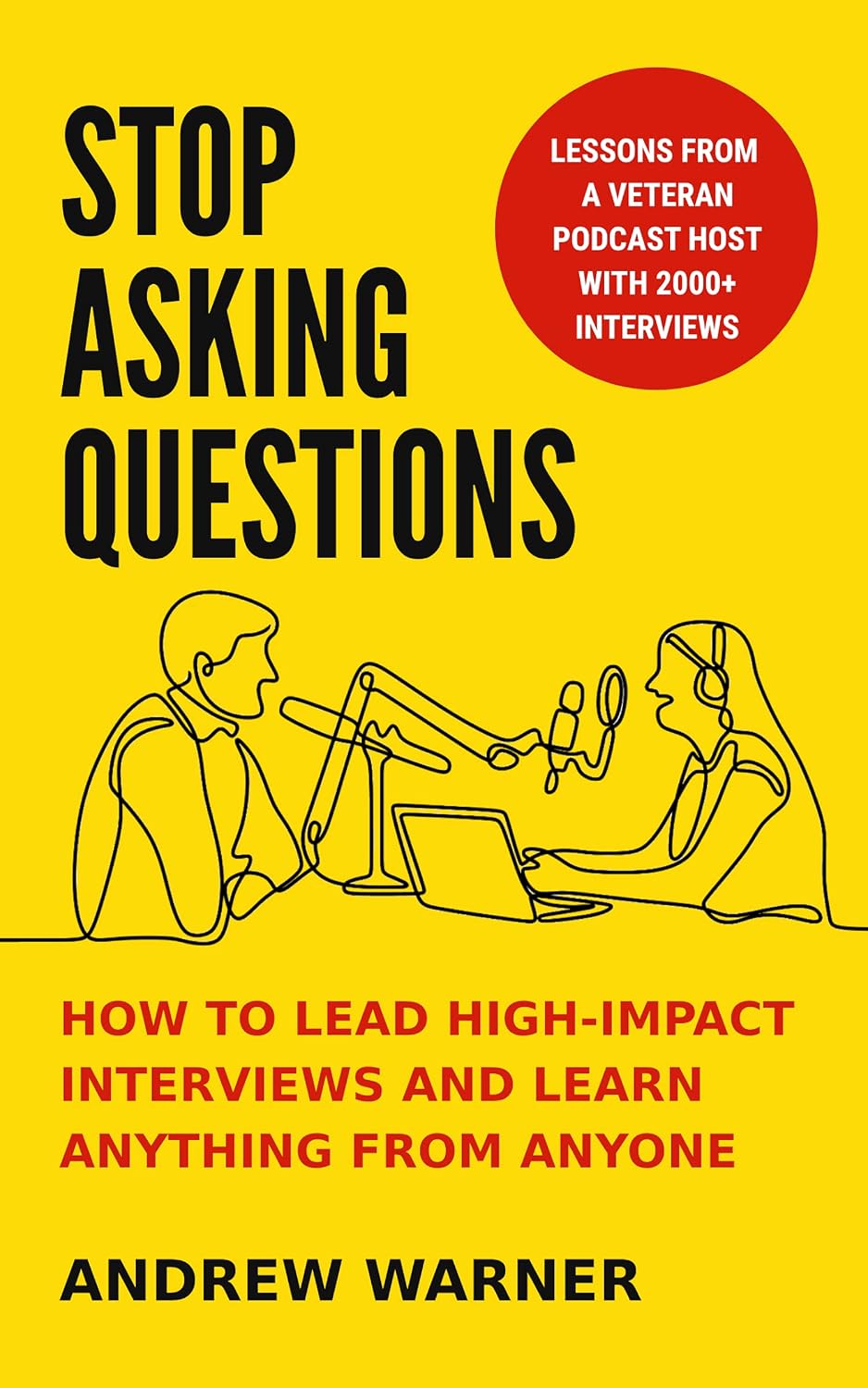
I've been a fan of Andrew Warner since the early Mixergy days, when he'd interview tech founders. This was before podcasts became mainstream. Andrew is an expert interviewer, so when I learned he was coming out with a book, I jumped on it. I've been interviewing candidates for over fifteen years, but I learned so much from him. The book isn't just about interviewing. It's about communication, conversation, and getting others to open up. I highly recommend it to anyone interested in leveling up their communication skills. Here are my notes.
Highlights
In the years that followed, I spent $38,188 to have my interviews transcribed. Then I hired producers and coaches to go over my conversations to help find patterns in the responses. If a technique worked, I added it to a doc so I could keep reusing it. When something didn’t work, I deconstructed it to understand how I should have done it better. The improved version went into the doc.
One final piece of advice: Don’t be rigid. You can’t force each of these techniques into a conversation. Use them as guides, but don’t be obsessed with using them perfectly. I don’t. You’re about to get to know and learn from your heroes. Enjoy it.
When you run a company, you have big responsibilities. If you don’t sell, you don’t eat. And if you have a team, their families don’t eat either.
I tried something new while preparing for an interview. Before recording, I asked my guest, “What’s a win for you?” That did it. Asking someone about their goals reassured them that I cared about their needs and that I’d work with them to reach those goals.
Once we talked about that, he was more than happy to give me what I was after—the chronological story of how he built and sold multiple companies.
My note: This seems like an example of the law of reciprocation
Most guests don’t have a clear answer to “What’s a win for you?”
When I ask the question, even if they don’t have a specific answer, they know I care about them and trust that I have their interest in mind, even as I pursue my own interview goals. Now I start most of my calls with some version of “What’s a win for you?” Variations on that question include: ● What’s your #1 goal for this interview? ● What would make your team happy to hear us talk about? ● Why did you agree to do this interview? ● How can I make this interview as useful for you as it will be for me and my listeners?
Join the Resistance: Get Guarded People to Open Up
Finally, instead of pushing back against a patient’s resistance, she decided to join the resistance. “It seems like everything is going well,” she’d say. “It’s nice for me to get to talk to someone who has an easy life, who has it good.”
Next time you’re trying to get someone to be vulnerable and tell you about their challenges, don’t push back against their resistance if they put up roadblocks. Accept it. And even congratulate them for it. They say, “I never failed.” You say, “It’s amazing to talk to someone who always got everything right.” They say, “I’m not a worrier.” You say, “I don’t usually get to talk to people who are 100 percent confident.”
Our friend shared something I call a “shoved fact.” He didn’t need to mention his divorce. He could have simply said, “Traffic is awful in this city,” and everyone would have related and moved on. But he intentionally pushed his divorce into the conversation. He was dying to talk about it because it was a big issue for him.
The Shoved Fact is very similar to the psychoanalysis term, “Freudian slip,” which says a slip of the tongue may represent an unconscious wish or internal train of thought. As conversationalists, we often ignore the teeny slips of the tongue because they’re mostly meaningless. The average person slips on up to 22 words per day.
But when someone pushes a big topic out of context, we need to be aware that they might be expressing a yearning to talk about it—especially during an interview.
Look for those Shoved Facts, and don’t be afraid to dive into them.
Reciprocation: Get Guests Comfortable with Transparency
“Do you feel comfortable saying more about your sister?” I asked. (In the chapter called “Inappropriate Questions,” you’ll understand why I phrased my question this way.)
As Elena told us about her family, I asked a few more questions, and she kept opening up.
Then, as she wound down, she said something that hurt me. She leaned back in the sofa, crossed her legs, and said, “Andrew’s always pumping us for personal information.” I looked at her and saw resentment in her eyes.
Mulling it over, I realized my mistake. I never shared anything revealing about myself. My conversation techniques worked so well that people opened up, often more than they ever had before. Yes, they felt relief and acceptance, but they also felt vulnerable. And, more painfully, they felt alone in their vulnerability.
So I started talking more about myself. At first, I tried keeping things balanced. I talked as much about myself as my conversation partners talked about themselves. Quickly, I discovered that most people don’t want to listen. They prefer to talk. So I learned to include a revealing sentence or two about myself every once in a while, then go back to giving others a chance to talk. That worked.
I add a line or two about myself when I ask guests to talk openly about themselves. I don’t do it to take attention off them. I do it to make them feel safe enough to talk openly.
Dax says people listen to his show because of the vulnerability of his guests. “I am so often trying to enact vulnerability,” he said as a guest on The Tim Ferriss Show, “which requires me to go first. It’s almost like an [Alcoholics Anonymous] meeting where it’s like, I share first, and then maybe you’re compelled to share back.”
I read the passage from the transcript. “Andrew, you shared,” he continued. “You got vulnerable. You can’t expect her to reciprocate instantly. This isn’t a transaction where you trade your story for hers. You’re setting the atmosphere, giving her space to share too. And she did. I’ve read dozens of your transcripts. I can’t think of a single time that didn’t happen . . . eventually. But you need to be patient and trust.” He was right. “And you know what?” Jeremy said, "Sometimes the people you’re talking with won’t open up on the first conversation. It might take them years. Others won’t open up at all. You need to be fine with that.” Today I am fine with that, but only because I saw how often it’s true. If you want people to be open with you, you need to be willing to share first, and do it without an expectation for immediate reciprocation. Give it time. The depth of your conversations will be worth it.
I found that it’s best to clarify the agenda with guests before we start recording. I get their buy-in by phrasing it as a question, like, “Of course I’ll mention your new project in my intro, but since my audience isn’t emotionally connected to it yet, do you mind if we build your credibility first by talking about the big company you sold?”
Sometimes, a guest might get excited about their new project and start talking about it in the middle of me asking questions about their previous startup. I quickly say, “We’ll get to that, but first let’s finish talking about how you got here.” When guests see me keep control of the conversation and promise to meet their needs, they share more and promote less. It’s a win-win.
Share Your Why: Help Guests Go Deeper
I ended up using a technique that’s always worked for me: I told him what I wanted and WHY I wanted it.
“Tell me about a time you were depressed,” I said. “Let me see that you’re human, not just a guy who’s a beaming Tony Robbins Jr.”
Share your why. Give people a heartfelt reason to help you.
“Because...”: Shorten a Long-Winded Style
Even if you listened to each of my 2,000-plus interviews, you would probably miss my best question. That’s because it’s my shortest question. Ironically, it’s also a question I stole from Charlie Rose.
As I studied his style, I noticed that he repeatedly asked one, simple question: “Because?”
If you think about the times you’ve used the word “because,” you’ll see that you often use it to transition from WHAT you did to WHY you did it. For example, “I started interviewing BECAUSE I wanted to learn how to build a successful company.”
And that’s my goal in every conversation: To go deeper, to understand why someone did what they did. To understand who they are. No other word in the English language spurs such a depth of understanding as “because.”
Dramatic Lowball: Get Them to Blurt the Truth
Over the years, I’ve been known to host events called Scotch Night at my office, where I invite a few Mixergy listeners to join me for a drink and conversation.
“Andrew, do you ever have a guest who won’t say anything about their financials? How do you get them to be so open?” Everyone quieted down. As information hunters, it was something they also wanted to learn. “Yeah,” I said. “A few days ago, Shradha Agarwal, founder of ContextMedia, which does health videos for waiting rooms, wouldn’t tell me anything about her revenue. I wasn’t trying to pry—I just needed a sense of how big her company was so the audience could understand what we were talking about. She wouldn’t give me anything.” “What’d you do?” he asked. “I threw out a number that was absurdly low for her. I asked, ‘Are you doing at least a million dollars in sales?’ Instantly I felt her aggravation. She shot back, ‘We’re doing twenty or thirty times that!’ That gave me my answer.”
It worked because I lowballed her dramatically.
Instinctively, she felt the need to correct the record.
Higher Purpose: Encourage Them to Join Your Mission
When I doubt myself, I remind myself of my mission. I want to get the true stories of how founders built their companies.
Before we started recording, I looked into my webcam—the closest I could get to looking him in the eyes. I said, “Gregg, I want to record an interview so good that decades from now when your great-great grandkids wonder how you built your business, they’ll come listen to what we record today.” With that one sentence, I got his attention.
Sharing my higher purpose has also helped me land interviews. One of the toughest pitches to potential guests was my Fail Series.
Tristan explained how the interview series would help listeners avoid potentially fatal mistakes in their businesses. As tough as it would be for a founder to talk about their own failures, it would be a gift to other entrepreneurs like them. It would lead to stronger startups. As a result of sharing our higher purpose, we ended up with more than a week’s worth of interviews in this series.
Sharing your higher purpose helps beyond interviewing. When my wife and I moved to Washington, DC, we argued about how much I ran. I understood how she felt. We were both working long hours, and she wanted to see more of me. But DC was the first city I had lived in with parks everywhere. I wanted to run and experience all of them. So we argued. I finally used what I learned in my interviews. I said, “Olivia, we both believe in pushing ourselves physically. I think I might be able to do my first solo 26.2-mile run, but I’m still at only fourteen miles. Would you help me?” That was a dramatic difference from my previous approach of saying, “You know how much I love running. I need time to do it. I can’t give that part of myself up.”
In business, interviewing, and life, we often find ourselves needing to persuade and motivate other people. Share your higher purpose to get others on board with your goals. Give them a mission they can buy into and support.
Most people think an interviewer’s job is to ask questions. I can tell you from experience that it’s not.
All curious people will encounter this problem. Asking questions makes you seem needy. And if you’re needy, people don’t respect you, which reduces the quality of their answers.
A couple of years into my interviewing career, I started to get a chip on my shoulder about being minimized by guests.
One of the ways I responded to that period of frustration was by taking charge of the conversation from the start. If the guest was in a loud room, I told them to move. I didn’t ask. I said, “You need to find a quiet place to record, or the audience won’t be able to hear your story.” If they didn’t have a strong internet connection, I told them to find a way to fix it, or we’d need to reschedule for a day when it would be better. Guests appreciated that kind of leadership, so I brought the attitude into my interview. I rephrased my questions as directives. Instead of asking, “How did you get your first customer?” I said, “Tell me how you got your first customer.”
At times it felt rude. Was I being bossy instead of kind? Did they think I was too demanding? Too pushy? Not at all. In fact, switching about half my questions to statements changed how people saw me. They stopped treating me like a needy kid and saw me as a leader who would guide them through their interview. I no longer felt ashamed or resentful of perceived slights. It felt good to guide them toward telling the best possible stories.
That’s what your interviewees need from you. Guide them.
So stop asking questions. Start leading your guests through better conversations.
Put the Words in Someone Else’s Mouth: Asking Tough Questions
I grew up in New York City, so I prefer to be blunt and ask for what I want. But as an interviewer, if I don’t take some of the sting out of my questions, my guest could become defensive, stop paying attention, and maybe even walk off.
If I have a series of tough questions to ask my guest, I look online for examples of other people asking them. For example, I wanted to ask Ryan Hoover of the maker community Product Hunt why he didn’t have enough women in his community. I did some research and found members of his own community bringing up the issue. Instead of taking a combative response, it allowed him to tell me about the partnerships he was working on to recruit a more diverse membership.
What if I can’t find someone else taking the position I want to bring up? That’s when I create a theoretical person. For example, when I talked with James Altucher about his self-help book, Choose Yourself, where he said we should be happy with who we are, something occurred to me. He’s probably happy now because he’s rich, not because of the techniques in his book. I asked, “What do you say to someone listening to us thinking, ‘James is only happy now because he has money in the bank. If he didn’t have it, he would be right back to wrestling with his own inner demons like everyone else?’”
Here are a few other examples of how I phrase criticism through other people’s words: ● What do you say to someone who’s listening to us and thinking . . .? ● What would you say to someone who thought . . .? ● I imagine someone listening to us thinking . . . What would you say to that? By putting the words in someone else’s mouth, you eliminate the “me versus you” feeling that comes with asking tough questions. It
Pre-Ask the Shocking: Stun Your Audience with Audacity
“A time when you . . .”: Draw Out Interesting Stories
“Can you give an example of that?”
I learned to rephrase my request. Instead of “Could you tell me a story about that?” I used phrases like the following: ● “Tell me about a time when you did that.” ● “Do you have an example of that?” ● “Tell me about the day you signed the agreement to sell your company.” ● “Take me to the moment you quit. What did you say?”
Notice that I don’t ask, “Tell me about the most important time . . .” Asking people “most” questions like this distracts them from the conversation,
Stop Asking “Most” Questions: Avoid Interviewers’ Worst Questions
Many folks that offer interview advice to new podcasters include lists of questions to ask guests. These lists are often packed with what I call “most” questions: What book had the most influence on you? What’s the worst thing that happened to you? Who was the most helpful person in your life?
The problem with this approach is that it freezes people. It forces them to do too much mental work for too little payoff.
So why not simply ask, “Could you tell me about someone who had a big influence on your life?”
So I usually rephrase all “most” questions in a way that gives guests options. Instead of asking “Who’s the most important person you hired?” I go with “Who’s an important person you hired?”
There are exceptions to this rule. For example, when I ask a founder what their top source for customers is, I don’t want to hear about the third most effective channel. I’m trying to understand what’s working best. It’s a factual piece of information that founders should know the answer to, so that’s what I ask for.
Double-Barreled Questions: How to Ask Questions You Shouldn’t Ask
My solution came from a conversation I had with the investigative reporter, John Sawatsky. He told me that he warns reporters not to ask what he called “Double-Barreled Questions.” These are questions that address two different issues. When reporters ask double-barreled questions, their subjects answer the easy part and ignore the part they don’t like.
As I thought about it, I realized Double-Barreled Questions could be my key to bringing up personal issues.
“Do you feel comfortable saying if you divorced your husband?” Break that down, and you’ll see I’m actually asking two questions: 1) Are you divorced? And 2) do you feel comfortable talking about it? People who don’t feel comfortable answering the divorce question will answer the easy question: No, I do not feel comfortable. Here are a few actual examples from my interviews: Example One: Is it inappropriate for me to ask you if you’re a millionaire now because of this business? Answer: I didn’t become a millionaire from the business. Example Two: Is it inappropriate to ask if [your partner] gets half of this business? Answer: He doesn’t own half my business. Example Three: Is it inappropriate for me to ask you who you’re dating these days? Answer: I’m dating my business ideas and my fifty-six thousand books.
To be clear, this technique isn’t fool-proof. It doesn’t always get people to open up, and that’s the point. The Double-Barreled approach gives people an easy out to avoid topics that are too personal for them. As an interviewer, be prepared to move on quickly if your guest opts out of the question.
Icon Stories: Recruit Their Heroes to Help You
So how could I get guests to open up about topics they were reluctant to discuss in public? My solution was to destigmatize those topics by drawing comparisons to their heroes.
If you’re trying to create an atmosphere where your interviewees can reveal the hidden parts of themselves, show them how their idols did it. When you come across a quote or story that illustrates it, keep it handy.
Sorry to Interrupt: Smoothly Cut Off Guests without Offense
Interruptions are considered a cardinal sin of polite society. But when done right, they not only improve your conversations—they also make your counterpart look better in the process.
When people struggle to get a point across, they start to talk in circles. Instead of clarifying, they make their point less clear with each round of explanations. Most people, like my interview guest, will appreciate your help sounding competent.
So how did I interrupt this entrepreneur without being rude or embarrassing him?
“I’m sorry to interrupt, but...” Then I’d complete the sentence by explaining why I was interrupting and often citing my higher purpose.
here are some examples to show you just how effective this magical little phrase can be: I’m sorry to interrupt, but I really want to get into the details of this. I’m sorry to interrupt, but [you said] “fanatical optimism.” How do you maintain fanatical optimism? I’m sorry to interrupt, but I really want to understand this concept because . . . I’m sorry to interrupt, but this is something that I need to learn from you . . . I’m sorry to interrupt, but I want to talk more in depth about that . . .
But when you share why you’re interrupting, people won’t think you’re rude—they’ll think you’re considerate. If you’re interrupting for a meaningful reason, your guest will appreciate it.
Train Crashed: How to Recover from a Nervous Mistake
If you’re ever stuck, find your own “in case of emergency” questions. Here are some examples: - Listening to you, I can see you work hard. I have to pause and ask, what’s your motivation? - Before we continue, I want to check in: How is this interview going for you? - I hate to switch gears, but with so little time together, I have to ask you about . . .
Homerun Questions: End on a High Note
I asked one tough question. Just one. And I waited until we had built enough rapport for me to bring it up. Why did that make her upset?
The peak-end rule is a cognitive bias that affects the way we recall events. Humans tend to remember two aspects of an experience more than anything else: The peak (i.e., most intense) and the end. By saving my toughest question for last, I unwittingly stacked the peak and the end into one dramatic moment. It was the only thing my guest remembered from our talk. No wonder she was upset.
decided to stop saving my gutsiest questions for last. I would ask those somewhere in the middle and then end the conversation with something easy. My goal was to give my guests a homerun question they could knock out of the park and leave the interview feeling confident about their performance. But I didn’t stop there. I started anticipating my guests’ need for validation. When an interview ended, I thanked them, told them they did well, and mentioned one specific thing I liked from our conversation.
The Talking Release: Remember This above All
Before we leave this section, I want to leave you with one important message: if you fail with every tip I gave you so far, you’ll do well if you simply let your guest talk.
I realized the importance of this years ago at a quiet dinner with my brother, Michael. I got a call from one of the employees at the greeting card company he and I founded. “Andrew, I can’t stop crying,” she said. I was surprised, not that she was crying or the reason why she was crying. I knew about the tough breakup she was going through. What took me by surprise was that she wanted to talk to me, not Michael. Ever since we were kids, people brought their business questions to me and their personal issues to Michael.
“My ex is being intentionally cruel,” she sobbed. “He keeps flaunting his new relationships. He wants me to be jealous.” “Don’t let him do this to you,” I said, trying to show that I empathized. Then I gave her some advice. She stopped responding. I sensed that I’d lost her. I could tell this wasn’t what she needed, but I didn’t know why. She thanked me, and we hung up.
Then Michael’s phone rang. She’d called him. I guess she didn’t realize we were at dinner together, and she looked to him for help. I sat silently, listening, trying to understand what magic he had. I wanted to understand what I should have said. Here’s his magic. He asked, “What happened?” Then he didn’t say much more than “Mhmm” for a long time. He followed that by asking, “Why did you say that?” and went back to listening. When they hung up, I asked my brother, “How’s she doing now?” He told me she was feeling better.
That’s the magic of listening. People prefer to be heard than to be helped.
Listening is a critical skill for an interviewer, even while off the air. A few years after I started interviewing, our producer Jeremy Weisz texted me, “Andrew, the founder you interviewed yesterday is furious. He asked us not to publish the interview and won’t change his mind.” Remembering what I learned from Michael, I called the founder. “I heard you weren’t happy with the interview I recorded with you,” I said. Then I let him talk. He vented that he didn’t come across well. I wanted to explain to him that he did well, but I resisted the urge. Instead, I simply asked, “Why?” He told me he knew my podcast was listened to by people who might fund his company or do business with him in the future, and he wanted it to be as good as possible. “What didn’t you like about it?” I asked. He explained that he said “ums” and “uhs” too much. He thought it made him sound like he didn’t know what he was talking about.
This point is important to repeat: When teaching your audience a new skill, make sure it fits into 5-8 steps. If not, narrow the scope of the lesson until it does.