- Rating
- —/10
- Read
- July 2014
- Why I read it
- This book brings together two things I care deeply about: Self-Improvement and Business.
- What I took from it
- Joe De Sena is a bad motherfucker.
- My favorite idea
- “Spartan up!” Gotta read the book to know.
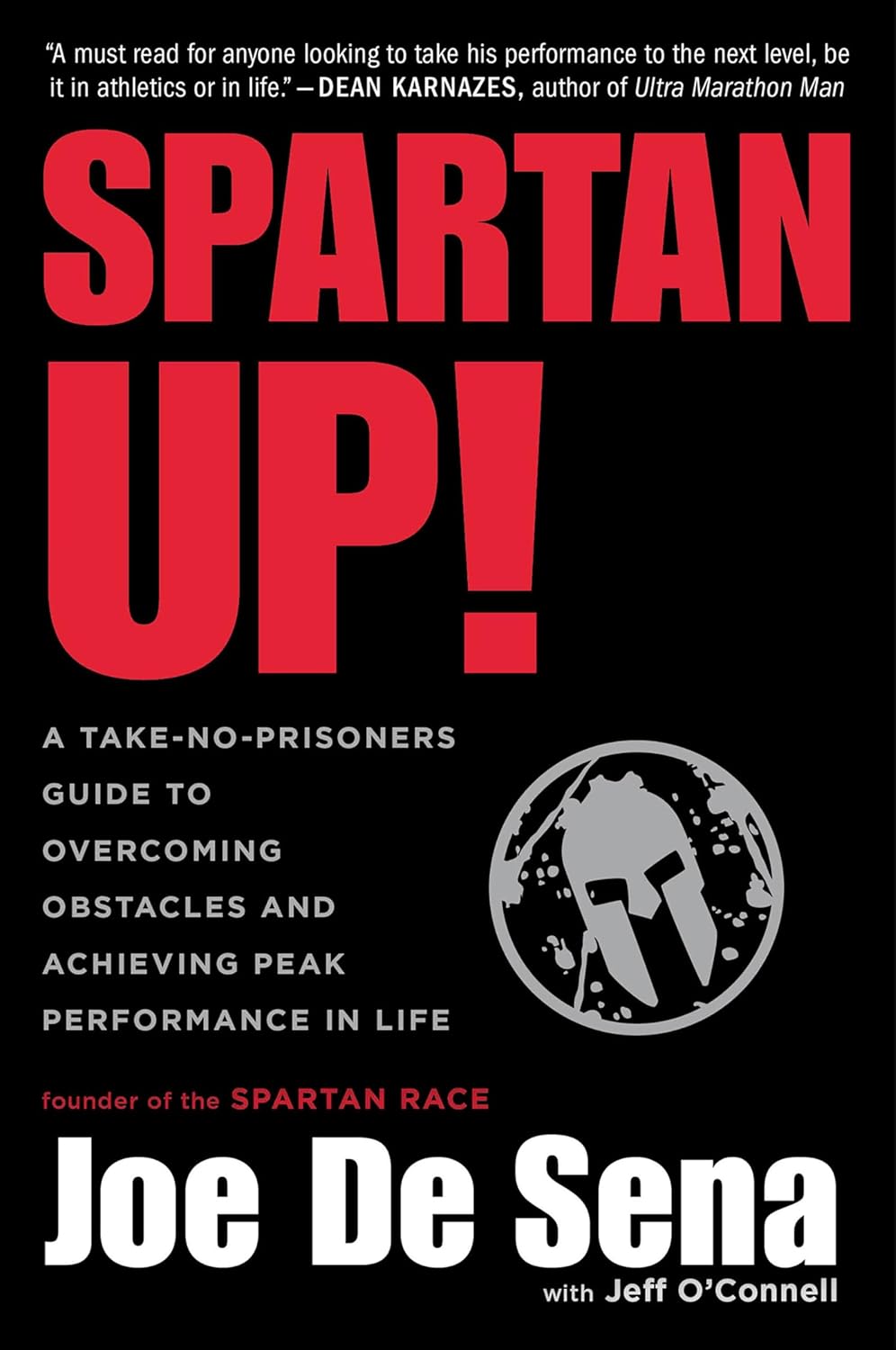
Joe De Sena grew up in Queens, built a business cleaning pools as a teenager, made money on Wall Street, then walked away to compete in ultra-endurance races and eventually founded Spartan Race, the obstacle course series. This book, written with Jeff Csatari, is his philosophy in one place: comfort makes you weak, discipline beats motivation, and the way to get through obstacles in business and life is to train for hardship on purpose. It mixes his own story with stories from racers who pushed through far worse than a muddy course.
Highlights
Many of life’s failures are people who did not realize how close they were to success when they gave up. —THOMAS EDISON
When I tell people what I’m about to do, most of them look at me in a way that tells me they think I’m really stupid or suicidal. But you know what? There’s a better way of looking at this. Challenging yourself to accomplish more than you know you can is never stupid—it helps show you what you are capable of. It creates a new frame of reference, one you can draw upon in the face of other things that are perceived as being tough in your life. It shows you possibilities you didn’t know existed.
Now, you’re on the mat and you’ve got ten seconds left, your opponent’s beating you, and you’re like—I did forty-eight hours straight with that fucking lunatic in Vermont. I can get through the next ten seconds. That was the difference between him being a world champion and not.
That’s how I always tackle life: put one foot in front of the other, focus on the little goal right in front of you, and almost anything is possible. As a result, I have learned to push through when others stop, even this coach who trained world-class athletes. How could he freeze up during the race? In my mind, you just commit to something and then get it done, no matter what. He had let self-doubt creep in—a major mistake I see people making all the time.
My goal with every Spartan Race is to push you to overcome your short-term desire for comfort in an effort to reach for something greater than your current self.
Physiologically, what you’re doing is resetting your body’s set point for stress. Our fight-or-flight mechanism is supposed to kick in when we are running from a lion to save our lives, not when our brussels sprouts are slightly undercooked, and not when we are worried that our house isn’t as big as that of a former classmate who we just reconnected with on Facebook. The easiest way to convince your body that sitting in traffic is not worthy of a stress-induced freakout is by showing your body what real stress feels like, in the controlled setting of your daily workout.
Whatever situations may come up during the rest of my day, they won’t be stressful in comparison. If I was able to push through that last set of burpees when my muscles were all shaking, that last quarter mile when my lungs were on fire, then I can easily handle whatever obstacles come up during my day.
The Stoics of ancient Greece believed that the greatest obstacle was not death, not pain, not suffering, but cowardice. By training themselves to accept what they could not change and to be courageous in front of any obstacle, they eliminated their fear of death. Tibetan monks identified the lack of control over the mind as the greatest obstacle. So the monks spend days making sand mandala paintings, and when they’re done, they sweep away their work with a broom. It’s not about the destination; it’s about the journey and the process that gives them the opportunity to practice awareness, focus, and control.
Kung fu students have to overcome the obstacle of fatigue. So the master has his students carry railroad ties to the top of the mountain and then carry them back down the mountain. There is no productive accomplishment, but the student will no longer find it challenging to run up the mountain carrying only his own body weight. Michael Phelps’s coach Bob Bowman identified the greatest obstacle as unknown challenges that might cause his athlete to lose focus. So Bowman prepared Phelps for the Olympics by picking him up late before a meet, so he’d have to skip a meal; or by breaking his goggles before practice, so that they’d fill up with water while he swam. When Phelps’s goggles broke during the 2012 Olympics, he was able to push through it to win gold.
I thought back to one of my high school history classes, where we had learned about the Spartans from ancient Greece. The stories
about these warriors resonated with me then and had stayed with me ever since. “Let’s call it Spartan Race,” I said.
Confronting the Greatest Obstacle: Your Will
You run the first half with your legs, the second half with your mind. — OLD RUNNING PROVERB
So my plan became to work crazy hard, sacrifice in the present to make money, and not get married until I had money and I was removed from the insanity I had witnessed as a child. I thought, “I’m going to spend the next fifteen years working hard while my friends are partying.” I would crush my goals by outworking and outhustling the next guy, undeterred by any obstacle that might appear before me.
I was not a naturally gifted student by any means, and I didn’t even really know how to study. My buddy at the time was like, “Hey, I’m going to party all summer because we have to buckle down this fall.” I said, “Fuck that,
I’m going to study all summer so I know how to study when I get into school.” He ultimately went to University of Las Vegas, while I got into Cornell. I have approached almost everything in my life this way by getting “ahead” of the project at hand, whether it’s doing my homework in advance or training for a race.
To make money, I started cleaning the pool of our next-door neighbor. I didn’t know it at the time, but he was the head of the Bonanno organized crime family. I thought he was just a great neighbor interested in helping the kid next door earn a few bucks. The opening of that single door changed my life forever. I ended up cleaning or building pools for anyone and everyone involved with the “five families of organized crime” that either had a pool or wanted one built. It became a multimillion-dollar business with a clientele of seven hundred customers, a lucrative and well-oiled machine that employed family and friends and paid my bills and then some.
I discovered a truth that would guide much of my life thereafter: when you sign up for something, you’re forced to train for it. Just like in a business: you’re
forced to work. Just like having a kid: you’re forced to take care of it. All of a sudden, you become accountable.
Who wouldn’t love feeling like an Olympian or a Navy SEAL? An explorer? We were out there doing stuff that I had only seen in the movies. I was an adventurer, and it felt incredible. Getting back in shape was child’s play compared to the effect endurance events had on me. They were helping me define who I was and who I needed to become. I started waking up super early, eating super healthy, and finally following my mother’s wisdom on yoga, which she had tried to impart to me for twenty-five years. I also started to find friends who enjoyed these unrelenting challenges as well. I kept raising the bar after every race. I’d ask everyone I met in the field: “What’s harder? What’s harder?” “Give me the hardest thing you got” became my mantra. I became addicted to backing myself up against the wall. The crazier the race, the more I wanted to do it. My perseverance hardened during races that others would call crazy.
An old running proverb goes, “You run the first half with your legs, the second half with your mind.”
He later wrote a best-selling book, Adrift, chronicling his ordeal.
The cliché is true: where there’s a will, there’s a way.
We may not have mapped new territories or been lost at sea, but Andy Weinberg and I raced all over the world. Wherever we’d go, I’d ask, “Could I live here?” I was seeking an escape from shortcuts, gadgets, and all the innovations designed to make life easier and safer. I wanted to get back to the way things used to be. I was in another country doing an eight-day race when it hit me. The local villagers we encountered everywhere we went were always smiling. They always seemed happy. They had everything they needed because they lived simple lives. It started to make more and more sense. That was for me, and that’s what I wanted for my family, too. That place turned out to be Pittsfield, Vermont. So in 2003, I took some of the money I had made on Wall Street and purchased an organic farm sitting on 140 acres. After I moved my family to Pittsfield, we quickly became entrenched in the local landscape. I became a family man working the land using organic gardening methods. I yearned for simplicity, and I had time to focus on what lay ahead: working the soil and raising my kids. When we landed in Vermont, it was a tough few years. Locals didn’t accept us right away, there was no traffic, not even the good kind, and everything shut down during hunting season. People had different priorities and news traveled fast. It took some time, but ultimately, it turned out exactly as planned—well, sort of. Pittsfield, Vermont, was supposed to be my retirement home. Some retirement. Other members of my inner circle not only visited my new digs, they started moving there, too. There are probably ten of us in all up there now. It took some convincing when Andy told his wife he wanted them to move there. “My wife is from Kansas City, Missouri, a big metropolitan area with about five hundred thousand people,” he recalls. “A Bed Bath & Beyond seemingly on every other block, concrete everywhere, highways with six lanes. So I moved her to Vermont, and she calls herself a pilgrim, whereas in my case, the outdoors is what I love. Now my kids are being raised in a place where it’s safe, it’s clean, people are happy, and there’s a lot going on. For us it’s much better, and now she enjoys it. She likes the simple life.”
It’s like the old saying: if I don’t do it, then who will?
Spartan Up! Life Lesson No. 1: Every Obstacle Presents an Opportunity
In ancient times, a king had a boulder placed on a roadway. Then he hid himself and watched to see if anyone would remove the huge rock. Some of the king’s
wealthiest merchants and courtiers came by and simply walked around it. Many loudly blamed the king for not keeping the roads clear, but none did anything about removing the stone. Then a peasant came along carrying a load of vegetables. Upon approaching the boulder, he laid down his burden and tried to move the stone to the side of the road. After much pushing and straining, he finally succeeded. After the peasant picked up his load of vegetables, he noticed a purse in the road where the boulder had been. The purse contained many gold coins, as well as a note from the king indicating that the gold was for the person who removed the boulder from the roadway. The peasant learned what many of us never understand: every obstacle presents an opportunity to improve our condition. —Author Unknown
When you are going through hell, keep going. — WINSTON CHURCHILL
“Spartan up!” The title of this book is a phrase I bark at people every day in one situation or another. Those two words have a simple meaning: stop complaining and get it done! “Spartan up!” is an attitude, an X factor, a way of life that I would sum up like this: Challenges make me tougher. Failure makes me work harder. Knock me down, and, sure as shit, I’m getting right back up.
In life, the biggest obstacle, the tallest wall, can be imaginary. It can exist only in your mind. Some people stay stuck to one spot for years because they are paralyzed by the fear of change. They may be stuck on the couch. They may be stuck in a dead-end relationship. They may be stuck in a lousy career. They are stuck in a prison of their own design. We’ve been conditioned to think that we as a society should spend tremendous resources eliminating obstacles from our lives, rather than teaching people how to surmount them.
Easy has never been my way of doing things. I’m not a naturally gifted athlete or thinker; I just gut things out until I’m successful. I know there are easier ways to get things done, but persistence always wins.
One of my professors shared with me a technique for whipping material into my long-term memory.
Every night I came home and I wrote out all of my class notes. The process was laborious, but it worked. I didn’t even have to study for exams anymore.
If you know obstacles are coming, how do you prepare for them? One of the key tenets of the Spartan Race is that we fill our course with obstacles that deliberately seek to trip people up. Essentially, you’re practicing encountering the unexpected.
In the Spartan world, we recognize that the key to success is commitment. The best way to get committed is to take the first step toward whatever it is you’re doing.
Spartans don’t look for shortcuts; we take the harder route because that is the path that offers the greatest reward.
In 1972, a Stanford researcher by the name of Walter Mischel hatched an idea for an experiment that has since become famous and is studied and debated to this day. Mischel would give children their preferred treat: a marshmallow, a cookie, or a pretzel. He would tell them they could eat it right away—or wait fifteen minutes and eat two instead. A simple choice. He then tracked their subsequent success as the children matured into adulthood. As it turns out, those kids who refused the first cookie became more successful adults than those who took it. Cookie refusers became winners.
Examples abound of people taking the cookie now with negative consequences, such as procrastinating in school or at work until a manageable task has turned into a crisis. You put off that term paper to party, but just think of the weight that would come off your shoulders if you had finished it early and turned it in. It’s the same in the workplace. Think about what you need to accomplish each day, make a list, and get it done. Just because five o’clock is getting close doesn’t mean you should give up and delay something until tomorrow. Push through until the end, check that item off your list, and start with a clean slate in the morning. Even minor chores and tasks are well suited for the “take the cookie later” approach. Don’t want to vacuum, clean the bathroom, or grocery shop? If tasks like these are left on the back burner, if you take the cookie now and relax, not only will the chores be harder when you eventually do them, but not having done them can complicate your day-to-day life. Rather buy a new pair of shoes than pay the electric bill on time? Put it off too long, and that bill will be way past due simply because you chose to forget about it for a week or two. You’ll spend as much money on the late fee as you did on the shoes.
Science has found that the most successful people are not the most intelligent or the most talented but rather the ones who tough it out.
Geoff Colvin, author of a book titled Talent Is Overrated, claims that the defining aspect of world-class performers isn’t their talent but rather their devotion to regular practice.
Then there are those with modest talent who nonetheless work on their skills and hone their talent through daily vigorous practice, over a long period of time, and become extremely successful as a result.
Mariano Rivera, the retired New York Yankees closer, threw one pitch and only one pitch—a cut fastball—every game to the best hitters on earth. They knew it was coming every time. But he had perfected that one pitch through such dedicated practice that they still couldn’t hit it. “Mo,” as he was known, hung up his cleats as the best closer in the history of Major League Baseball. All based on the complete mastery of one pitch.
“Grit entails working strenuously toward challenges, maintaining effort and interest over years despite failure, adversity, and plateaus in progress. The gritty individual approaches achievement as a marathon; his or her advantage is stamina.”
Do you want more grit? Start here: Write out your plan for success. Establish your baseline, set a goal, define a clear path toward that goal. Share the plan. The recipient should be someone who is supportive yet can offer constructive criticism when needed. If necessary, hire a coach. Eliminate distractions. What are your barriers? TV, Internet, video games? Keep a journal of your successes and failures. Remember the days when you would receive a gold star for exceptional performance in grade school? Give yourself a gold star for every success you have during the day. Adjust as needed, as long as it doesn’t diminish or change your original goal. Always work on solutions. Last but not least, don’t give up. Don’t let setbacks become failures. Learn from them and keep moving forward. You must remain committed to your goals.
As you age, your ability to delay gratification can become second nature. You can go farther by actively attacking those things that you least want to do. To use a gym analogy, if you hate squats more than any other exercise, you will enter the gym and head straight to the squat rack, almost embracing the discomfort. If you go to work and have a to-do list twenty items deep, you tackle the most unappealing line item first—say, a call with a dissatisfied customer that you know will be difficult.
Big Phil taught me many things but chief among them: (1) Be extremely physical, and (2) use every minute of your time.
My wife thinks I am nuts, but I will stretch or exercise in public places while I have time to kill. She gets embarrassed, for example, if I am doing burpees in an airport. But being healthy should never be embarrassing.
We often settle into these routines without really thinking about them, let alone analyzing their genesis. Then, one day, we wake up in a strange place, blink, and say, “How the hell did I get here? Have I been here this whole time?” It happens to the best of us. We become so comfortable that days blend into weeks, weeks into months, and, before we know it, we have sleepwalked through much our life. Many of us are sleeping now, and if we don’t wake up soon, we may end up somewhere we didn’t want to go, or worse, nowhere.
Everyone says they don’t have the time. Well, you have to make time. You need to add up all the hours in your day, as your day progresses, and see if you had thirty minutes where you could have done burpees, or walked, or done anything physical. I
While sleepwalking through life, a person may unknowingly reject a golden opportunity. It might seem strange and unconventional, and therefore unsuited to “the way things really are.” But could it be life is not as it should be? Could it be that life itself has gradually been covered and weighed down with something else, to the point where it is now completely hidden? Could it be that what we thought was life was keeping us from living this whole time? What could living be, anyway, if it’s not this?
I believe that life without change is death.
I believe we have a choice to make every day. We could choose to reject change, cling to our destructive habits, and continue ticking away the moments of our dull days in a steady march to death. It doesn’t matter if we die tomorrow because nothing of note would happen in one day, ten days, or ten years.
“Life should not be a journey to the grave,” said Hunter S. Thompson, “with the intention of arriving safely in a pretty and well preserved body, but rather to skid in broadside in a cloud of smoke, thoroughly used up, totally worn out, and loudly proclaiming, ‘Wow! What a ride!’” Don’t take this the wrong way. It doesn’t mean to abuse yourself; it means to use up your time wisely—explore, create, and get what you want to get done in life done.
The way to get started is to quit talking and begin doing. — WALT DISNEY
Human beings, like all animals, are creatures of habit. Not only do we develop behaviors of action, we also develop patterns of expectation. Based on prior experience, we establish our frame of reference, and we look at everything through that prism. But that doesn’t mean it’s reality.
Happiness = What I Have Now – What I Had Before
Creatures of habit get used to everything, including the greatest pleasures. What was once a luxury becomes a convenience, and what was once a convenience becomes a need. Eventually, everything in our lives starts to “suck,” because we are continuously bored or dissatisfied with what we have. Society teaches us to respond to this dissatisfaction by accumulating more. We will be happy if only we get a raise, if only we get the latest gadget, if we get a bigger house. Let’s say that, by some stroke of fate, we do get our raise, our new toy, or our new house, then for a while, we love life. What we have now is greater than what we had before. So we are happy. Fast forward. We have grown accustomed to our new salary, to our new toys, to our new house. What we have now is equal to what we had before, so we are no longer happy. The
quest for more and more stuff, for more and more pleasure—all it does, ultimately, is raise our expectations for more and more material stimulation.
I use daily intense exercise as one way to reset my frame of reference. My mom would reset hers every day by meditating. People may have thought, She’s just sitting there doing nothing. Yet the science has caught up and discovered that meditation can make people happier by increasing their pain threshold and releasing feel-good chemicals in the brain.
Epictetus, the great Stoic, defined wealth not as having numerous and extravagant possessions, but as having few wants.
Working hard all week makes us thankful for Friday. Winter makes us appreciate spring.
When extreme events become your “new normal,” you develop something greater than endurance, and you learn about more than mere survival. You develop a new ability to make clear judgments even during unclear circumstances.
Spartan Up! Life Lesson No. 2: Everyone Matters During my second month of college, our professor gave us a pop quiz. I had studied hard and breezed through the
questions until I read the last one: “What is the first name of the woman who cleans the school?” Surely this was some kind of joke. I had seen the cleaning woman several times. She was tall, dark haired, and in her fifties, but how would I know her name? So I handed in my paper with the last question blank. As we were being dismissed, one student asked if the last question would count toward our quiz grade. “Absolutely,” said the professor. “In your careers, you will meet many people. All are significant. They deserve your attention and care, even if all you do is smile and say ‘Hello.’” I’ve never forgotten that lesson. Her name was Susan.
I hated every minute of training, but I said, “Don’t quit. Suffer now and live the rest of your life as a champion.” — MUHAMMAD ALI
Exercise is the best defense you have against anxiety, stress, depression, and a whole host of other diseases. It helps cells repair themselves, and it quite literally heals the effects of stress through the release of something called brain-derived neurotrophic factor, or BDNF.
To quote the late football player and professional wrestler Alex Karras, “Toughness is in the soul and spirit, not in muscles.”
I’ve found one exercise that puts it all together: the burpee, aka the squat thrust. Beginning from a standing position, drop into a squat until your hands are actually touching the ground. Without hesitation, kick your legs back to assume the up position of the pushup; do a pushup; and again without hesitation, draw your legs back into lower squat position before standing back up to starting position. From there, drop into another rep. Think about how many great fitness elements that exercise rolls into one. The squat alone is arguably the single best exercise known to mankind, working your entire body in a way that unleashes a cascade of natural growth hormone and other growth factors. As soon as you kick your feet back, you’re in a plank, arguably the single best position for developing core strength. You also enhance cardiovascular conditioning because of the rapid-fire nature of the move when done for reps.
I think burpees are the ultimate exercise for all those reasons. In fact, if you never want to get sick again in your life, do thirty burpees a day. This works, assuming you eat healthier as well. I’m convinced that disease comes from stagnation within the body. That’s why I love burpees so much, because they feel like they’re lubricating all of your joints and oxygenating all of your tissues. It’s a different sensation than what’s produced by bench pressing or going on a rough run.
You know by now how strongly I feel about the importance of starting each day with a workout. Not just any workout, either: military-style workouts filled with calisthenics, cardio, and other forms of conditioning.
means. Swimming, for example, is another favorite activity of mine, one that works every muscle in your body, including your heart, without putting much stress on your joints. Bike riding is another great form of early morning exercise.
Researchers have found that morning exercise offers specific benefits. Exercising hard in the morning also fills a person with a sense of “I can do anything.” In Spark: The
Revolutionary New Science of Exercise and the Brain, John J. Ratey writes, “By going beyond where you thought you could, straining and stressing and lingering in that pain for even just a minute or two, you sometimes transcend into a rarefied state of mind, in which you feel like you can conquer any challenge.”
Another favorite activity of mine is high-intensity interval training. HIIT, as it’s better known, alternates short bursts of furiously intense activity with short periods of downshifting. These jolts of intense activity force the body to adapt in a profoundly positive way. Researchers at the University of Bath found that sprinting as fast as you can for thirty seconds sets off a hormone blast that lasts for two hours after the sprint. You need to run as if your life depends on it, though. To paraphrase former NFL coach Denny Green, high intensity means what you think it means.
As Aristotle said, “We are what we repeatedly do.” Imagine where you could be if you had already started. So start now. The best way to finish is to start. You can either go to bed satisfied with your efforts today or stressed with what you left for tomorrow. You can either work hard to take on the hill or never know what it is that people see at the top.
Eat food. Not too much. Mostly plants. — MICHAEL POLLAN
Here’s the one Spartan rule you must live by: “If your great grandparents didn’t eat it, you probably shouldn’t eat it.”
US consumers think that if a food is sitting on the shelf at the supermarket, its ingredients must have been tested by the FDA for safety, and it must be healthy. Surprise! Nice marketing and packaging and location in the right aisle don’t necessarily mean that, and more than half of the chemicals added to our foods have never been FDA-tested.
The Spartan diet is mostly plant-based, including an abundance of vegetables and fruits. It’s moderate in grains and animal food products. It eliminates processed foods, added sugars, and trans fats. Our meals are prepared from fresh foods. They don’t come in a box or a wrapper.
As Samuel Johnson wrote, “The chains of habit are generally too small to be felt until they are too strong to be broken.”
The Spartan goes for the extra mile rather than the extra cupcake. Cars don’t run on empty, so why would your body? You are what you eat, and if you eat poorly, you are more prone to injury, health complications, and possibly a shorter lifespan. A good diet will provide your body with the energy it needs to complete a successful race. It’ll also make you feel better and add healthy years to your life.
Your body’s filtration system was designed to metabolize foods found in nature, not to process the residues from laboratory-engineered substances like high-fructose corn syrup or most of the processed foods we eat.
Spartans ate to live rather than living to eat,
I think fasting once in a while is excellent for digestive health. Imagine any engine that never gets a break; it would break down soon enough. Your gut is no different.
Sugar is an enemy of the body and one of the substances it finds the most addictive. It causes tooth decay, leads to chronic inflammation, increases insulin levels in the body, contributes to the onset of type 2 diabetes, and has even been linked to several deadly cancers. That’s just for starters. We all know it contributes to obesity and heart disease.
You need at least fourteen grams of fiber for every one thousand calories you take in. Fiber helps with weight loss, colon health, and glycemic (blood sugar) control.
Know the code names that are used to disguise sugar on food labels: dextrose/maltodextrin, fructose, fruit juice concentrate, glucose, high-fructose corn syrup, honey, maple syrup, molasses, sucrose, and xylose. Avoid the foods whose packages list them. Better yet, switch from packaged to whole foods. Look at the label where it says “sugars” and divide those grams by four to get teaspoons, a more visual measure. So the forty grams in a can of soda equals ten teaspoons.
Food should be fuel for your workouts, not medication for your moods.
Science has proven that consuming plenty of fruits and vegetables protects against chronic disease in numerous ways.
Fruits and vegetables are packed with vitamins, minerals, healthy plant chemicals, and fiber. Mother nature, as it turns out, is a pretty adept chemist. You may have heard terms like phenolics, flavonoids, and carotenoids, but you may not know what they mean. Well, they’re all phytochemicals—but phyto just means plant. So they’re chemicals found in edible plants. Different fruits and veggies are higher or lower in different plant chemicals, but they all have their unique profile and combinations. Many of these vital nutrients are now available in tablet form. Nothing against dietary supplements, but the Spartan way is to find them in whole foods. Here are some that we always try to include in our weekly diet:
Berries: Blueberries, raspberries, and strawberries are superfoods with antioxidant, anticancer, antimicrobial, anti-inflammatory, and anti-nerve-degeneration compounds. They’re rich in what are called polyphenols, which are plant substances that help slow the aging process, protecting your mind and body. The compound that makes blueberries blue, a polyphenol called anthocyanin, also helps relax your blood vessels, among other benefits. Blueberries even contain resveratrol, the antiaging compound best known for its presence in red wine. Apples: One reason an apple a day keeps the doc away is that each medium-sized one contains four grams of soluble fiber, which helps to steady blood sugar. Steady blood sugar helps your arteries stay healthy and keeps hunger pangs at bay. Apples are also rich sources of cancer-fighting antioxidants, many of which reside in the peel—one more reason to eat the whole fruit and skip the apple juice. Vegetables: I’m going to single out a few vegetables below, but vegetables as an entire class of food are Spartan approved. You can buy them whole or even precut if you want to save time. Women…
threats, including…
Almonds: Monounsaturated fat, fiber, α-tocopherol, magnesium, copper, phytonutrients—all are found in relative abundance in this nutrient-dense and satiating…
Avocado: This is actually a fruit, and it’s one of the healthiest foods you can consume, offering potential health benefits against inflammation and cancer cell growth. Power up your smoothies or salads with one of the healthiest fatty foods out there! Edamame: This version of the soybean is as addictive a snack as popcorn, yet it’s full of protein, fiber, and phytochemicals. Studies have found that edamame may have antidiabetic effects, not surprising given their high fiber content. Eggs: This is a great protein source for any athlete or fitness enthusiast. Only remove the yolks if you want to cut some calories; otherwise, they contain important nutrients. Quinoa: This superfood is a complete nonmeat protein. An ancient…
Dan Buettner, author of the book that explores the blue-zone phenomenon, recommends nine strategies for improving overall health: Practice physical movement as much as possible. Find a sense of lasting purpose. Reduce stress. “80 percent rule”—Eat only to 80 percent satisfaction. Eat less meat and more “beans, lentils, and nuts.” Drink a reasonable amount of alcohol every day. Find a strong community—and stay there. Nurture family relationships. Develop relationships that support your values.
There are six components to fitness: cardiovascular conditioning, muscular strength, endurance, flexibility, body composition, and nutrition. Nutrition is more important than nearly 20 percent of the equation, though. To me, being fit is 50 percent nutrition, 50 percent hard work. You can work out all you want, but if you eat crap food, you’re going to look and feel like crap.
Opportunity is missed by most people because it is dressed in overalls and looks like work. — THOMAS EDISON
Attitude in life is everything. With the right attitude, you can climb all those mountains even when the terrain is brutal. Can attitude be taught? Based on my experience watching countless people succeed only by challenging themselves, I believe the answer is yes. The way to improve your attitude is to push through adversity. Once you have seen the dark side, you push through until that dark phase comes to an end, and everything after that appears brighter, more hopeful. I have a saying I use whenever I’m uncomfortable: “It could be worse. I could be freezing in Alaska or surrounded by sharks.” Whatever is bothering you in that moment suddenly doesn’t seem so bad. This too shall pass.
When successful executives are studied, one of the basic common denominators found is that they all wake up early and work out. None of them are hitting snooze. They all know that if you snooze, you lose. Developing grit is easier said than done, but there are specific strategies to do so, which include: Making a commitment, one that will make life better for you and for those around you. Determining what kinds of bullshit usually gets in the way of your fulfilling said commitment. Learning how to recognize the bullshit when it sneaks up on you and telling it to go away by focusing solely on the task at hand. Executing the task at hand as if your ass is on fire. Recommitting and doing it all again!
In ancient Greece, a group called the Stoics drew a hard line between what people can and cannot change. In contrast to our “everybody gets a trophy” society, the Stoics did not believe that human beings could be anything they wanted to be. In that culture, people were born into social classes they couldn’t transcend. It’s not tragic; that’s just the way it was. But the Stoics did believe that all human beings had control over their beliefs, efforts, desires, and actions. While a person was pretty much stuck in his social rank, body, and responsibilities, he still had his will, with which, as the ancient Greek philosopher Epictetus says, he could pursue and attain great things.
But as an athlete, I’m well aware that certain foods work better at certain times than others. A piece of fruit eaten thirty minutes before an endurance event will be metabolized much differently than the same food consumed ten minutes before bed. Protein consumed post-workout will be more effective than protein consumed at some other time, because your body is primed for protein synthesis and post-workout muscle growth.
Epictetus summed it up perfectly: “Aiming therefore at such great things, remember that you must not allow yourself to be carried, even with a slight tendency, towards the attainment of lesser things. Instead, you must entirely quit some things and for the present postpone the rest.”
If we didn’t know pain, we would never be satisfied with simple pleasures such as eating, resting, and living.
Normal is what you make it. Normal for a kid who walks to and from school every day is different from normal for a kid driven to and from school in a BMW every day. Normal is different for an Eskimo living in an igloo than it is for someone growing up in a Beverly Hills mansion. Our mind creates limits around what is “normal.” It’s not normal to run continuously for twenty-four hours. It’s not possible. . . . Says who? What if you were tracking big game, and it was your only chance of survival?
We can impose limits on ourselves or we can create unlimited extraordinary experiences.
Here’s a quick checklist for internalizing the process of the “dosing of pain,” the proper management of time, and the fast decision-making of the Rule of Upside Downside. Realize that time is the most precious asset we have. Once you truly understand this, you learn how to make sure you don’t waste any. All of your time is used in a way that maximizes the achievement of your goals. Understand that time passes whether we like it or not. Every second another second is gone. When you truly understand that, it helps you in those moments when you’re uncomfortable. You know you can handle it if it’s for a greater good. Why does quick decision making matter here? You don’t want to waste more time than required in making decisions. This will sound harsh but none of us know if we will be here one minute from now. If
you understand that, you won’t want to waste time being unproductive. If you can make accurate decisions quickly, you have time to enjoy the fruits of those decisions.
The Rule of Upside Downside holds that before deciding on a course of action, you should think quickly about the positive effects and negative effects of it, weigh them, and decide. I’ve always been really good at making quick decisions. What’s my downside? This is the question I ask myself dozens of times per day.
Everyone I know thinks that I leap out of bed every morning with an eager smile and a spring in my step. Not a chance. Most of the time I’m pretty unmotivated, but upside-downside analysis is my foolproof method for deciding what to do. I think quickly about potential gains and losses all day every day when making decisions, and then I’m ready to go. Ask yourself: What is the upside versus the downside to sitting on the couch for the next hour? For not taking the elevator and taking the stairs instead? For walking to the store?
The only way to find the limits of the possible is by going beyond them to the impossible. — SIR ARTHUR C. CLARKE
IN NOVEMBER 2003, five years after my first adventure race, a friend and I were driving from Vermont to see my father in the hospital after he had suffered a heart attack. My friend was behind the wheel, and I was in the passenger seat. At some point, I must have dozed off. When I awoke, I was face-down in frost-covered grass, shivering and disoriented. When I tried to move, I couldn’t. Apparently my buddy had dozed off, too. We veered off the road and drove into a tree. On impact I was ejected from the car. I didn’t know it at the time, but my left leg had been torn loose from my hip socket. I was experiencing pain the likes of which I had never felt before, even during the worst moments of my toughest endurance races. This has to be terrible, whatever it is, I thought. I heard a siren approaching, followed shortly thereafter by the crunch of rapidly nearing footsteps. Someone started speaking, and I remember telling him something along the lines of, no, you can’t move me, at least not before you give me some morphine. So they got approval for the morphine, administered it, and then maneuvered me into the ambulance. I woke up on the emergency room to what sounded like medical professionals discussing my situation. One voice began talking to me. “We have to run you through some tests,” it said. “Your leg was ripped out of your hip, and it’s behind your body. We need to break your hip and put your leg back where it belongs.” “Do whatever needs to be done,” I remember saying. Time was of the essence, I would find out later. With these injuries, surgeons have six hours to get the leg back in place, or else the internal bleeding would become so severe they would have to amputate the limb. My leg was saved, but the long-term prognosis for its function wasn’t promising, especially considering this new life of endurance racing that I had fallen in love with. In fact, the first five doctors said I would never run again. I didn’t know if I could prove the doctors wrong. What I did know was that if the doctors were right, I was fucked. I therefore quickly analyzed the situation and realized I had no choice. I had to prove the doctors wrong. If I turned out to be wrong, I’d be no worse off, anyway. What I needed from the doctors was knowledge. What could I do to increase the chances that I could run again? Could I do any harm? I definitely didn’t want to do any more damage. I asked hundreds of questions, reviewed x-rays, and learned everything I could. After grilling them for days, I formulated my game plan. I bought myself a bunch of Pilates equipment; hired a leading instructor, Christina Gloger; and did Pilates nearly every day for the next six months. Somehow, somewhere, I found the energy to rebuild. It wasn’t that I didn’t trust the doctors; it was more that I knew I couldn’t live with myself if I didn’t exhaust all possibilities. You don’t get to put another coin in the video game of life. We get one shot at this, and I had to make sure I was doing…
For starters, sleep is everything when it comes to achieving mental focus and physical preparedness. In fact, living with the mindset “I’ll sleep when I’m dead” may get you there quite a bit faster! A healthy lifestyle includes at least seven hours of uninterrupted sleep per night. Without it, you’re more likely to suffer from obesity, cognitive decline, type 2 diabetes, heart disease, and perhaps even cancer.
To sleep longer and more soundly, avoid consuming caffeine after 3:00 P.M. Caffeine is a stimulant that stays in your system for more than six hours! Even if you don’t feel jittery,
caffeine is still pinging your sympathetic nervous system. You should also avoid using laptops, iPads, and cell phones for at least an hour or two before bedtime. The intense blue light emitted by many of today’s most popular gadgets shine directly into the eyeballs, confusing the brain, suppressing melatonin production, and disrupting the circadian rhythm developed over hundreds of thousands of years, whereby we sleep and awaken by the rising and falling of the sun.
I believe we all need to be tested; otherwise, how do we discover what we’re made of?
The use of our body is a privilege, one that millions of people forget, neglect, and forfeit.
A healthy life is a life without limits.
To understand why some people succeed and why some people don’t, you have to look at their assumptions of what is normal. These assumptions will drive their motivation. To achieve more, people must change their outlook. They must change their frame of reference.
Think of the teenager who wants to get better grades. At night, he thinks it’s normal to do homework for one hour and play video games for two hours. What would happen if
suddenly he thought it was normal to study four hours a night? The kid who wants to make the basketball team—he thought it was normal to practice for one hour per day after school, including one hundred practice free throws. What would happen if suddenly he thought it was normal to practice for three hours per day and to shoot five hundred practice free throws?
Actively listen. Most people would benefit from speaking less and listening more. You can always learn from other people’s experiences, but first you have to hear them. Listening is a sign of respect, and it shows that you value what the other person has to say. Some would argue that this is the reason we have two ears and one mouth. Add value. In any situation, we can enhance or detract from the experience of those around us. We can help to clear the dishes, keep an eye on the kids, smile and bring positive energy to the room. People will invite you back if they enjoyed their own experience more as a result of our presence. Don’t complain. Nothing productive comes from the statements “This sucks” or “Fuck my life.” When we complain, we are implicitly shifting responsibility for our situation onto someone else and blaming them for our unhappiness. If the situation could be better, we can take responsibility for it and volunteer to
provide solutions to improve our lot. Inform but don’t dictate. We know what’s best for us, but we can never truly know what’s best for another person. Life is complicated, and often it’s hard to know the best course of action. Share information freely, but allow people to decide their own fate. Allow them to take responsibility for their own happiness. Bring out the best in others. We can encourage people to be the best person they can be by giving them credit for what they’re good at, by telling them how they have inspired us, by explaining to them how our lives are better because of them. By being supportive, we can help others to build self-confidence, to achieve more in life, to fully realize their potential. Living a Spartan life means expressing the full potential of your entire person. Be open and receptive. Seeing the world from someone else’s perspective can shift our beliefs, and that’s a good thing. To expand our own horizons, we need to be willing to try new things and explore new beliefs. Smile. Be happy. By smiling, we remind others, “It’s not so bad, everything will be okay.” By exuding happiness, we are saying: “We are grateful to be where we are and with the people around us.”
Bob Emmons, a professor of psychology at the University of California–Davis, has researched gratitude as a concept. He has found that people who have a daily gratitude practice also: Consistently experience more positive emotions Feel more alert, energetic, enthused, alive Sleep better Have lower blood pressure Are more likely to accomplish personal goals Are more likely to exercise and stick with a self-improvement program like losing weight
We are on the planet for a very short time, and that is our most precious asset: our time.
So what are the great things to do every day? Invest in the people around you. Spartan relationships are strong. Build them strong and keep them that way. Invest in developing self-awareness and self-mastery. Take advantage of opportunities to learn all the time. Discover the causes that you really care about and find ways to support them. Act on your conscience. Lead by your actions and your character. A true Spartan life starts with total physical fitness, but it encompasses emotional and intellectual fitness as well. The Spartan life is as simple—and as hard—as applying your common sense. Throw the norm out the window. For most people in our contemporary Western culture, “normal” is whatever is easy or provides instant gratification. Fast food is normal, consuming alcohol is normal, not exercising is normal, cutting corners is normal, watching hours of TV every day is normal, cheating is normal . . . Common sense tells you that this definition of normal is unhealthy, unsatisfying, and degrading. So fuck normal and follow your common sense. Exercise your body, heart, and mind.
Many years ago, when a friend worked as a volunteer at a hospital, I got to know a little girl named Liz who was suffering from a rare disease that threatened her life. Her only chance of recovery appeared to be a blood transfusion from her five-year-old brother, who had miraculously…
The doctor explained the situation to her little brother and asked the boy if he would be willing to give his blood to his sister. My friend saw him hesitate for only a moment before taking a deep breath and saying, “Yes, I’ll do it if it will save her.” As the transfusion progressed, he lay in bed next to his sister and smiled, as we all did, seeing the color returning to her cheek. Then his face grew pale and his smile faded. He looked up at the doctor and asked with a trembling voice, “Will I start to die right away?” Being young…
Whether you think you can, or you think you can’t—you are…
Sir Richard Branson, the multibillionaire founder of the Virgin Group, is, in many ways, a quintessential Spartan. Virgin comprises more than four hundred companies, and Branson himself is a natural-born adventurer. He owns an airline, of course, and he’s even launched a…
about traveling long distances through unfamiliar terrain. In late 2013, I spent a weekend in the British Virgin Islands with him and a small group of people. On our last day there, Branson announced that he wanted to go sailing. The weather was lousy and deteriorating by the moment, and word was that the sea was wild and choppy. I heard several people, including a few who were experienced sailors, explaining to Branson why taking out his catamaran was a bad idea and perhaps even dangerous. He was undaunted. “Who wants to go?” he asked. No one else wanted to go. But I told him, “If you’re going, I’m going.” So he, two buddies of his, and I boarded his eighteen-foot Hobie catamaran and headed out into the bay. The winds were gusting so hard that we were flying in no time. The water was choppy as hell, and we were getting buckets of water tossed in our face. Sometimes the whole boat would practically be underwater, but Branson was undaunted. His zest for life was on full display, and he was clearly in his element, even if the rest of us were out of ours and drenched. We navigated our way to an island Branson owns called Mosquito. As we were walking around the island, a group of guys—employees of his, I assume—insisted, “Hey, we’ll take you back.” Well, a few minutes later, I looked over and there was Branson, at sixty-three years old, wrestling with this heavy boat and getting it back in the water all by himself. Mind you, this boat was probably twenty times…
by opulence and be over the top, but that’s not him. He’s working hard every day, breathing heavy and sweating, doing all those…
When we were walking around the island, I finally just had to stop and ask: “Sir Richard, Spartan Race is growing by leaps and bounds, and I’m trying to manage it all, but you’ve got four hundred companies! How do you do it?” “The key is delegation,” he said. “Yeah,” I said, “but I want to look at everything that might be wrong and stay on top of the brand. So are you here all the time?” “Nah,” he said. “I’m always traveling around.” It’s easy to say “Delegate!” but as it turns out, he runs around like crazy too. I think it’s par for the course. If you’re in business, no matter how much you delegate, if you want to be successful, you’ve got to stay on top of it. That’s a very Spartan mindset. Branson has moved beyond mere grit and determination. He’s not forcing his way forward or making conscious effort to stay on track. He’s doing what he loves, and…
We believe that there are things we can do and things that we can’t, and we come to accept that distinction. It creates our everyday reality, and it makes us feel secure, because we think we know what to expect of the world and of ourselves. Even if we’re completely and utterly dissatisfied with life, it’s a dissatisfaction that offers a certain degree of security. We know the rules, we know the boundaries, and we become comfortable being their prisoner.
So the status quo isn’t something to cling to. You were bombarded with these influences right after leaving the womb, and they have continued through childhood and adolescence and into adulthood. My theory is that you need to rewire your brain to undo the constant onslaught of advertising and convenience and shortcuts that have been thrown at you for decades. The Spartan Race will definitely whip you into great shape. It can give you a tight butt or abs or pretty much whatever it is you want body-wise. But equally or more important, the Spartan lifestyle will help improve your mental strength and clarity of thought.
Everyone has to suffer to put things in perspective, and bitching burns between zero
and zero calories a minute, so there’s no use in complaining about your hardships.
It’s all in how you look at things.
Failure creates a positive kind of pain. I experience this pain almost every single day. I set ambitious goals in my workouts, and most of the time I don’t succeed. If I did 100 burpees without stopping yesterday, today I’ll shoot for 110. Maybe I get 104 before my arms collapse. I failed, but you know what? That’s okay. It’s okay for me to fail. We all experience failure. This is what drives us to improve!
Today, the opposite is true everywhere you look. You don’t build a business for the long haul; you try to hit a quarterly number by hook or by crook. You don’t build a championship team; you buy one through free agency. You don’t pay your dues in the music business; you get on American Idol and succeed overnight. These achievements ring hollow, because what matters is the journey, and there was no journey. Instant success imparts nothing of any real or lasting value. No adversity has been confronted and handled because everything came fast and easy. When adversity does arrive, and it always does, someone who has never encountered it before will have no clue what to do in response.
A Spartan pushes his/her mind and body to its limits.
A Spartan masters his/her emotions. A Spartan learns continuously. A Spartan gives generously. A Spartan leads. A Spartan stands up for his/her beliefs, no matter the cost. A Spartan knows his/her flaws as well as his/her strengths. A Spartan proves himself/herself through actions, not words. A Spartan lives every day as if it were his/her last.