- Rating
- —/10
- Read
- April 2021
- Why I read it
- What I took from it
- My favorite idea
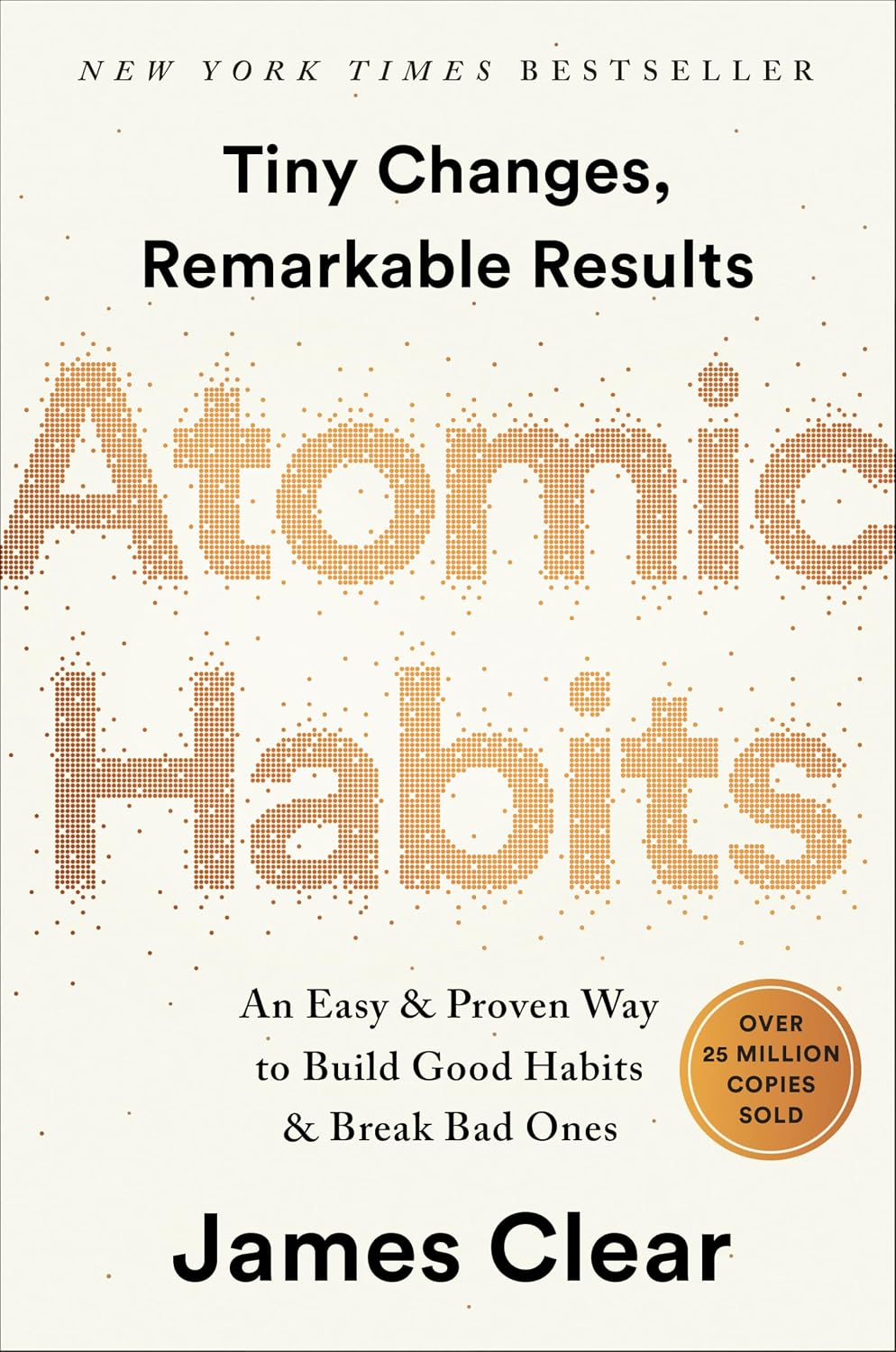
James Clear’s argument is that big results come from small habits repeated over a long time, the way money grows through compound interest. Getting slightly better every day barely registers at first, but over a year or a career the gap becomes enormous. From there he makes the case for focusing on systems instead of goals, since the process you follow every day decides where you end up, and for building habits around identity: deciding the kind of person you want to be and proving it with small wins. The practical core is his four-step habit loop (cue, craving, response, reward) and the four laws that come out of it. To build a good habit, make it obvious, attractive, easy and satisfying. To break a bad one, flip each law.
Highlights
changes that seem small and unimportant at first will compound into remarkable results if you’re willing to stick with them for years.
With the same habits, you’ll end up with the same results. But with better habits, anything is possible.
I began by publishing a new article every Monday and Thursday. Within a few months, this simple writing habit led to my first one thousand email subscribers, and by the end of 2013 that number had grown to more than thirty thousand people. In 2014, my email list expanded to over one hundred thousand subscribers, which made it one of the fastest-growing newsletters on the internet. I had felt like an impostor when I began writing two years earlier, but now I was becoming known as an expert on habits—a
The backbone of this book is my four-step model of habits—cue, craving, response, and reward—and the four laws of behavior change that evolve out of these steps.
Behavioral scientists like Skinner realized that if you offered the right reward or punishment, you could get people to act in a certain way.
Brailsford had been hired to put British Cycling on a new trajectory. What made him different from previous coaches was his relentless commitment to a strategy that he referred to as “the aggregation of marginal gains,” which was the philosophy of searching for a tiny margin of improvement in everything you do. Brailsford said, “The whole principle came from the idea that if you broke down everything you could think of that goes into riding a bike, and then improve it by 1 percent, you will get a significant increase when you put them all together.”
Too often, we convince ourselves that massive success requires massive action.
Meanwhile, improving by 1 percent isn’t particularly notable—sometimes it isn’t even noticeable—but it can be far more meaningful, especially in the long run.
Here’s how the math works out: if you can get 1 percent better each day for one year, you’ll end up thirty-seven times better by the time you’re done. Conversely, if you get 1 percent worse each day for one year, you’ll decline nearly down to zero.
1% BETTER EVERY DAY 1% worse every day for one year. 0.99365 = 00.03 1% better every day for one year. 1.01365 = 37.78
Habits are the compound interest of self-improvement. The same way that money multiplies through compound interest, the effects of your habits multiply as you repeat them. They seem to make little difference on any given day and yet the impact they deliver over the months and years can be enormous. It is only when looking back two, five, or perhaps ten years later that the value of good habits and the cost of bad ones becomes strikingly apparent.
The impact created by a change in your habits is similar to the effect of shifting the route of an airplane by just a few degrees. Imagine you are flying from Los Angeles to New York City. If a pilot leaving from LAX adjusts the heading just 3.5 degrees south, you will land in Washington, D.C., instead of New York. Such a small change is barely noticeable at takeoff—the nose of the airplane moves just a few feet—but when magnified across the entire United States, you end up hundreds of miles apart.*
Success is the product of daily habits—not once-in-a-lifetime transformations.
You should be far more concerned with your current trajectory than with your current results.
Your outcomes are a lagging measure of your habits. Your net worth is a lagging measure of your financial habits. Your weight is a lagging measure of your eating habits. Your knowledge is a lagging measure of your learning habits. Your clutter is a lagging measure of your cleaning habits. You get what you repeat.
Time magnifies the margin between success and failure. It will multiply whatever you feed it. Good habits make time your ally. Bad habits make time your enemy.
Productivity compounds. Accomplishing one extra task is a small feat on any given day, but it counts for a lot over an entire career. The effect of automating an old task or mastering a new skill can be even greater. The more tasks you can handle without thinking, the more your brain is free to focus on other areas.
The San Antonio Spurs, one of the most successful teams in NBA history, have a quote from social reformer Jacob Riis hanging in their locker room: “When nothing seems to help, I go and look at a stonecutter hammering away at his rock, perhaps a hundred times without as much as a crack showing in it. Yet at the hundred and first blow it will split in two, and I know it was not that last blow that did it—but all that had gone before.”
FORGET ABOUT GOALS, FOCUS ON SYSTEMS INSTEAD
What’s the difference between systems and goals?
Goals are about the results you want to achieve. Systems are about the processes that lead to those results.
Goals are good for setting a direction, but systems are best for making progress.
Problem #1: Winners and losers have the same goals.
Problem #2: Achieving a goal is only a momentary change. Imagine you have a messy room and you set a goal to clean it. If you summon the energy to tidy up, then you will have a clean room—for now. But if you maintain the same sloppy, pack-rat habits that led to a messy room in the first place, soon you’ll be looking at a new pile of clutter and hoping for another burst of motivation.
Achieving a goal only changes your life for the moment.
We think we need to change our results, but the results are not the problem. What we really need to change are the systems that cause those results.
Problem #3: Goals restrict your happiness.
The implicit assumption behind any goal is this: “Once I reach my goal, then I’ll be happy.” The problem with a goals-first mentality is that you’re continually putting happiness off until the next milestone.
A systems-first mentality provides the antidote. When you fall in love with the process rather than the product, you don’t have to wait to give yourself permission to be happy. You can be satisfied anytime your system is running. And a system can be successful in many different forms, not just the one you first envision.
Problem #4: Goals are at odds with long-term progress. Finally, a goal-oriented mind-set can create a “yo-yo” effect. Many runners work hard for months, but as soon as they cross the finish line, they stop training. The race is no longer there to motivate them.
The purpose of setting goals is to win the game. The purpose of building systems is to continue playing the game. True long-term thinking is goal-less thinking. It’s not about any single accomplishment. It is about the cycle of endless refinement and continuous improvement. Ultimately, it is your commitment to the process that will determine your progress.
You do not rise to the level of your goals. You fall to the level of your systems.
Chapter Summary Habits are the compound interest of self-improvement. Getting 1 percent better every day counts for a lot in the long-run. Habits are a double-edged sword. They can work for you or against you, which is why understanding the details is essential. Small changes often appear to make no difference until you cross a critical threshold. The most powerful outcomes of any compounding process are delayed. You need to be patient. An atomic habit is a little habit that is part of a larger system. Just as atoms are the building blocks of molecules, atomic habits are the building blocks of remarkable results. If you want better results, then forget about setting goals. Focus on your system instead. You do not rise to the level of your goals. You fall to the level of your systems.
WHY IS IT so easy to repeat bad habits and so hard to form good ones?
Changing our habits is challenging for two reasons: (1) we try to change the wrong thing and (2) we try to change our habits in the wrong way.
Our first mistake is that we try to change the wrong thing. To understand what I mean, consider that there are three levels at which change can occur.
change in your outcomes, a change in your processes, or a change in your identity.
The first layer is changing your outcomes. This level is concerned with changing your results: losing weight, publishing a book, winning a championship. Most of the goals you set are associated with this level of change. The second layer is changing your process. This level is concerned with changing your habits and systems: implementing a new routine at the gym, decluttering your desk for better workflow, developing a meditation practice. Most of the habits you build are associated with this level. The third and deepest layer is changing your identity. This level is concerned with changing your beliefs: your worldview, your self-image, your judgments about yourself and others. Most of the beliefs, assumptions, and biases you hold are associated with this level.
Outcomes are about what you get. Processes are about what you do. Identity is about what you believe.
With outcome-based habits, the focus is on what you want to achieve. With identity-based habits, the focus is on who you wish to become.
The ultimate form of intrinsic motivation is when a habit becomes part of your identity. It’s one thing to say I’m the type of person who wants this. It’s something very different to say I’m the type of person who is this.
The more pride you have in a particular aspect of your identity, the more motivated you will be to maintain the habits associated with it. If you’re proud of how your hair looks, you’ll develop all sorts of habits to care for and maintain it.
Once your pride gets involved, you’ll fight tooth and nail to maintain your habits.
The goal is not to read a book, the goal is to become a reader. The goal is not to run a marathon, the goal is to become a runner. The goal is not to learn an instrument, the goal is to become a musician.
Many people walk through life in a cognitive slumber, blindly following the norms attached to their identity. “I’m terrible with directions.” “I’m not a morning person.” “I’m bad at remembering people’s names.” “I’m always late.” “I’m not good with technology.” “I’m horrible at math.”
Progress requires unlearning. Becoming the best version of yourself requires you to continuously edit your beliefs, and to upgrade and expand your identity.
This brings us to an important question: If your beliefs and worldview play such an important role in your behavior, where do they come from in the first place? How, exactly, is your identity formed? And how can you emphasize new aspects of your identity that serve you and gradually erase the pieces that hinder you?
Your identity emerges out of your habits. You are not born with preset beliefs. Every belief, including those about yourself, is learned and conditioned through experience.*
This is a gradual evolution. We do not change by snapping our fingers and deciding to be someone entirely new. We change bit by bit, day by day, habit by habit. We are continually undergoing microevolutions of the self.
It is a simple two-step process: Decide the type of person you want to be. Prove it to yourself with small wins.
First, decide who you want to be.
What do you want to stand for? What are your principles and values? Who do you wish to become?
These are big questions, and many people aren’t sure where to begin—but they do know what kind of results they want: to get six-pack abs or to feel less anxious or to double their salary. That’s fine. Start there and work backward from the results you want to the type of person who could get those results. Ask yourself, “Who is the type of person that could get the outcome I want?” Who is the type of person that could lose forty pounds? Who is the type of person that could learn a new language? Who is the type of person that could run a successful start-up?
This process can lead to beliefs like: “I’m the kind of teacher who stands up for her students.” “I’m the kind of doctor who gives each patient the time and empathy they need.” “I’m the kind of manager who advocates for her employees.”
Once you have a handle on the type of person you want to be, you can begin taking small steps to reinforce your desired identity. I have a friend who lost over 100 pounds by asking herself, “What would a healthy person do?” All day long, she would use this question as a guide. Would a healthy person walk or take a cab? Would a healthy person order a burrito or a salad?
But the true question is: “Are you becoming the type of person you want to become?” The first step is not what or how, but who. You need to know who you want to be. Otherwise, your quest for change is like a boat without a rudder. And that’s why we are starting here.
A habit is a behavior that has been repeated enough times to become automatic.
Whenever you face a problem repeatedly, your brain begins to automate the process of solving it. Your habits are just a series of automatic solutions that solve the problems and stresses you face regularly.
“Habits are, simply, reliable solutions to recurring problems in our environment.”
As habits are created, the level of activity in the brain decreases. You learn to lock in on the cues that predict success and tune out everything else. When a similar situation arises in the future, you know exactly what to look for. There is no longer a need to analyze every angle of a situation. Your brain skips the process of trial and error and creates a mental rule: if this, then that. These cognitive scripts can be followed automatically whenever the situation is appropriate. Now, whenever you feel stressed, you get the itch to run. As soon as you walk in the door from work, you grab the video game controller. A choice that once required effort is now automatic. A habit has been created.
Habits do not restrict freedom. They create it.
If you’re always being forced to make decisions about simple tasks—when should I work out, where do I go to write, when do I pay the bills—then you have less time for freedom.
The process of building a habit can be divided into four simple steps: cue, craving, response, and reward.* Breaking it down into these fundamental parts can help us understand what a habit is, how it works, and how to improve it.
First, there is the cue. The cue triggers your brain to initiate a behavior. It is a bit of information that predicts a reward.
Cravings are the second step, and they are the motivational force behind every habit. Without some level of motivation or desire—without craving a change—we have no reason to act.
What you crave is not the habit itself but the change in state it delivers. You do not crave smoking a cigarette, you crave the feeling of relief it provides.
You do not want to turn on the television, you want to be entertained.
Cravings differ from person to person.
The third step is the response. The response is the actual habit you perform, which can take the form of a thought or an action. Whether a response occurs depends on how motivated you are and how much friction is associated with the behavior. If a particular action requires more physical or mental effort than you are willing to expend, then you won’t do it.
Finally, the response delivers a reward. Rewards are the end goal of every habit. The cue is about noticing the reward. The craving is about wanting the reward. The response is about obtaining the reward. We chase rewards because they serve two purposes: (1) they satisfy us and (2) they teach us.
In summary, the cue triggers a craving, which motivates a response, which provides a reward, which satisfies the craving and, ultimately, becomes associated with the cue. Together, these four steps form a neurological feedback loop—cue, craving, response, reward; cue, craving, response, reward—that ultimately allows you to create automatic habits. This cycle is known as the habit loop.
Problem phase 1. Cue: You wake up. 2. Craving: You want to feel alert. Solution phase 3. Response: You drink a cup of coffee. 4. Reward: You satisfy your craving to feel alert. Drinking coffee becomes associated with waking up.
I refer to this framework as the Four Laws of Behavior Change, and it provides a simple set of rules for creating good habits and breaking bad ones.
How to Create a Good Habit The 1st law (Cue): Make it obvious. The 2nd law (Craving): Make it attractive. The 3rd law (Response): Make it easy. The 4th law (Reward): Make it satisfying.
How to Break a Bad Habit Inversion of the 1st law (Cue): Make it invisible. Inversion of the 2nd law (Craving): Make it unattractive. Inversion of the 3rd law (Response): Make it difficult. Inversion of the 4th law (Reward): Make it unsatisfying.
Whenever you want to change your behavior, you can simply ask yourself: How can I make it obvious? How can I make it attractive? How can I make it easy? How can I make it satisfying?