- Rating
- —/10
- Read
- July 2022
- Why I read it
- What I took from it
- My favorite idea
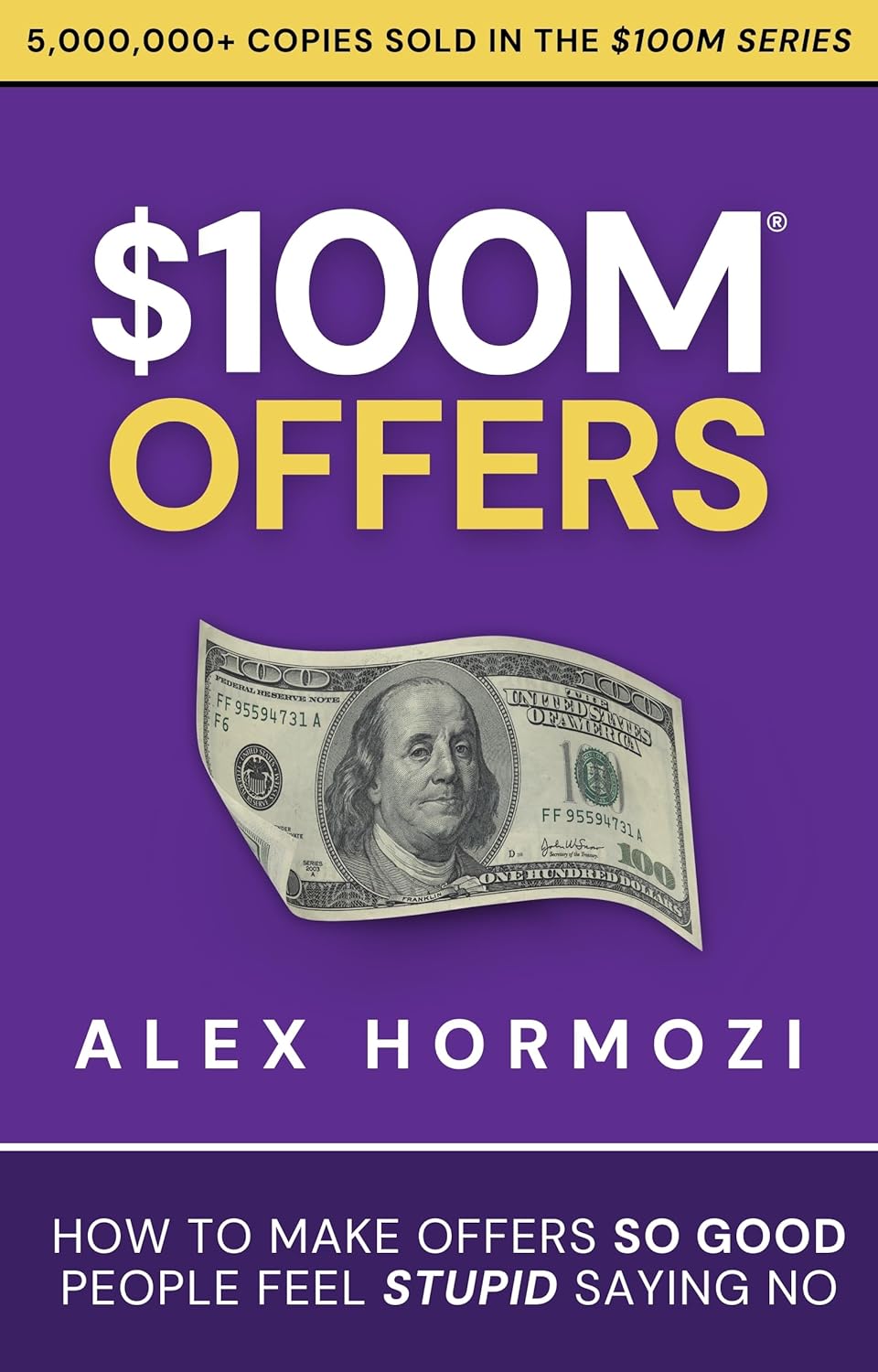
Alex Hormozi built and sold several businesses, starting with a chain of gyms, and this is the first book in his $100M series. His argument is that most businesses struggle because their offer is a commodity, so they end up competing on price. The fix is a “Grand Slam Offer”: something so valuable and so different that customers can’t compare it to anything else. The heart of the book is his value equation. Value goes up when you increase the dream outcome and the customer’s confidence they’ll get it, and when you cut the time it takes and the effort and sacrifice involved. From there he shows how to list every obstacle a customer faces, turn each one into a solution, and then strengthen the offer with scarcity, urgency, bonuses, guarantees and a good name. It’s written for business owners, but the same thinking applies to anyone pitching anything, including a recruiter pitching a firm or a candidate.
Highlights
As entrepreneurs, we make bets everyday. We are gamblers ― gambling our hard- earned money on labor, inventory, rent, marketing, etc., all with the hopes of a higher pay out. Oftentimes, we lose. But, sometimes, we win and win BIG.
the offer
What you are literally providing them in exchange for their money.
“Make people an offer so good they would feel stupid saying no.”
“Do you want to know the secret to sales?”
“Make people an offer so good they would feel stupid saying
Dr Burgelman, a famous Stanford business school professor said, it is far better to have understood why you failed than to be ignorant of why you succeeded.
The Two Main Problems Most Entrepreneurs Face and How This Book Solves Them
Not enough clients Not enough cash (excess profit at the end of the month)
What’s In It For You?
But What Does A Grand Slam Offer Do?
It’s an offer you present to the marketplace that cannot be compared to any other product or service available, combining an attractive promotion, an unmatchable value proposition, a premium price, and an unbeatable guarantee with a money model (payment terms) that allows you to get paid to get new customers . . . forever removing the cash constraint on business growth. In other words, it allows you to sell in a “category of one,”
We want to make an offer that’s so different that you can skip the awkward explanation of why your product is different from everyone else’s (which, if they have to ask, then they are probably too ignorant to understand the explanation) and instead just have the offer do that work for you. That’s the Grand Slam Offer way.
A marketing professor asked his students, “If you were going to open a hotdog stand, and you could only have one advantage over your competitors . . . which would it be . . . ?” “Location! ….Quality! …. Low prices! ….Best taste!” The students kept going until eventually they had run out of answers. They looked at each other waiting for the professor to speak. The room finally fell quiet. The professor smiled and replied, “A starving crowd.”
In order to sell anything, you need demand. We are not trying to create demand. We are trying to channel it.
When picking markets, I look for four indicators:
1) Massive Pain They must not want, but desperately need, what I am offering.
The degree of the pain will be proportional to the price you will be able to charge (more on this in the Value Equation chapter).
I have a saying I use to train sales teams “The pain is the pitch.” If you can articulate the pain a prospect is feeling accurately, they will almost always buy what you are offering.
2) Purchasing Power
3) Easy to Target
I make my life easier by looking for easy- to-target markets.
4) Growing Growing markets are like a tailwind. They make everything move forward faster. Declining markers are like headwinds. They make all efforts harder.
There are three main markets that will always exist: Health, Wealth, and Relationships.
Think about what you are good at in regards to health, wealth, and relationships. Then think about who might value your service the most (is in the most pain), has the buying power to pay what you want (money), and can be found easily (targeting). As long as those three criteria are strong and the market isn’t shrinking, you’ll be in good shape.
order of importance between markets, offers, and persuasion skills: Starving Crowd (market) > Offer Strength > Persuasion Skills
Commit to the Niche
Niching Product
You want to be ‘the guy’ who services ‘this type of person’ or solves ‘this type of problem.’ And even more niched ‘I solve this type of problem for this specific type of person in this unique counter-intuitive way that reverses their deepest fear.”
That’s why a fitness program for generic weight loss might be priced at only $19 while a fitness program designed and marketed only to shift-nurses might be priced at $1997….(even though the core of the program is likely similar - eat less, move more).
If you try one hundred offers, I promise you will succeed. Most people never try anything. Others fail once, then give up. It takes resilience to succeed. Stop personalizing! It’s not about you! If your offer doesn’t work, it doesn’t mean you suck. It means your offer sucks. Big difference. You only suck if you stop trying. So, try again. You’ll never become world class if you stop after a failed attempt.
In order to understand how to make a compelling offer, you must understand value. The reason people buy anything is to get a deal. They believe what they are getting (VALUE) is worth more than what they are giving in exchange for it (PRICE). The moment the value they receive dips below what they are paying, they stop buying from you.
Warren Buffet said, “Price is what you pay. Value is what you get.”
As Dan Kennedy said, “There is no strategic benefit to being the second cheapest in the marketplace, but there is for being the most expensive.”
When you decrease your price, you . . . . . . Decrease your clients’ emotional investment since it didn’t cost them much . . . Decrease your clients’ perceived value of your service since it can’t be that good if it’s so cheap, or priced the same as everyone else . . . Decrease your clients results because they do not value your service and are not invested . . . Attract the worst clients who are never satisfied until your service is free . . . Destroy any margin you have left to be able to actually provide an exceptional experience, hire the best people, invest in your people, pamper your clients, invest in growth, invest in more locations or more scale, and everything else that you had hoped in the goal of helping more people solve whatever problem it is that you solve.
When you raise your prices, you . . . . . . Increase your clients’ emotional investment . . . Increase your clients’ perceived value of your service . . . Increase your clients’ results because they value your service and are invested . . . Attract the best clients who are the easiest to satisfy and actually cost less to fulfill, and who are the most likely to actually receive and perceive the most relative value . . . Multiply your margin because you have money to invest in systems to create efficiency; smart people; improved customer experience; scale your business; and, most importantly of all, to keep watching the number in your personal bank account go up, month after month, even with reinvesting in your business.
Your product must deliver
Those who understand value are the ones who will be able to charge the most money for their services.
The Value Equation
The Grand Slam Offer only becomes valuable once the prospect perceives the increase in likelihood of achievement, perceives the decrease in time delay, and perceives the decrease in effort and sacrifice.
#1 Dream Outcome (Goal = Increase) People have deep, unchanging desires. This is what marriages are lost over, wars are fought over, and people will willingly die for. Our goal is not to create desire. It’s simply to channel that desire through our offer and monetization vehicle.
People generally, and our clients specifically, want: To be perceived as beautiful To be respected To be perceived as powerful To be loved To increase their status These are all powerful drivers.
Take the desire “to be perceived as beautiful” for example, here are a lot of things that touch on this desire: Make Up Anti-aging creams/serums Supplements Shapewear Plastic Surgery Fitness
#2 Perceived Likelihood of Achievement (Goal = Increase)
people pay for certainty. They value certainty. I call this “the perceived likelihood of achievement.” In other words, “How likely do I believe it is that I will achieve the result I am looking for if I make this purchase?”
#3 Time Delay (Goal = Decrease)
Time delay is the time between a client buying and receiving the promised benefit. The shorter the distance between when they purchase and they receive value/the outcome, the more valuable your services or product is.
having to wait 12 to 24 months to get what you want is a long time when you can do liposuction and be done in an afternoon. This shows just one of the reasons people pay $25,000 for liposuction with a tummy tuck, while people will barely pay $100/mo to join a bootcamp.
#4 Effort & Sacrifice (Goal = Decrease)
This is why “done for you services” are almost always more expensive than “do-it- yourself” because the person doesn’t have all the effort and sacrifice.
Step #1: Identify Dream Outcome
Step #2: List Problems Next, I wrote down all the things people struggled with and their limiting thoughts around them.
Step #3: Solutions List
First, we are going to first transform our problems into solutions. Second, we are going to name these solutions.
“What would I need to show someone to solve this problem?” Then we are going to reverse each element of the obstacle into solution-oriented language.
simply adding “how to” then reversing the problem will give most people new to this process a great place to start.
Once we have our list of solutions, we will operationalize how we are actually going to solve these problems (create value)
Everyone buys bargains.
I have always lived by the mantra, “Create flow. Monetize flow. Then add friction.” This means I generate demand first. Then, with my offer, I get them to say yes. Once I have people saying yes, then, and only then, will I add friction in my marketing, or decide to offer less for the same price.
Use scarcity to decrease supply to raise prices (and indirectly increase demand through perceived exclusiveness) Use urgency to increase demand by decreasing the action threshold of a prospect. Use bonuses to increase demand (and increase perceived exclusivity). Use guarantees to increase demand by reversing risk. Use names to re-stimulate demand and expand awareness of my offer to my target audience.
Creating Scarcity When there’s a fixed supply or quantity of products or services that are available for purchase it creates “scarcity” or a “fear of missing out.” It increases the need to take action, and by extension, purchase your offer.
The single greatest objection for any product or service being sold is...drum roll...risk. Risk that it doesn’t do what it’s supposed to do for them.